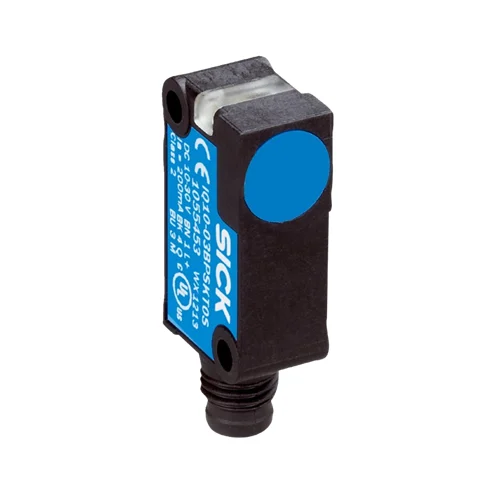
SICK 1055465 IQ10-03BPPKW2S Complementary PNP Inductive Sensor

USD 45.24

IQ10-03BPPKW2S offers 3 mm nominal inductive sensing, complementary PNP outputs and a 2 m PVC cable, flush mounting, 2,000 Hz and IP68.

SKU SICK-1055465 Category
SICK IQB

SICK IQ10-03BPPKW2S Complementary PNP Inductive Sensor

BrandSICK
Model IdentifierIQ10-03BPPKW2S
Official Part Number1055465

Technical Overview

The SICK IQ10-03BPPKW2S is a rectangular inductive proximity sensor for flush installation in metal. It specifies a 3 mm nominal sensing range and 2.43 mm assured range, with reference reduction factors for different target metals. The device provides complementary PNP outputs and 2,000 Hz switching through a 2 m four-wire PVC cable. Its 10–30 V DC electronics include short-circuit and power-up pulse protection, with continuous output current up to 200 mA and a 10 mA no-load current. The housing and sensing face use VISTAL plastic, with IP68 protection and operation from −25 to +75 °C. Maximum tightening torque is 1 Nm.

Flush inductive sensor with 3 mm nominal range, complementary PNP outputs, 2,000 Hz switching and 2 m four-wire PVC cable.

Key Features

  • Rectangular inductive sensor; flush installation in metal
  • 3 mm nominal sensing range; 2.43 mm assured range
  • Complementary PNP outputs; DC four-wire
  • 2,000 Hz switching frequency
  • 2 m four-wire PVC cable
  • 10–30 V DC; continuous output current ≤200 mA
  • Short-circuit and power-up pulse protection
  • VISTAL plastic housing and sensing face
  • ≤1 Nm maximum tightening torque
  • IP68; −25 to +75 °C operation

Use a flush-mounted inductive sensing point to provide metal-part position and repeated-passage signals to external machine logic.

Technical Specification Matrix

ParameterValue
Functional principleInductive proximity sensing
Housing designRectangular
InstallationFlush in metal
Nominal sensing range Sn3 mm
Assured sensing range Sa2.43 mm
Switching outputComplementary PNP
Electrical wiringDC four-wire
Switching frequency2,000 Hz
Connection2 m four-wire PVC cable
Power supply10–30 V DC
Ripple≤10% of supply voltage
Voltage drop≤3 V at maximum Ia
Availability delay≤100 ms
Hysteresis5–15%
Reproducibility≤2% of Sr at supply voltage UB and constant ambient temperature Ta
Temperature drift±10% of Sr
Continuous output current≤200 mA
No-load current10 mA
Circuit protectionShort-circuit protection; power-up pulse protection
Housing materialVISTAL® plastic
Sensing face materialVISTAL® plastic
Maximum tightening torque≤1 Nm
IP ratingIP68 according to EN 60529
Operating temperature−25 to +75 °C
Shock and vibration resistance30 g, 11 ms; 10–55 Hz, 1 mm
EMCEN 60947-5-2
Material reduction factorsReference values, may vary: stainless steel V2A/304 0.7; aluminum 0.4; copper 0.3; brass 0.5
Installation diagram clearancesA=0 mm; B=10 mm; C=10.3 mm; D=9 mm; E=0 mm; F=24 mm; G=0 mm; letters refer to manufacturer installation diagram
Body height28 mm
Body depth16 mm
Conductor functionsCD-005: BN=L+; BK=NO; WH=NC; BU=M
Cable materialPVC
Cable length2 m
Conductor cross-section0.25 mm²
Cable diameterØ3.7 mm
MTTFD1,491 years
DCavg0%
Mission time TM20 years
Indication270° LED indicator
Mounting hole detailØ3.2 mm through holes; 22.2 mm spacing

Industrial Applications

1. Confirming a seated metal component in an assembly fixture

An assembly fixture can present a seated metal component to the flush sensing face and read the PNP normally-open state after the component settles. The 3 mm nominal and 2.43 mm assured sensing ranges provide the gap references. Setup accounts for the actual target metal, reference reduction factors and the manufacturer installation diagram when integrating the rectangular sensor into nearby metalwork.

Problem Solved

A seated-target reference gives external inspection logic a component-present condition, helping distinguish a presented metal part from an empty fixture location before the next assembly operation.

Fixture presence Flush installation PNP normally-open

2. Counting separated metal tabs on a moving guide

A moving guide can carry separated metal tabs across the sensing face and supply PNP normally-open transitions to an external counter. The 2,000 Hz rating supports repeated events when tab width, spacing, gap and transit speed allow distinct output intervals. Target-material reduction factors and the flush-installation clearances guide setup for the actual moving hardware.

Problem Solved

Inductive transitions provide external counting logic with tab-passage events, helping track repeated metal features without mechanical contact between the sensor face and moving guide.

Tab counting 2,000 Hz Inductive transitions

3. Evaluating complementary process signals in external logic

A machine can connect the black normally-open and white normally-closed PNP conductors to separate controller inputs and evaluate their opposed target states. The external program compares the two readings during a defined settled part condition. Its design accounts for the 10–30 V supply, output-current limit and voltage drop when relating the sensor signals to the controller’s input thresholds.

Problem Solved

Complementary target-state signals provide external process logic with two opposed observations, helping identify an unexpected input combination during the machine’s settled inspection condition.

Complementary PNP Two process inputs External evaluation

Select your currency