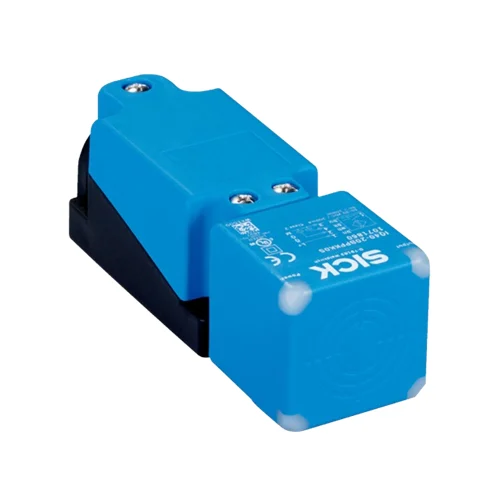
SICK 1071855 IQ40-40NNSKK0S NPN Inductive Sensor

USD 63.18

Non-flush rectangular inductive sensor with 40 mm nominal range, 32.4 mm assured range, NPN normally-open output, 100 Hz and cable-gland connection.

SKU SICK-1071855 Category
SICK IQG

SICK IQ40-40NNSKK0S NPN Inductive Sensor

BrandSICK
Model IdentifierIQ40-40NNSKK0S
Official Part Number1071855

Technical Overview

The SICK IQ40-40NNSKK0S is a rectangular inductive proximity sensor for non-flush installation, with 40 mm nominal sensing range and 32.4 mm assured range. Its normally-open NPN output uses a DC three-wire circuit and supports 100 Hz switching with continuous current up to 200 mA. The cable-gland connection accepts conductors up to 2.5 mm², while the 10–30 V DC electronics consume 12.5 mA without load. PA66 housing and sensing face provide IP67/IP68/IP69K protection and operation from −25 to +85 °C. Yellow output and green operational LEDs assist local inspection. Installation observes the specified non-flush clearances, target-material reduction factors and maximum tightening torque of 1.8 Nm.

Non-flush rectangular inductive sensor with 40 mm nominal range, NPN normally-open output, 100 Hz, cable-gland wiring and IP67/IP68/IP69K.

Key Features

  • Non-flush rectangular inductive sensing
  • 40 mm nominal range; 32.4 mm assured range
  • NPN normally-open output; DC three-wire circuit
  • 100 Hz switching; continuous output current ≤200 mA
  • Cable-gland connection; conductor size ≤2.5 mm²
  • 10–30 V DC; 12.5 mA no-load current
  • Short-circuit and power-up pulse protection
  • PA66 housing and sensing face; IP67/IP68/IP69K
  • −25 to +85 °C operation; maximum tightening torque 1.8 Nm
  • Yellow output-state LED and green operational LED

Detect metal targets across a 40 mm nominal non-flush gap and report normally-open NPN transitions through a cable-gland connection.

Technical Specification Matrix

ParameterValue
Functional principleInductive proximity sensing
Housing designRectangular, standard design
InstallationNon-flush
Nominal sensing range Sn40 mm
Assured sensing range Sa32.4 mm
Switching outputNPN
Output functionNormally open (NO)
Electrical wiringDC three-wire
Switching frequency100 Hz
ConnectionCable gland
Cable-gland designationM20 1.5, as specified by manufacturer
Conductor size≤2.5 mm²
Terminal assignmentCD-342: 1=L+; 4=NO output; 3=M; 2=not connected
Power supply10–30 V DC
Voltage drop≤2 V
Time delay before availability≤50 ms
Hysteresis3–15% of Sr
Reproducibility≤6%
Temperature drift of Sr±10%
Continuous current≤200 mA
No-load current12.5 mA
Protective functionsShort-circuit protection; power-up pulse protection
Housing materialPA66 plastic
Sensing-face materialPA66 plastic
Tightening torqueMaximum 1.8 Nm
Protection classII; reference voltage 50 V DC
IP ratingIP67 / IP68 / IP69K
Operating temperature−25 to +85 °C
Storage temperature−40 to +85 °C
Shock resistance30 g, 11 ms
Vibration resistance10–55 Hz, 1 mm
Material reduction factorsApproximate reference values which may vary: V2A/304 stainless steel 0.8; aluminum 0.34; copper 0.27; brass 0.38
Installation clearancesManufacturer diagram keys A=42 mm; B=150 mm; C=40 mm; D=120 mm; E=40 mm; F=150 mm
Mounting holesØ5.5 mm
IndicationYellow output-state LED; green operational-status LED
UL fileE348498
MTTFD1,125 years
DCavg0%
Mission time20 years
Dimensions L x W x H (cm)11.8 x 4 x 4

Industrial Applications

1. Confirming a metal carriage at a transfer position

A transfer mechanism can present a metal carriage target beside the non-flush sensing face at its intended stop. The normally-open NPN output reports target arrival to external sequence logic. Setup accounts for the 40 mm nominal and 32.4 mm assured ranges, target material and geometry, and the documented clearances around the sensing location.

Problem Solved

A discrete metal-target reference gives external transfer logic a carriage-position condition, helping coordinate a dependent handover when the mechanism reaches its intended stop.

Carriage position 40 mm nominal NPN output

2. Counting metal tabs on a rotating mechanism

A rotating mechanism can carry separated metal tabs past the sensing face and feed NPN transitions to external counting logic. The 100 Hz switching rating provides the basis for assessing tab passage rate and spacing. Installation holds the commissioned gap within the suitable target range and preserves the documented non-flush clearances around the housing.

Problem Solved

Repeated metal-target transitions provide external counting electronics with cycle or passage events, helping track mechanism movement through a stationary inductive sensing point beside the tabs.

Metal-tab count 100 Hz External counter

3. Monitoring metal stock at a feeder reference

A metal-feeding station can mount the sensor beside a location normally occupied by incoming stock. The normally-open state changes when material leaves the sensing region, and external logic times that absence against the expected feed sequence. Actual stock material and cross-section guide the commissioned gap using the assured range and approximate reduction factors.

Problem Solved

A sustained target-absence condition supplies external feed monitoring with a stock-continuity reference, helping identify missing metal at the monitored location before the next process step.

Stock continuity External timing Metal sensing

Select your currency