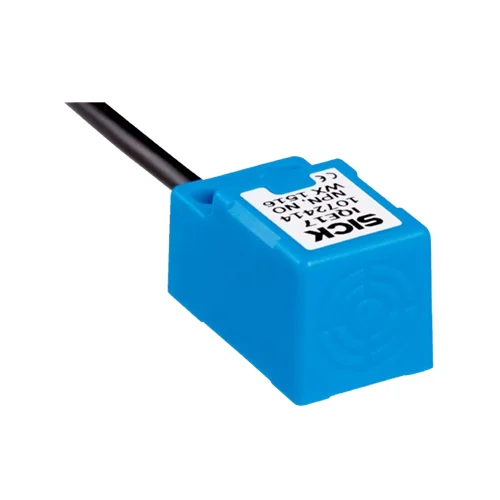
1. Confirming a metal clamp at its seated position
A fixture can present a metal clamp target at a controlled gap beside the non-flush sensing face. The normally-open NPN output reports target arrival to external sequence logic. Installation uses the nominal and assured ranges, actual target geometry and material reduction factors while preserving the specified clearances around the protruding sensing location.
Problem Solved
A discrete clamp-position reference helps external sequence logic distinguish the expected seated metal target from an open fixture location before a dependent operation begins.
Clamp position
Non-flush
NPN output
2. Counting metal tabs on a rotating mechanism
A rotating mechanism can carry separated metal tabs past the sensor and deliver NPN transitions to external counting logic. The 1,000 Hz rating provides the basis for assessing tab passage frequency and spacing. Installation holds the sensing gap within the commissioned range and preserves the documented non-flush clearances around the sensor body.
Problem Solved
Repeated metal-target transitions supply external counting electronics with cycle or index events, helping track mechanism movement without a contacting switch beside the rotating tabs.
Tab count
1,000 Hz
External counter
3. Monitoring metal stock at a feeding reference
A metal-feeding station can position the sensor beside a reference location normally occupied by stock. The normally-open output changes when the metal leaves that location, and external monitoring times the absence against the expected feed sequence. Actual stock material and geometry guide the commissioned gap using the assured range and documented reduction factors.
Problem Solved
A sustained target-absence condition gives external feed monitoring a stock-continuity reference, helping identify a missing metal section before a dependent forming or assembly step.
Stock continuity
External timing
Metal sensing