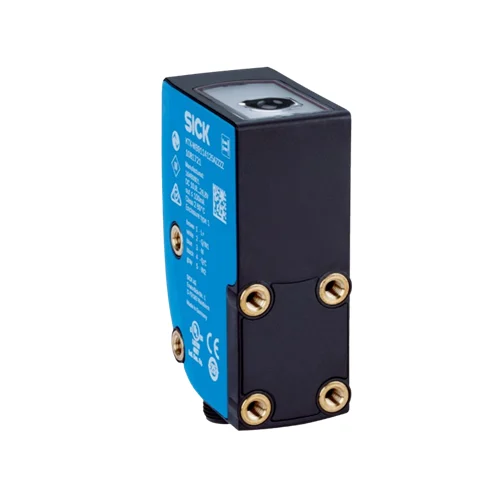
SICK 1220994 KTX-WP92142252ZZZZ RGB PNP Contrast Sensor

USD 694.72

KTX-WP92142252ZZZZ combines RGB TwinEye contrast sensing, a 0.9 ×3.8 mm horizontal spot, 70 kHz switching, PNP output and static/dynamic teaching.

SKU SICK-1220994 Category
SICK KTX Prime

SICK KTX-WP92142252ZZZZ RGB PNP Contrast Sensor

BrandSICK
Model IdentifierKTX-WP92142252ZZZZ
Official Part Number1220994

Technical Overview

The SICK KTX-WP92142252ZZZZ is an RGB LED contrast sensor with TwinEye technology and light emission from the short housing side. Its 0.9 ×3.8 mm spot is horizontal relative to the housing’s long side; the stated sensing distance is ≤13 mm with ±5 mm tolerance. One-point, two-point, dynamic and auto teaching modes set the detection condition, with automatic selection of emitted light for RGB teaching. The PNP output supports light/dark switching, 70 kHz operation at a 1:1 ratio and 3 µs response. One-point color mode instead has 23 kHz switching and 9 µs jitter. An M12 five-pin plug, display, navigation buttons, VISTAL housing and COP optics accompany IP67 protection and 10.8–28.8 V DC supply.

RGB TwinEye contrast sensor with horizontal 0.9 ×3.8 mm spot, PNP output, 70 kHz switching, 3 µs response and M12 five-pin connection.

Key Features

  • RGB LED contrast sensing with TwinEye technology
  • 470, 525 and 625 nm wavelengths; automatic emitted-light selection during RGB teaching
  • Short-side emission; 0.9 ×3.8 mm spot horizontal to the housing long side
  • Sensing distance ≤13 mm; sensing-distance tolerance ±5 mm
  • One-point, two-point, dynamic and auto teaching modes; two-point default
  • 70 kHz switching at 1:1 light/dark ratio; 3 µs response and 3 µs jitter
  • One-point color mode: 23 kHz switching and 9 µs jitter
  • PNP light/dark output; M12 five-pin plug; Q/IN1 and IN2 connection functions
  • Display, navigation buttons, Quality of Teach feedback and key lock
  • 10.8–28.8 V DC; VISTAL housing; COP optics; IP67

Teach mark/background contrast with automatic RGB light selection and use the PNP event as a registration reference for external machine control.

Technical Specification Matrix

ParameterValue
Product typeStandard large-housing contrast sensor; manufacturer special application: High Precision
Light sourceRGB LEDs; 470 / 525 / 625 nm
TwinEye technologyProvided
Average LED service life100,000 h at +25 °C
Light emissionShort device side
Light spot size0.9 ×3.8 mm
Spot directionHorizontal relative to the long housing side
Receiving filtersNone
Sensing distance≤13 mm
Sensing-distance tolerance±5 mm
Teach modesOne-point; two-point; dynamic; auto mode
Default teach modeTwo-point teach-in; no parameter presettings
RGB teaching behaviorOptimum emitted light selected automatically
Two-point teachingManually present mark and background; Quality of Teach displayed
Dynamic teachingTeach moving mark/background; threshold set between their signals; output active on mark when background occupies the field longer during teaching
Switching outputPNP; light/dark switching
Switching frequency70 kHz at 1:1 light/dark ratio; one-point color mode 23 kHz
Response time3 µs
Jitter3 µs; one-point color mode 9 µs
PNP signal HIGH/LOWSupply voltage −3 V / 0 V
Output current100 mA total across all outputs
Power supply10.8–28.8 V DC; DC 12 V −10% to DC 24 V +20%; short-circuit-protected network, maximum 8 A
Ripple≤5 Vpp; remain within supply tolerances
Current consumption<100 mA without load
Teach input levelTeach: 10 V ≤U<supply voltage; Run: U<2 V
Blanking-function levelBlanked: 10 V ≤U<supply voltage
Fine/coarse-function levelCoarse: 10 V ≤U<supply voltage
ET retention time25 ms; non-volatile memory
Protection classIII
Circuit protectionSupply reverse-polarity protection; output Q short-circuit protection; interference-pulse suppression
ConnectionM12 five-pin plug
Pin assignmentCD-382: 1 BN=L+; 2 WH=Q/IN1; 3 BU=M; 4 BK=Q; 5 GY=IN2
Display and controlsLED status indicators; display; navigation buttons; Quality of Teach indication
Key lockHold + button for more than 10 s to activate/deactivate; Q LED flashes and Err appears
MountingM5 threaded mounting holes; connector shown in delivery and end-stop positions
Housing materialVISTAL
Optics materialCOP
IP ratingIP67
Operating temperature−20 to +60 °C
Storage temperature−25 to +75 °C
Shock resistance30 g / 11 ms, IEC 60068-2-27
UL fileE181493
MTTFD291 years
Physical Weight (kg)0.094

Industrial Applications

1. Registering a printed web before a cutting operation

A packaging machine can aim the horizontal light spot at a printed registration track and feed PNP transitions to its external registration controller. RGB teaching establishes a contrast threshold between the mark and background. Machine design relates the 3 µs response and mode-specific jitter to web speed and required registration tolerance, keeping the sensor event separate from the controller’s cut-position calculation.

Problem Solved

A taught contrast event gives external registration control a mark reference, helping synchronize a downstream cutting operation with the printed web rather than relying only on estimated feed travel.

Printed-web registration RGB contrast 3 µs response

2. Checking for a missing contrast reference on a label

An inspection station can present each label at a defined location and use a taught mark/background contrast to check whether the expected reference appears. External inspection logic evaluates the PNP event within its own presentation window. Two-point teaching and the Quality of Teach display establish the optical condition using the actual print and substrate; the sensor is evaluating contrast at that spot, rather than reading label text.

Problem Solved

A contrast event within an external inspection window gives machine logic evidence that the expected printed reference is present, helping flag a label that lacks that local mark.

Mark presence Inspection window Two-point teaching

3. Teaching a new packaging print while material moves

A packaging line changing to a new printed film can use dynamic teaching while the mark and background pass through the light spot. The sensor selects the emitted RGB light and places the threshold between the observed signals. The documented dynamic-teach condition requires the background to occupy the field longer than the mark, and Quality of Teach feedback supports the setup assessment.

Problem Solved

Dynamic teaching lets setup establish a new moving print’s contrast condition, helping adapt the detection reference to a changed mark/background combination without manually positioning each teach sample.

Print changeover Dynamic teaching Quality of Teach

Select your currency