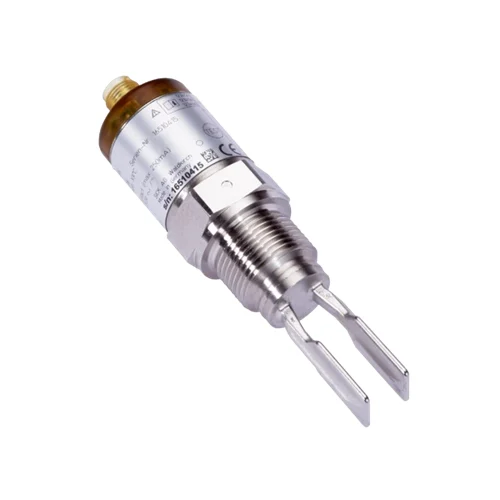
SICK 6036359 LFV200-XASGBTPM PNP Tuning-Fork Level Switch

USD 441.48

LFV200-XASGBTPM detects liquid point levels with a PNP output, G ¾ A PN 64 process connection, 316L wetted parts and 9.6–35 V DC supply.

SKU SICK-6036359 Category
SICK LFV200

SICK LFV200-XASGBTPM PNP Tuning-Fork Level Switch

BrandSICK
Model IdentifierLFV200-XASGBTPM
Official Part Number6036359

Technical Overview

The SICK LFV200-XASGBTPM is a tuning-fork point level switch for liquids with density from 0.7 to 2.5 g/cm³. It uses a G ¾ A PN 64 process connection and 316L stainless steel wetted parts, with process pressure from −1 to 64 bar and process temperature from −40 to +100 °C. The specified 67 mm probe provides a switching signal through one PNP transistor output. Sensor-element accuracy is ±2 mm, reproducibility and resolution are each no greater than 1 mm, and response time is 500 ms. An M12 four-pin connector supplies 9.6–35 V DC. The stainless steel/PEI housing has IP67 protection and a separate −40 to +70 °C ambient operating range.

Liquid point level switch with tuning fork, PNP output, G ¾ A PN 64 connection, 316L wetted parts, M12 connector and 9.6–35 V DC supply.

Key Features

  • Tuning-fork point level switching for liquids
  • Fill-material density 0.7–2.5 g/cm³; viscosity 0.1–10,000 mPa·s
  • 67 mm specified probe length; G ¾ A PN 64 process connection
  • Process pressure −1 to 64 bar; process temperature −40 to +100 °C
  • PNP transistor output; output current <250 mA
  • Sensor-element accuracy ±2 mm; reproducibility ≤1 mm
  • Resolution ≤1 mm; 2 mm hysteresis; 500 ms response
  • 9.6–35 V DC; current consumption ≤10 mA; initialization <2 s
  • M12 × 1 four-pin round connector; IP67
  • 316L stainless steel wetted parts; stainless steel/PEI housing; WHG approval

Use a defined liquid point-level condition to inform external filling or handling control through the PNP output and G ¾ A process connection.

Technical Specification Matrix

ParameterValue
Functional principleTuning-fork point level switch
MediumLiquids
Probe length67 mm
Fill-material density0.7–2.5 g/cm³
Process pressure−1 to 64 bar
Process temperature−40 to +100 °C
Viscosity0.1–10,000 mPa·s
Sensor-element accuracy±2 mm
Reproducibility≤1 mm
Resolution≤1 mm
Response time500 ms
MTBF1.25 × 10⁷ h
Power supply9.6–35 V DC
Residual ripple≤5 Vpp
Current consumption≤10 mA
Initialization time<2 s
Protection classVDE class II
ConnectionM12 × 1 four-pin round connector
Output signalPNP transistor output
Hysteresis2 mm
Output current<250 mA
Inductive load≤1 H
Capacitive load100 nF
Temperature drift0.03 mm/K
IP ratingIP67
Wetted partsStainless steel 1.4404 / 316L
Process connectionG ¾ A PN 64
Housing materialStainless steel 1.4404 / 316L and PEI
Operating ambient temperature−40 to +70 °C
Storage temperature−40 to +80 °C
Approvals and declarationsWHG approval; cCSAus certificate; food contact material manufacturer declaration; EU, UK and ACMA declarations of conformity

Industrial Applications

1. Reporting an upper filling level in a process vessel

A process vessel can place the tuning fork at its intended upper liquid level through the G ¾ A connection. External filling control interprets the PNP switching condition and commands its own fill valve. Setup checks actual liquid density and viscosity, pressure and process temperature, and allows for the 500 ms response and installed filling rate.

Problem Solved

A defined upper-level condition gives external filling control a reference for ending a fill step, helping limit continued inflow after liquid reaches the installed sensing point.

Upper fill level PNP condition Liquid vessel

2. Monitoring the liquid reserve feeding a pump

A supply tank can locate the tuning fork at a selected reserve level above its pump pickup. External pump control reads the level condition and determines whether sufficient reserve remains for the next transfer. The installation accounts for liquid density, viscosity, turbulence and response time so the chosen sensing point corresponds to the required usable reserve.

Problem Solved

A reserve-level condition helps external pump sequencing recognize a depleted supply before starting another ordinary transfer, using the installed sensing height as its process reference.

Supply reserve Pump sequencing Point level

3. Detecting liquid accumulation in a collection vessel

A collection vessel can mount the tuning fork at a defined accumulation height and route its PNP condition to external monitoring logic. The controller can record the event or request a controlled emptying step. Commissioning verifies compatible liquid properties, wetted materials and the separate ambient and process temperature limits for the actual location.

Problem Solved

A liquid-accumulation event helps external monitoring distinguish an empty collection vessel from one requiring attention, with the installed point providing a clear process threshold.

Collection vessel Accumulation event 316L wetted parts

Select your currency