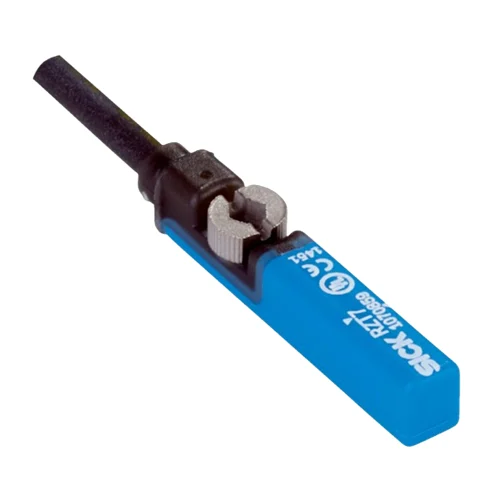
1. Confirming piston arrival before the next machine step
A pneumatic assembly can locate the sensor in a T-slot so that the piston magnet reaches its sensing element at the required end position. The normally-closed reed contact changes condition in the magnetic switching region. External sequence logic evaluates that transition before advancing the next process step, using the documented sensitivity and overrun behavior to establish sensor placement.
Problem Solved
A piston-position transition gives external sequencing logic an arrival reference, helping coordinate the following machine operation with the actuator reaching its selected end position.
Piston arrival
T-slot mounting
NC reed contact
2. Detecting an actuator that has not completed its stroke
A clamping station can place the reed sensor at the expected piston endpoint and start an external timer when motion is commanded. The controller watches for the normally-closed contact transition within the permitted process interval. If that transition is absent, the controller identifies a stroke-completion problem; the sensor supplies position state while the external controller performs the timing and fault decision.
Problem Solved
An endpoint signal compared with an external motion timer helps identify a stalled or incomplete cylinder stroke, supporting process fault handling before subsequent tooling advances.
Stroke timeout
External timing
Endpoint signal
3. Counting completed pneumatic actuator cycles
A production counter can record one selected transition each time a piston magnet passes the fixed sensing element during a completed actuator cycle. The 400 Hz switching rating and typical 10 mm overrun distance provide the sensor timing and magnetic travel basis. External counting logic distinguishes the selected arrival edge from the return stroke and checks the actual cylinder speed and magnetic field.
Problem Solved
Selected reed-contact transitions provide external counting logic with actuator-cycle events, helping track machine utilization or maintenance intervals from observed piston movement at a fixed sensing location.
Cycle count
400 Hz
Magnetic travel