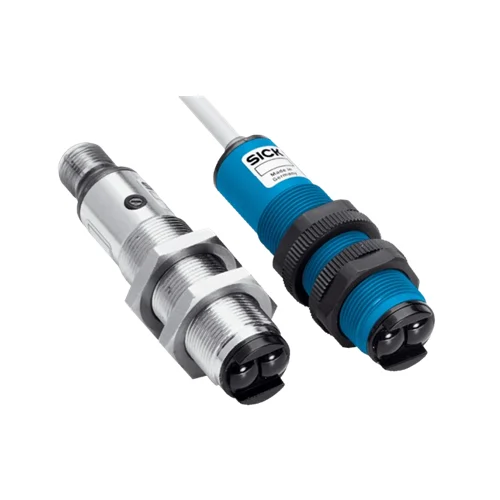
SICK 6013614 VL18-4N3740 NPN Retro-reflective Sensor

USD 95.16

0.05–3 m sensing with C110A, M12 four-pin connection, 10–30 V DC supply and IP67 PBT/PC housing; NPN output with L/D control input.

SKU SICK-6013614 Category
SICK V18

SICK VL18-4N3740 NPN Retro-reflective Sensor

BrandSICK
Model IdentifierVL18-4N3740
Official Part Number6013614

Technical Overview

The SICK VL18-4N3740 is an axial M18 photoelectric retro-reflective sensor with a visible red LED and polarizing filter. Its specified sensing range is 0.05–3 m with a C110A reflector, with maximum range extending to 3.7 m and a 150 mm light spot at 3 m. A 270° potentiometer adjusts sensitivity. The NPN output supports light/dark selection through the L/D input; leaving that input open selects light switching L.ON. Response is no greater than 2 ms with a resistive load, and switching frequency is 250 Hz at a 1:1 light/dark ratio. The PBT/PC housing has PMMA optics, IP67 protection and an M12 four-pin connection, operating from 10–30 V DC.

Polarized M18 red LED retro-reflective sensor with NPN output, L/D input, 270° sensitivity adjustment and M12 four-pin connection.

Key Features

  • Polarized retro-reflective sensing; axial M18 ×1 cylindrical design
  • 0.05–3 m sensing range with C110A reflector; maximum 0.05–3.7 m
  • Visible red LED; Ø150 mm light spot at 3 m; approximately 2.8° dispersion
  • Sensitivity potentiometer, 270°
  • NPN output with light/dark control input; open input selects Light switching L.ON
  • ≤2 ms resistive-load response; 250 Hz at 1:1 light/dark ratio
  • 10–30 V DC supply; 30 mA without load; output current ≤100 mA
  • M12 four-pin male connector: supply, ground, Q and L/D input
  • Supply/I/O reverse-polarity protection, interference suppression and output overcurrent/short-circuit protection
  • PBT/PC housing, PMMA optics and IP67; −25 to +70 °C operation

Monitor interruptions of a reflector-returned red beam and select the NPN switching behavior through the L/D input for external machine sequencing.

Technical Specification Matrix

ParameterValue
Functional principlePhotoelectric retro-reflective sensing
Polarizing filterProvided
Housing designCylindrical; axial optical axis
Mounting threadM18 ×1
Nominal housing length78 mm
Sensing range0.05–3 m with C110A reflector
Maximum sensing range0.05–3.7 m with C110A reflector
Light sourceVisible red LED
Average LED service life100,000 h at ambient +25 °C
Light spot sizeØ150 mm at 3 m
Focus and dispersion angleApproximately 2.8°
Sensitivity adjustmentSensitivity potentiometer, 270°
Switching outputNPN
Switching modeLight/dark switching via L/D control input
Open control-input defaultLight switching L.ON
Output current≤100 mA
Response time≤2 ms; signal transit time with resistive load
Switching frequency250 Hz at light/dark ratio 1:1
ConnectionM12 four-pin male connector
Pin assignmentCD-087: 1 BN=L+; 2 WH=L/D input; 3 BU=M; 4 BK=Q
Power supply10–30 V DC; limit values
Ripple±10%; remain within supply-voltage tolerances
Current consumption30 mA without load
Circuit protectionA: supply reverse-polarity protection; B: input/output reverse-polarity protection; C: interference suppression; D: output overcurrent and short-circuit protection
Protection classIII
Housing materialPBT/PC plastic
Optics materialPMMA plastic
IP ratingIP67
Operating temperature−25 to +70 °C
IndicationYellow LED, signal-strength indicator
Mounting-nut detailShared drawing specifies 22 mm hexagonal plastic nut for plastic-housing equipment
MTTFD68 years
DCavg0%
UL fileNMFT2.E175606
Physical Weight (kg)0.1

Industrial Applications

1. Counting separated opaque packages

A packaging conveyor can position the sensor opposite a suitable reflector so opaque packages interrupt the returned red beam. The NPN output supplies passage events to an external counter, with light/dark operation selected through the L/D input. Package width, spacing and conveyor speed are assessed against the 2 ms response and 250 Hz switching specification; the stated 0.05–3 m sensing range uses a C110A reflector.

Problem Solved

Returned-beam interruptions give external counting logic a package-passage reference, helping production totals follow separated opaque items without relying on a contacting mechanical switch.

Package passage External counter 250 Hz

2. Monitoring continuity of an opaque web

A converting station can place an opaque web across the sensor-to-reflector path so normal material blocks the returned light. A break or run-out restores the beam and changes the NPN signal for external process logic. The L/D control input sets the required switching behavior, and the yellow signal-strength indicator supports an optical alignment check with the installed reflector and material presentation.

Problem Solved

A change between blocked and restored reflector light gives external web-control logic a continuity reference, helping distinguish expected opaque material coverage from an open optical path.

Web continuity L/D control Returned light

3. Timing retained material at a transfer point

A transfer station can align the sensor with a reflector behind a position that should clear after each opaque item moves onward. External sequencing times the NPN state and compares the interrupted-beam duration with the normal transfer interval. The M18 mounting thread secures the sensor at the monitored position, and the M12 four-pin connector carries supply, output and the L/D input.

Problem Solved

A sustained beam interruption gives external transfer logic an occupancy-duration reference, helping identify material that remains at the monitored position beyond its expected passage time.

Transfer occupancy External timing M18 mounting

Select your currency