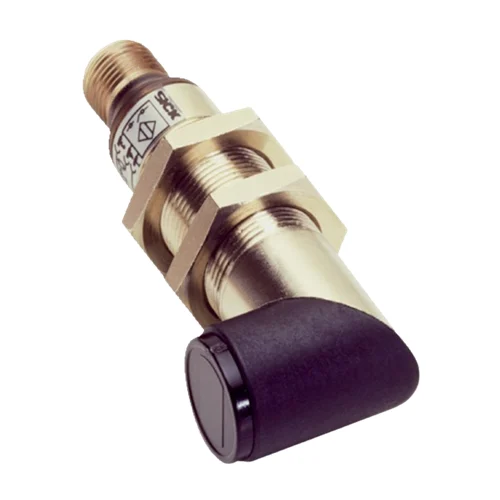
SICK 6013587 VL18-4P3440 PNP Retroreflective Sensor

USD 118.30

VL18-4P3440 offers 0.05–3 m sensing on C110A reflector, red LED light, a polarizing filter, PNP light/dark control, sensitivity adjustment and M12.

SKU SICK-6013587 Category
SICK V18

SICK VL18-4P3440 PNP Polarized Retroreflective Sensor

BrandSICK
Model IdentifierVL18-4P3440
Official Part Number6013587

Technical Overview

The SICK VL18-4P3440 is a cylindrical photoelectric retroreflective sensor with a polarizing filter and radial optics. Its visible red LED operates with a C110A reflector at 0.05–3 m sensing range and 0.05–3.7 m maximum range, producing a 150 mm spot at 3 m. A 270° sensitivity potentiometer adjusts the optical setting. The single PNP output supports light or dark operation selected through the L/D control wire; leaving that input open selects dark switching. Response is no more than 2 ms with a resistive load, with 250 Hz switching at a 1:1 light/dark ratio. The 10–30 V DC device uses an M18 × 1 nickel-plated brass housing, PMMA optics, M12 four-pin connection and IP67 protection.

Polarized M18 retroreflective sensor with 0.05–3 m C110A sensing, PNP light/dark control, 270° sensitivity adjustment and M12 four-pin connection.

Key Features

  • VL18-4P3440 / 6013587: polarized photoelectric retroreflective sensor
  • 0.05–3 m sensing; 0.05–3.7 m maximum range on C110A reflector
  • Visible red LED; Ø150 mm light spot at 3 m; approximately 2.8° dispersion
  • 270° sensitivity potentiometer
  • Single PNP output; light/dark selection through L/D input; open selects dark
  • ≤2 ms response with resistive load; 250 Hz at 1:1 light/dark ratio
  • 10–30 V DC; 30 mA without load; output current ≤100 mA
  • M18 × 1 nickel-plated brass housing; radial optics; 75 mm housing length
  • M12 four-pin male connector; L/D input on pin 2, output Q on pin 4
  • PMMA optics; IP67; yellow signal-strength LED; −25 to +70 °C operation

Detect interruptions of a polarized reflector-return path and send the selected PNP light/dark condition to external process logic.

Technical Specification Matrix

ParameterValue
Functional principlePhotoelectric retroreflective sensing with polarizing filter
Optical axisRadial
Sensing range0.05–3 m with C110A reflector
Maximum sensing range0.05–3.7 m with C110A reflector
Light sourceVisible red LED
Light spot sizeØ150 mm at 3 m
Angle of dispersionApproximately 2.8°
Average LED service life100,000 h at +25 °C
Sensitivity adjustmentPotentiometer, 270°
Switching outputSingle PNP output
Switching modeLight/dark switching through L/D control wire; open input selects dark switching
Output current≤100 mA
Response time≤2 ms, signal transit time with resistive load
Switching frequency250 Hz at 1:1 light/dark ratio
Power supply10–30 V DC
Ripple±10%; remain within supply-voltage tolerances
Current consumption30 mA without load
ConnectionM12 four-pin male connector
Pin assignmentCD-087: 1 BN=L+; 2 WH=L/D control; 3 BU=M; 4 BK=Q
Circuit protectionSupply and input/output reverse-polarity protection; interference suppression; output overcurrent and short-circuit protection
Protection classIII
Housing threadM18 × 1
Housing length75 mm
Housing materialNickel-plated brass
Optics materialPMMA plastic
Mounting hardwareMetal housing drawing identifies 24 mm-across-flats metal fastening nuts
IndicationYellow signal-strength LED
IP ratingIP67
Operating temperature−25 to +70 °C
UL fileNMFT2.E175606
Physical Weight (kg)0.12

Industrial Applications

1. Counting separated opaque cartons across a conveyor

A conveyor can mount the sensor on one side of the carton path and a C110A reflector opposite it. An opaque carton interrupts the return path and changes the selected PNP output state for an external counter. Commissioning verifies alignment, carton coverage, spacing and motion timing against the 0.05–3 m sensing range, 250 Hz rating and resistive-load response limit.

Problem Solved

Reflector-return interruptions provide external counting logic with carton-passage events, helping count separated opaque loads while electrical connections remain on the sensor side of the conveyor.

Carton counting Reflector return PNP output

2. Confirming a component crossing a transfer threshold

A transfer station can place the reflector-return path across the location an opaque component must cross before the next operation. External sequencing logic evaluates the selected PNP light/dark condition as a passage reference. The sensitivity potentiometer adapts the optical setting, while commissioning checks actual target coverage, the chosen reflector and installed distance within the documented operating range.

Problem Solved

A monitored return path gives external sequencing logic a crossing event, helping confirm that an opaque component passed the selected transfer location before the next process step.

Transfer crossing Sensitivity adjustment Light/dark control

3. Monitoring sustained material blockage at a chute

A chute can place the sensor and reflector across a location that normally clears between opaque parts. External timing logic measures the duration of the selected blocked-path PNP condition and compares it with the expected process interval. The sensor supplies the optical state, while the external timer distinguishes brief part passages from material that remains across the return path.

Problem Solved

A maintained blocked-path condition gives external timing logic an accumulation reference, helping identify opaque material that remains at the monitored chute position instead of passing through.

Chute accumulation External timing Blocked return path

Select your currency