1. Counting separated opaque products across a conveyor
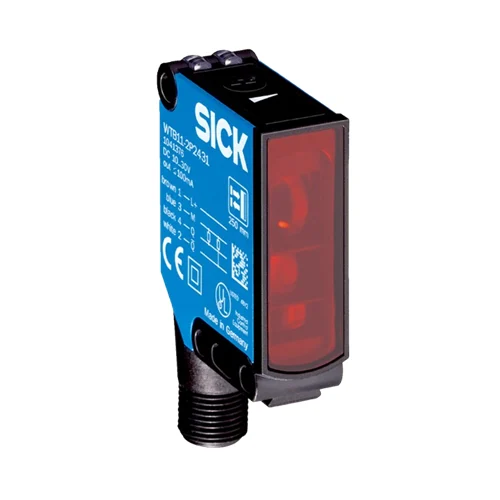
A conveyor can move separated opaque products between the sensor and its aligned reflector. Each blocked and restored return beam produces a PNP transition for an external counter, with the fixed light-switching polarity interpreted by the receiving input. Commissioning verifies beam coverage, minimum reflector distance and product spacing against the 200 Hz rating and specified resistive-load response.
Problem Solved
Distinct beam interruptions provide external counting logic with product-passage events, helping track separated opaque articles through a reflector-equipped conveyor sensing location.
Conveyor counting
Polarized return beam
PNP
2. Triggering a station from an article leading edge
A packaging or inspection station can align the sensor and reflector across the expected path of an opaque article. Its leading edge interrupts the return beam, giving external timing electronics an event tied to actual article arrival. Setup positions the beam relative to the process point and accounts for the spot size, fixed output logic and response time.
Problem Solved
An interruption tied to the approaching article gives external station timing a leading-edge reference, helping coordinate the next process step with actual product arrival.
Leading-edge trigger
External timing
M12 connection
3. Timing occupancy of a transfer position
A transfer station can place the beam across a selected position and monitor how long an opaque workpiece keeps the return path blocked. External sequencing measures the occupancy interval and compares it with the intended transfer timing. The installation establishes reflector alignment and sufficient target coverage while interpreting the fixed light-switching output state correctly.
Problem Solved
The duration of a blocked return beam gives external transfer logic an occupancy reference, helping identify an unexpectedly long hold at the monitored process position.
Occupancy timing
Transfer monitoring
Retro-reflective