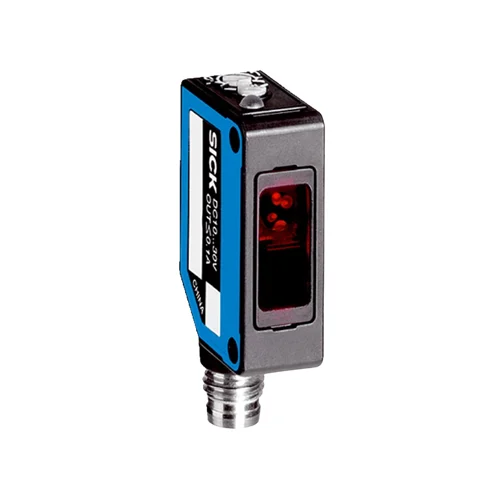
SICK 6036082 WL8G-P2231S01 PNP Transparent-Object Sensor

USD 156.78

WL8G-P2231S01 detects transparent objects with coaxial red-LED optics, 0–1.7 m PL80A sensing, PNP light/dark switching and an M8 four-pin connector.

SKU SICK-6036082 Category
SICK W8G

SICK WL8G-P2231S01 PNP Transparent-Object Sensor

BrandSICK
Model IdentifierWL8G-P2231S01
Official Part Number6036082

Technical Overview

The SICK WL8G-P2231S01 is a special-device retro-reflective sensor for transparent objects, using coaxial autocollimation optics without a reflector minimum distance. Its 650 nm red LED provides 0–1.7 m sensing and a 0–3 m maximum range with a PL80A reflector, with a Ø70 mm spot at 2 m. A 270° sensitivity potentiometer and light/dark rotary switch adapt the single PNP output to the installed optical condition. Response is ≤0.5 ms with resistive load and switching frequency is 1,000 Hz at a 1:1 light/dark ratio. The 10–30 V DC sensor uses an M8 four-pin male connector, IP67 ABS housing and PMMA optics, with operation from −25 to +55 °C.

Coaxial transparent-object retro-reflective sensor with 0–1.7 m PL80A sensing, PNP light/dark selection, 270° sensitivity adjustment and M8 connection.

Key Features

  • Special-device retro-reflective sensor for transparent objects
  • Coaxial autocollimation optics without reflector minimum distance
  • 0–1.7 m sensing; 0–3 m maximum with PL80A reflector
  • 650 nm visible red LED; Ø70 mm spot at 2 m
  • 270° sensitivity potentiometer and light/dark rotary switch
  • Single PNP output, ≤100 mA; response ≤0.5 ms with resistive load
  • 1,000 Hz switching at 1:1 light/dark ratio; beam-attenuation specification ≤20%
  • 10–30 V DC; 30 mA no-load current; M8 four-pin male connector
  • ABS housing, PMMA optics and IP67; operation −25 to +55 °C
  • M3 threaded mounting holes, maximum torque 0.6 Nm; orange output LED

Detect a commissioned transparent-target condition in a coaxial reflector path and provide a selectable PNP switching signal from a miniature M8-connected sensor.

Technical Specification Matrix

ParameterValue
Functional principleRetro-reflective sensing with coaxial autocollimation optics; no reflector minimum distance
Special applicationDetecting transparent objects; special-device version
Sensing range0–1.7 m with PL80A reflector
Maximum sensing range0–3 m with PL80A reflector
Additional reflector rangesSensing / typical maximum: P250F 0–1.9 / 0–2.5 m; PL20F 0–1.0 / 0–1.3 m; PL10F 0–0.6 / 0–0.7 m
Light source650 nm visible red LED
Average LED service life100,000 h at +25 °C
Light spot sizeØ70 mm at 2 m
Adjustment270° sensitivity potentiometer
Switching outputSingle PNP output; maximum current ≤100 mA
Switching modeLight/dark switching selected by rotary switch; L=light, D=dark
PNP signal voltage HIGH/LOWApproximately supply voltage −1.8 V / 0 V
Response time≤0.5 ms; signal transit time with resistive load
Switching frequency1,000 Hz at 1:1 light/dark ratio
Attenuation along light beam≤20%, manufacturer specification
Power supply10–30 V DC; short-circuit-protected network, maximum 8 A
Ripple±10%; remain within supply tolerances
Current consumption30 mA without load
ConnectionM8 four-pin male connector
Pin assignmentCD-066: 1 BN=L+; 2 WH=not connected; 3 BU=M; 4 BK=Q
Circuit protectionSupply and input/output reverse-polarity protection; output overcurrent and short-circuit protection
Housing materialABS
Optics materialPMMA
IP ratingIP67
Operating temperature−25 to +55 °C
Storage temperature−40 to +70 °C
MountingM3 threaded holes; maximum tightening torque 0.6 Nm; 25.4 mm spacing
IndicatorOrange LED: switching output active
MTTFD1,028.4 years
DCavg0%
Physical Weight (kg)0.01

Industrial Applications

1. Counting transparent containers on a filling line

A filling line can place the sensor and reflector across the path of separated transparent containers. The manufacturer identifies transparent-object detection, and the sensitivity potentiometer establishes the optical setting for the actual container and reflector. The PNP output provides passage events to an external counter, with 1,000 Hz switching and ≤0.5 ms response assessed alongside container spacing and input sampling.

Problem Solved

A commissioned transparent-target optical condition gives external counting logic a container-passage event, helping track separated clear containers at the selected observation point.

Transparent containers PNP output 1,000 Hz

2. Monitoring transparent film continuity at a feed station

A transparent-film feeder can place the reflector return path through its normal material position. External monitoring observes the PNP state when the film is present and when a break or exhausted roll leaves the path open. The 270° sensitivity adjustment and light/dark rotary switch establish the installed condition for the actual film, reflector, distance and optical attenuation.

Problem Solved

A sustained change in the commissioned film-presence condition gives external feed monitoring a continuity event, helping identify a break or exhausted transparent material supply.

Film continuity 270° adjustment Light/dark selection

3. Checking that a clear container leaves a transfer nest

A transfer nest can direct the reflector return beam through the expected position of a clear container. External sequence logic checks the commissioned optical state before transfer and again after removal, flagging a container that remains in place. Coaxial optics remove the reflector minimum-distance requirement, while reflector selection and target attenuation establish the useful installed geometry.

Problem Solved

A container-presence check after the transfer command gives external sequencing evidence of a retained clear container, helping identify a transfer cycle that did not clear the nest.

Transfer confirmation Coaxial optics Retained container

Select your currency