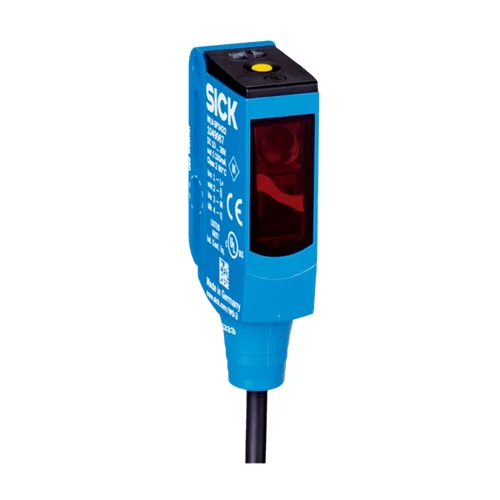
SICK 1049084 WL9G-3P3432 PNP Transparent-object Sensor

USD 187.46

WL9G-3P3432 detects transparent objects with 0–3 m PL80A sensing, 650 nm polarized optics, teach-in, AutoAdapt, complementary PNP outputs and M12 pigtail.

SKU SICK-1049084 Category
SICK W9

SICK WL9G-3P3432 PNP Transparent-object Sensor

BrandSICK
Model IdentifierWL9G-3P3432
Official Part Number1049084

Technical Overview

The SICK WL9G-3P3432 is a retro-reflective photoelectric sensor configured for detecting transparent objects. Polarized autocollimation/coaxial optics provide 0–3 m sensing with a PL80A reflector, with 0–5 m maximum range specified separately and no reflector minimum distance. A single local teach-in button sets detection, and AutoAdapt is present. The 650 nm red PinPoint LED produces a 45 mm spot at 1.5 m. Complementary PNP outputs provide light/dark switching, with Q defined as light switching. Response is below 0.5 ms with resistive load, with a 1,000 Hz switching rating. The device uses a 120 mm PVC cable with M12 four-pin male connector, M3 mounting holes and an IP66/IP67/IP69K VISTAL housing with PMMA optics.

Transparent-object retro-reflective sensor with 0–3 m PL80A sensing, local teach-in, AutoAdapt, complementary PNP outputs and 120 mm PVC cable with M12 four-pin male connector.

Key Features

  • Dedicated transparent-object detection with polarized retro-reflective coaxial optics
  • 0–3 m sensing range with PL80A reflector; 0–5 m maximum range
  • 650 nm red PinPoint LED; Ø45 mm light spot at 1.5 m
  • Single local teach-in button; AutoAdapt present
  • Complementary PNP outputs; Q is light switching and inverse Q is dark switching
  • Response <0.5 ms with resistive load; 1,000 Hz at 1:1 light/dark ratio
  • 120 mm PVC cable with M12 four-pin male connector
  • 10–30 V DC; 20 mA consumption without load; output current derated to 50 mA at ≥+50 °C
  • VISTAL plastic housing and PMMA optics; IP66/IP67/IP69K
  • M3 mounting holes; green power and yellow received-light indicators

Teach detection for transparent material in a defined reflector path and provide complementary PNP conditions to external counting or presence-control logic.

Technical Specification Matrix

ParameterValue
Functional principlePhotoelectric retro-reflective sensor
Optical arrangementAutocollimation/coaxial optics; without reflector minimum distance
Special applicationDetecting transparent objects
Housing designRectangular
Sensing range0–3 m with PL80A reflector
Maximum sensing range0–5 m with PL80A reflector
Other reflector rangesSensing / maximum: P250F 0–2 / 0–3.5 m; PL40A 0–2 / 0–4 m; PL20F 0–1.3 / 0–2.2 m; PL10F 0–1.2 / 0–1.6 m; REF-IRF-56 tape 0–0.5 / 0–0.8 m
Light sourceVisible red PinPoint LED
Wavelength650 nm
Average LED service life100,000 h at +25 °C
Light spot sizeØ45 mm at 1.5 m
Additional light spot sizesØ25 mm at 1 m; Ø60 mm at 2 m; Ø120 mm at 3.5 m; Ø160 mm at 5 m
AdjustmentSingle local teach-in button
AutoAdaptPresent
Polarizing filterPresent
Switching outputComplementary PNP outputs Q and inverse Q
Switching modeLight/dark switching; Q is light switching
Output current≤100 mA; at ambient temperature ≥+50 °C, maximum load current is 50 mA
Response time<0.5 ms signal transit time with resistive load
Switching frequency1,000 Hz with 1:1 light/dark ratio
Power supply10–30 V DC in short-circuit-protected network, maximum 8 A
Ripple<5 Vpp; remain within supply-voltage tolerances
Current consumption20 mA without load
Connection120 mm PVC cable with M12 four-pin male connector
Pin assignmentCD-084: 1 BN=L+; 2 WH=inverse Q; 3 BU=M; 4 BK=Q
Circuit protectionSupply reverse-polarity protection; inputs and output reverse-polarity protection; interference suppression
Protection classIII
Housing materialVISTAL® plastic
Optics materialPMMA plastic
IP ratingIP66 / IP67 / IP69K
MountingM3 mounting holes; Ø3.1 mm in manufacturer drawing
IndicationYellow LED: received-light status; green LED: power on
Operating temperature−40 to +60 °C
Storage temperature−40 to +75 °C
UL fileNRKH.E181493
MTTFD1,232 years
DCavg0%
Cable materialPVC plastic; do not bend below 0 °C
Conductor cross-section0.14 mm²
Physical Weight (kg)0.08

Industrial Applications

1. Counting separated transparent containers on a conveyor

A packaging conveyor can move separated transparent containers through the optical path between the sensor and a facing reflector. The dedicated transparent-object configuration and single teach-in button establish detection using representative containers. External counting electronics evaluate PNP output transitions, with setup checking container geometry, reflector alignment and spacing within the specified PL80A sensing range rather than the separate maximum range.

Problem Solved

A taught change in received light provides container-passage events to external counting electronics, helping register transparent containers that transmit much of the incident beam.

Transparent containers Local teach-in PNP outputs

2. Monitoring continuity of a transparent strip at a material guide

A material guide can hold a transparent strip in a defined path between the sensor and reflector. Teaching establishes the received-light change produced by the actual strip, and a break or missing section changes that condition. External handling logic evaluates the complementary PNP signals after threading, while guide geometry keeps normal lateral movement from clearing the monitored beam.

Problem Solved

A change at the taught optical threshold gives external strip-handling logic a continuity reference, helping identify missing transparent material at a constrained guide location.

Transparent strip Continuity monitoring Complementary signals

3. Checking a transparent tray presented in a loading nest

A loading nest can bring a transparent tray wall into a repeatable optical path before an insertion step. The sensor faces a fixed reflector, and button teaching establishes the actual tray-present condition. External station logic samples the complementary PNP outputs after the tray settles, with commissioning checking the tray wall geometry and optical change at the installed reflector distance.

Problem Solved

A taught tray-present condition helps external loading logic distinguish an occupied nest from an empty presentation point before the next ordinary assembly operation begins.

Tray presence Loading nest Taught optical threshold

Select your currency