1. Counting separated opaque parts across a feed path
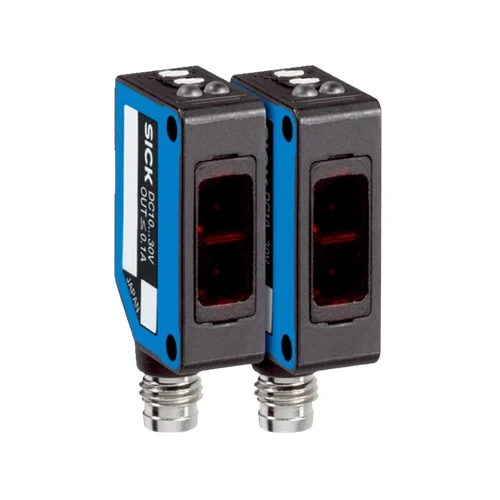
A feed path can place the laser sender and receiver on opposite sides so separated opaque parts interrupt the beam. External counting logic reads the receiver’s PNP transitions. The documented small-object role, beam size at the installed distance, response below 0.25 ms and 2,000 Hz switching inform the selected part coverage, spacing and input sampling.
Problem Solved
Fast beam-interruption events give external counting logic passage information for separated opaque parts, helping track feed output without relying on light reflected from each part’s surface.
Part count
Through-beam laser
2,000 Hz
2. Monitoring continuity of an opaque strip feed
An opaque strip feed can run between the opposed units so intact material blocks the laser and a break leaves the beam path clear. External monitoring evaluates the received-light condition, using the light/dark selector to establish the useful PNP polarity. The 270° sensitivity control sets the receiver for the installed separation and representative strip presentation.
Problem Solved
A persistent beam-state change gives external feed monitoring an event associated with a break or exhausted opaque strip, helping identify loss of material continuity.
Opaque strip continuity
Light/dark selection
Sensitivity adjustment
3. Measuring occupancy duration at a conveyor transfer
A conveyor transfer can place the opposed laser units across its receiving point. An opaque load at that location blocks the beam and holds the selected PNP condition. External timing logic measures the interruption duration to distinguish passage from sustained occupancy, then coordinates upstream release with the expected transfer sequence and available receiving space.
Problem Solved
Beam-state duration gives external transfer sequencing an occupancy interval, helping delay upstream release when a load continues to block the receiving point.
Transfer occupancy
External timing
PNP state