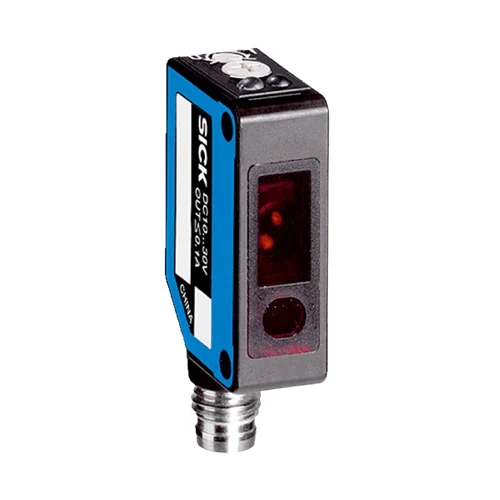
SICK 6035583 WSE8-P2231 PNP Through-Beam Sensor

USD 161.72

WSE8-P2231 offers 0–8 m through-beam sensing, 650 nm red LED light, PNP light/dark switching, 2,000 Hz operation, M8 connectors and two mounting brackets.

SKU SICK-6035583 Category
SICK W8

SICK WSE8-P2231 PNP Through-Beam Sensor

BrandSICK
Model IdentifierWSE8-P2231
Official Part Number6035583

Technical Overview

The SICK WSE8-P2231 is a through-beam photoelectric sensor arrangement with a separate sender and receiver. Its 650 nm visible red LED provides 0–8 m sensing range and 0–10 m maximum range, with a 30 mm light spot at 1 m. A 270° potentiometer adjusts sensitivity, while a separate rotary switch selects light or dark operation for the PNP output. Response is no more than 0.25 ms with a resistive load, and switching frequency is 2,000 Hz at a 1:1 light/dark ratio. Both units use M8 four-pin connectors and 10–30 V DC supply. ABS housings, PMMA optics, IP67 protection and two supplied stainless steel brackets support installation across the material path.

Red-LED through-beam sensor arrangement with 0–8 m sensing, PNP light/dark selection, 2,000 Hz operation and M8 four-pin connectors.

Key Features

  • WSE8-P2231 / 6035583: through-beam sensor with separate sender and receiver
  • 0–8 m sensing range; 0–10 m maximum range
  • 650 nm visible red LED; Ø30 mm light spot at 1 m
  • 270° sensitivity potentiometer; separate light/dark rotary selector
  • PNP output; ≤100 mA; HIGH approximately supply −1.8 V, LOW 0 V
  • ≤0.25 ms response with resistive load; 2,000 Hz at 1:1 light/dark ratio
  • M8 four-pin connectors; receiver output on pin 4; sender pin 4 not connected
  • 10–30 V DC; 30 mA without load; supply/input/output reverse-polarity and output overcurrent/short-circuit protection
  • Two BEF-W100-A mounting brackets in 1.4301/304 stainless steel supplied
  • ABS housing; PMMA optics; IP67; −25 to +55 °C operation

Detect interruptions of a separately aligned red-light beam and send the selected PNP switching state to external counting or sequencing logic.

Technical Specification Matrix

ParameterValue
Functional principleThrough-beam photoelectric sensor; separate sender and receiver
Sensing range0–8 m
Maximum sensing range0–10 m
Light source650 nm visible red LED
Light spot sizeØ30 mm at 1 m
Average LED service life100,000 h at +25 °C
Sensitivity adjustmentPotentiometer, 270°
Switching modeLight/dark switching, selected using separate rotary selector; L=light, D=dark
Switching outputPNP
Signal voltage HIGH/LOWApproximately supply voltage −1.8 V / 0 V
Output current≤100 mA
Response time≤0.25 ms, signal transit time with resistive load
Switching frequency2,000 Hz at 1:1 light/dark ratio
Power supply10–30 V DC; short-circuit-protected network, maximum 8 A
Ripple±10%; remain within supply-voltage tolerances
Current consumption30 mA without load
ConnectionM8 four-pin male connectors
Sender pin assignmentCD-057: 1 BN=L+; 3 BU=M; 2 WH and 4 BK not connected
Receiver pin assignmentCD-057: 1 BN=L+; 2 WH not connected; 3 BU=M; 4 BK=Q
Circuit protectionSupply connections reverse-polarity protected; inputs/output reverse-polarity protected; outputs overcurrent and short-circuit protected
Housing materialABS plastic
Optics materialPMMA plastic
IP ratingIP67
MountingM3 threaded mounting holes; maximum tightening torque 0.6 Nm
Items suppliedTwo BEF-W100-A stainless steel mounting brackets, 1.4301/304
IndicationOrange switching-output-active indicator; green stability indicator
Operating temperature−25 to +55 °C
Storage temperature−40 to +70 °C
MTTFD739.3 years
DCavg0%

Industrial Applications

1. Counting separated opaque packages across a conveyor

A conveyor can position the sender and receiver on opposite sides of an opaque-package path and feed beam-interruption transitions to an external counter. The red LED beam provides the monitored line, while the 2,000 Hz rating and resistive-load response define sensor timing capabilities. Commissioning verifies alignment, package coverage, spacing and actual controller input timing within the documented sensing range.

Problem Solved

Distinct beam interruptions give external counting logic package-passage events, helping count separated opaque loads at one conveyor position using opposed sender and receiver optics.

Package counting Through-beam 2,000 Hz

2. Confirming material transfer across a machine opening

A transfer station can place the opposed optics across the line that an opaque component must cross before the next process step. External sequencing logic reads the selected PNP state as a passage condition. Sensitivity and light/dark selection adapt the switching behavior, while setup verifies actual target coverage and alignment across the installed sender-to-receiver distance.

Problem Solved

A monitored beam line provides external sequencing logic with a material-transfer event, helping confirm that an opaque component crossed the selected machine location.

Transfer confirmation PNP process input Light/dark selection

3. Monitoring sustained blockage in an accumulation chute

A parts chute can place the red-light beam across a point that clears during normal flow. External timing logic measures how long the selected PNP blocked-beam condition remains present and compares it with the process interval. The sensor supplies the optical condition, while the external timer distinguishes a brief part passage from material that remains across the monitored path.

Problem Solved

A sustained beam-blockage condition gives external timing logic an accumulation reference, helping distinguish passing material from an opaque obstruction that remains at the selected chute location.

Chute accumulation External dwell timing Blocked beam

Select your currency