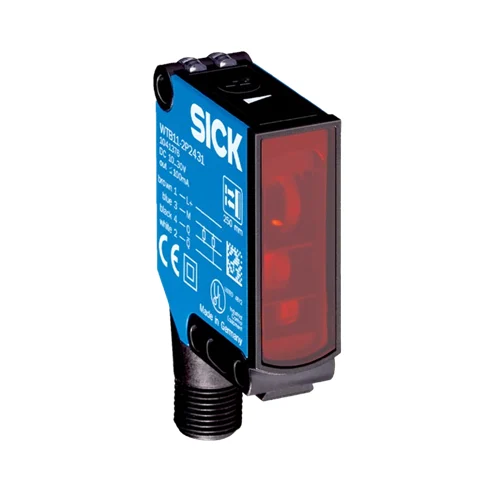
SICK 1041379 WTB11-2N1131 NPN Background-Suppression Sensor

USD 131.04

WTB11-2N1131 offers 20–350 mm reference-white sensing, 640 nm red LED light, complementary NPN outputs, five-turn adjustment and a 2 m PVC cable.

SKU SICK-1041379 Category
SICK W11-2

SICK WTB11-2N1131 NPN Background-Suppression Sensor

BrandSICK
Model IdentifierWTB11-2N1131
Official Part Number1041379

Technical Overview

The SICK WTB11-2N1131 is a photoelectric proximity sensor with background suppression and complementary NPN light/dark outputs. Its 640 nm visible red LED forms a 6 mm spot at 200 mm, and a five-turn potentiometer adjusts sensing range. Both the sensing and maximum range are 20–350 mm on 90% remission reference white; the documented range is shorter for gray and black targets. Response is no more than 2.5 ms with a resistive load, with 200 Hz switching at a 1:1 light/dark ratio. The sensor operates from 10–30 V DC through a 2 m four-wire PVC cable, consuming 40 mA without load. Its ABS housing and PMMA optics provide IP66/IP67/IP69K protection.

Background-suppression sensor with 20–350 mm reference-white sensing, complementary NPN outputs, 640 nm red LED and 2 m four-wire PVC cable.

Key Features

  • WTB11-2N1131 / 1041379: photoelectric proximity sensing with background suppression
  • 20–350 mm sensing and maximum range on 90% remission reference white
  • 20–300 mm on 18% gray; 20–200 mm on 6% black
  • 640 nm visible red LED; Ø6 mm spot at 200 mm
  • Five-turn potentiometer for sensing-range adjustment
  • Complementary NPN light/dark outputs; current ≤100 mA
  • ≤2.5 ms response with resistive load; 200 Hz at 1:1 light/dark ratio
  • 2 m four-wire PVC cable; 10–30 V DC; 40 mA without load
  • Green supply-voltage and yellow received-light indicators
  • ABS housing; PMMA optics; IP66/IP67/IP69K; −30 to +60 °C operation

Set a foreground target zone with background suppression and provide complementary switching conditions to external machine inspection or sequencing inputs.

Technical Specification Matrix

ParameterValue
Functional principlePhotoelectric proximity sensor with background suppression
Sensing range20–350 mm on 90% remission reference white, DIN 5033
Maximum sensing range20–350 mm on 90% remission reference white, DIN 5033
Other reference-target ranges20–300 mm on 18% gray; 20–200 mm on 6% black
Light source640 nm visible red LED
Light spot sizeØ6 mm at 200 mm
Average LED service life100,000 h at +25 °C
AdjustmentSensing-range potentiometer, five turns
Switching outputsComplementary NPN outputs, Q and complement Q
Switching modeLight/dark switching via complementary outputs
Signal voltage HIGH/LOWApproximately supply voltage / <2.5 V
Output current≤100 mA
Response time≤2.5 ms, signal transit time with resistive load
Switching frequency200 Hz at 1:1 light/dark ratio
Power supply10–30 V DC; short-circuit-protected network, maximum 8 A
Residual ripple<5 Vpp; remain within supply-voltage tolerances
Current consumption40 mA without load
Connection2 m four-wire PVC cable
Pin or wire assignmentCD-094: BN=L+; WH=complement Q; BU=M; BK=Q
Circuit protectionSupply reverse-polarity protection; interference suppression; output overcurrent and short-circuit protection
Protection classIII
Housing materialABS plastic
Optics materialPMMA plastic
IP ratingIP66 / IP67 / IP69K
Mounting holesØ4.2 mm
IndicationGreen LED: supply voltage active; yellow LED: received-light condition
Operating temperature−30 to +60 °C
Storage temperature−40 to +75 °C
UL filesNRKH.E181493; NRKH7.E181493
MTTFD894 years
DCavg0%
Mission time20 years
Conductor cross-section0.25 mm²
Cable handlingDo not bend cable below 0 °C
Physical Weight (kg)0.2

Industrial Applications

1. Checking component presentation ahead of a fixture background

An assembly fixture can present an opaque component inside the adjusted target zone while the fixture structure remains farther behind it. Background suppression and the five-turn potentiometer establish the optical condition. External inspection logic reads a complementary NPN output after presentation, with commissioning checking actual target remission, working distance and background separation against the documented sensing diagram.

Problem Solved

An adjusted foreground target zone gives external inspection logic a component-presence condition, helping distinguish a presented part from more distant fixture structure behind the sensing position.

Fixture presentation Background suppression Five-turn adjustment

2. Counting separated raised components on a conveyor

A conveyor can carry separated raised components through the optical field, with its belt surface farther behind the targets. The complementary NPN outputs provide switching conditions for external counting inputs. Setup verifies target coverage using the 6 mm spot at 200 mm, and checks spacing, actual remission and motion timing against the sensing diagram, 200 Hz switching rating and resistive-load response limit.

Problem Solved

Separated target transitions give external counting logic component-passage events, helping track raised parts at one conveyor location while background suppression separates them from a farther surface.

Component counting 200 Hz 6 mm spot at 200 mm

3. Timing material occupancy at a chute position

A parts chute can place its expected material surface within the adjusted sensing zone, with the empty chute background farther away. External timing logic measures how long the selected NPN condition remains present and compares that interval with the process sequence. Commissioning checks representative material remission, background separation and stable target presentation before setting the maintained-occupancy interval.

Problem Solved

A maintained optical condition gives external timing logic a material-occupancy reference, helping distinguish a brief part passage from material that remains at the monitored chute position.

Chute occupancy External timer Complementary outputs

Select your currency