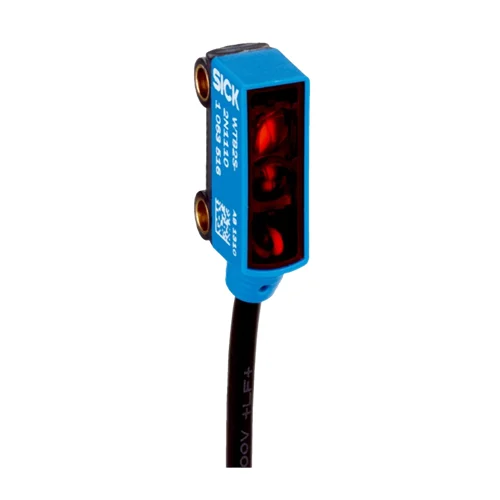
SICK 1064578 WTB2S-2N1330 NPN Miniature BGS Sensor

USD 101.66

WTB2S-2N1330 combines red PinPoint LED background suppression, a 30 mm reference-white sensing reach, NPN light-switching output and a 2 m cable.

SKU SICK-1064578 Category
SICK W2

SICK WTB2S-2N1330 NPN Miniature BGS Sensor

BrandSICK
Model IdentifierWTB2S-2N1330
Official Part Number1064578

Technical Overview

The SICK WTB2S-2N1330 is a miniature photoelectric proximity sensor using background suppression and a visible 640 nm PinPoint LED. Its sensing reach is 30 mm on 90% remission reference white, with a maximum reach of 36 mm and typical background suppression from 38 mm. The fixed sensing configuration requires no adjustment. A single NPN light-switching output connects through a 2 m three-wire PVC cable and supports up to 50 mA. Response is below 0.4 ms with resistive load, with a 1,200 Hz switching rating. The ABS/PC housing and PMMA optics provide IP67 protection, while green and yellow indicators show power and received light.

Fixed-range miniature background-suppression sensor with 640 nm red PinPoint LED, NPN light-switching output, 1,200 Hz switching and 2 m cable.

Key Features

  • Miniature background-suppression photoelectric proximity sensor
  • Reference-white sensing reach 30 mm; maximum reach 36 mm
  • 640 nm visible red PinPoint LED
  • Typical background suppression from 38 mm; fixed range without adjustment
  • Single NPN light-switching output; maximum current ≤50 mA
  • Response <0.4 ms with resistive load; 1,200 Hz at 1:1 light/dark ratio
  • 2 m three-wire PVC cable; 0.09 mm² conductors; Ø3 mm cable
  • 10–30 V DC; 20 mA consumption without load
  • ABS/PC housing and PMMA optics; IP67; −25 to +50 °C operation
  • Two Ø3.2 mm mounting holes; green power and yellow received-light indicators

Use a fixed optical sensing boundary to detect a presented near target while suppressing a farther background, without local range adjustment.

Technical Specification Matrix

ParameterValue
Functional principlePhotoelectric proximity sensor with background suppression
Housing designMiniature rectangular
Sensing reachUp to 30 mm on 90% remission reference white, DIN 5033
Maximum sensing reachUp to 36 mm on 90% remission reference white, DIN 5033
Background suppressionTypically from 38 mm
Light sourceVisible red PinPoint LED; 640 nm
Average LED service life100,000 h at +25 °C
AdjustmentNone; fixed sensing configuration
Manufacturer special applicationDetecting small objects
Switching outputSingle NPN output
Switching modeLight switching
Output current≤50 mA
Response time<0.4 ms signal transit time with resistive load
Switching frequency1,200 Hz with 1:1 light/dark ratio
Power supply10–30 V DC; limit values
Ripple<5 Vpp; remain within supply-voltage tolerances
Current consumption20 mA without load
Connection2 m three-wire PVC cable; do not bend below 0 °C
Conductor cross-section0.09 mm²
Cable diameterØ3 mm
Conductor functionsCD-044: BN=L+; BU=M; BK=Q
Circuit protectionSupply reverse-polarity protection; output reverse-polarity protection; output overcurrent and short-circuit protection
Housing materialABS/PC plastic
Optics materialPMMA plastic
IP ratingIP67
Mounting holesTwo Ø3.2 mm holes
IndicationGreen LED: supply voltage; yellow LED: received light
Operating temperature−25 to +50 °C
Storage temperature−40 to +75 °C
UL fileNRKH.E181493
MTTFD3,378 years
DCavg0%

Industrial Applications

1. Confirming a small insert at an assembly position

An assembly fixture can present a small opaque insert close to the sensing face, with a farther structure beyond the intended detection position. The fixed background-suppression configuration provides the optical boundary without a range-adjustment step. External sequence logic reads the light-switching output after placement, with setup verifying target coverage, remission and separation from the background.

Problem Solved

A fixed near-target condition provides external assembly logic with an insert-presence reference, helping distinguish the presented component from a farther structure behind the fixture.

Insert presentation Fixed range Background suppression

2. Counting separated tabs on a moving component carrier

A moving carrier can bring separated opaque tabs through the near sensing location while the farther carrier structure remains outside the intended detection zone. Each tab produces a light-switching event for an external counter. The 1,200 Hz rating and response below 0.4 ms provide the electrical timing basis, with actual tab width, reflectance, spacing and motion verified during setup.

Problem Solved

Separated foreground tabs produce discrete electrical passage events, helping external counting logic track carrier features while rejecting a suitably spaced background behind the sensing location.

Tab counting 1,200 Hz Light switching

3. Monitoring continuity of an opaque strip at a feed point

A strip feeder can aim the sensor at an opaque material face held in a defined near sensing position. When the strip ends or breaks, the farther structure beyond the strip is suppressed under the installed geometry. External control logic evaluates a sustained change in the output state before issuing a material-loss or replenishment request for the feeding process.

Problem Solved

Loss of the near material face creates a sustained switching change for external feeder logic, helping identify a broken or exhausted strip at the monitored feed point.

Strip continuity Material-loss condition Fixed optical boundary

Select your currency