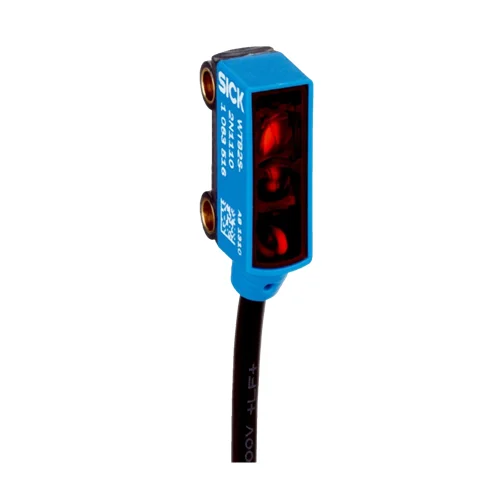
1. Establishing a foreground target condition during fixture setup
An assembly fixture can present its intended opaque component while setup logic operates the separate teach conductor. Cable-based adjustment establishes the background-suppression sensing condition without a local range potentiometer. During the process, external sequence logic reads the PNP light-switching state, with commissioning verifying the actual target surface and its distance from the farther fixture structure.
Problem Solved
The separate teach conductor supports setting the foreground sensing condition from the machine wiring location, helping prepare a compact fixture for its intended component presentation.
Cable teach-in
Foreground setup
PNP output
2. Counting separated opaque components on a narrow track
A narrow transport track can bring separated opaque components through the red sensing location with a farther surface behind them. Background suppression distinguishes foreground passages under the installed geometry. External counting electronics use output transitions and assess speed against the 1,000 Hz switching rating and response below 0.5 ms, while setup verifies target coverage, remission and separation.
Problem Solved
Foreground passages become discrete electrical count events, helping external transport logic count separated components while suppressing a suitably spaced surface behind the sensing location.
Component counting
1,000 Hz
Background suppression
3. Monitoring opaque material at a replenishment threshold
A feeder can aim the sensor at opaque material occupying a defined location near its outlet. Cable teach-in adjusts the sensing condition for the presented material and background, and the single PNP signal reports local occupancy. External logic evaluates a sustained absence condition before requesting replenishment, with the working distance selected for the actual target remission.
Problem Solved
A sustained change at the monitored material threshold gives external feeder logic a replenishment reference, helping detect when the expected foreground material no longer occupies the sensing location.
Material replenishment
Cable adjustment
Sustained absence