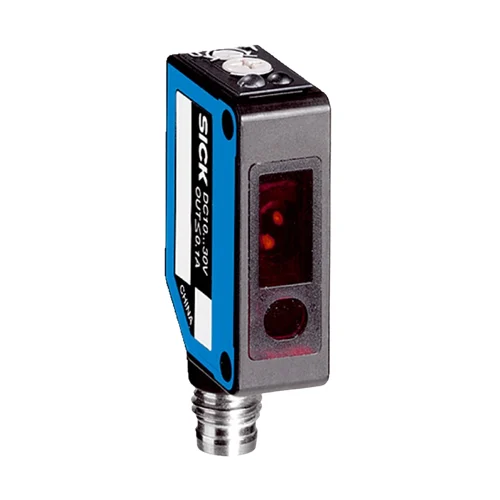
SICK 6033226 WTB8L-N2211 NPN Laser Sensor

USD 284.70

WTB8L-N2211 offers 20–100 mm reference-white sensing with background suppression, a Class 1 laser, NPN output, 2 kHz switching and M8 connection.

SKU SICK-6033226 Category
SICK W8 Laser

SICK WTB8L-N2211 NPN Laser Sensor

BrandSICK
Model IdentifierWTB8L-N2211
Official Part Number6033226

Technical Overview

The SICK WTB8L-N2211 is a photoelectric proximity sensor with background suppression and a visible 650 nm Class 1 laser. The exact-model feature table specifies a 20–100 mm sensing range and 5–100 mm maximum range on 90% remission reference white. Its 1 mm spot at 100 mm provides a small optical field for component detection. A four-turn potentiometer adjusts sensing range, while a separate rotary control selects light or dark switching for the single NPN output. Response is no greater than 0.25 ms with resistive load, with 2,000 Hz switching at a 1:1 light/dark ratio. The ABS housing with PMMA optics has an M8 four-pin connector, IP67 protection and a supplied stainless steel mounting bracket.

Class 1 red-laser background-suppression sensor with 20–100 mm reference-white sensing, a 1 mm spot at 100 mm, NPN output and M8 connection.

Key Features

  • Background-suppression photoelectric proximity sensing
  • 20–100 mm sensing; 5–100 mm maximum range on 90% remission white
  • 650 nm red Class 1 laser; Ø1 mm spot at 100 mm
  • Four-turn sensing-range potentiometer and separate light/dark rotary selection
  • Single NPN output; ≤100 mA output current
  • ≤0.25 ms resistive-load response; 2,000 Hz at 1:1 light/dark ratio
  • 10–30 V DC; 30 mA consumption without load
  • M8 four-pin male connector; dedicated test input
  • ABS housing, PMMA optics and IP67; −10 to +50 °C operation
  • BEF-W100-A stainless steel mounting bracket supplied

Use a small laser spot and adjustable background suppression to send defined component-detection events to external NPN process inputs.

Technical Specification Matrix

ParameterValue
Functional principlePhotoelectric proximity sensor with background suppression
Sensing range20–100 mm on 90% remission reference white, DIN 5033
Maximum sensing range5–100 mm on 90% remission reference white, DIN 5033
Light sourceVisible red laser; 650 nm
Laser class1
Average laser service life100,000 h at +25 °C
Light spot sizeØ1 mm at 100 mm
AdjustmentFour-turn sensing-range potentiometer
Switching outputSingle NPN output
Switching modeLight/dark switching selected by separate rotary control
Signal voltage HIGH/LOWApproximately supply voltage / <1.8 V
Output current≤100 mA
Response time≤0.25 ms signal transit time with resistive load
Switching frequency2,000 Hz at 1:1 light/dark ratio
ConnectionM8 four-pin male connector
Pin assignmentCD-078: 1 BN=L+; 2 WH=test input; 3 BU=M; 4 BK=Q
Power supply10–30 V DC; short-circuit-protected network, maximum 8 A
Ripple±10%; remain within supply-voltage tolerances
Current consumption30 mA without load
Circuit protectionSupply reverse-polarity protection; inputs and output reverse-polarity protection; output overcurrent and short-circuit protection
Housing materialABS plastic
Optics materialPMMA plastic
IP ratingIP67
Operating temperature−10 to +50 °C
Storage temperature−40 to +70 °C
IndicationOrange: output state; green: stability
Mounting holesM3; 25.4 mm pitch
Nominal body partial sizes11 mm width ×31 mm height ×20 mm depth; connector and raised controls extend beyond the body
Included bracketBEF-W100-A; stainless steel 1.4301 / 304
MTTFD477 years
DCavg0%
Physical Weight (kg)0.01

Industrial Applications

1. Counting small separated parts on a feed track

A feed track can move small opaque parts through the 1 mm laser spot at a controlled standoff. Each detected part produces an NPN transition for an external counter, with the chosen light/dark mode interpreted by that input. Commissioning checks representative surface remission, part coverage and gaps against the documented range, 2,000 Hz rating and resistive-load response.

Problem Solved

A small optical spot gives external counting logic a localized part-passage event, helping separate successive components when their actual spacing and surface return support distinct detection.

Small-part counting 1 mm spot NPN

2. Checking a seated component against a fixture background

An inspection fixture can place an opaque component within the adjusted sensing zone while more distant fixture surfaces remain behind it. The four-turn range adjustment and background suppression establish the intended optical condition. External inspection logic samples the NPN state after seating, with setup checking actual target remission and separation from the background at the installed distance.

Problem Solved

An adjusted background-suppression condition gives external inspection logic a component-presence reference, helping distinguish the seated part from more distant surfaces behind the inspection position.

Fixture inspection Background suppression Range adjustment

3. Triggering an operation from a component leading edge

A process station can align the small laser spot with the expected path of an opaque component edge and use the NPN transition as an external timing input. The selected light/dark mode defines the event polarity. Installation locates the beam relative to the process point and includes the documented response time, surface remission and spot coverage when setting the trigger timing.

Problem Solved

A localized edge transition gives external station timing an arrival reference tied to the component, helping coordinate a subsequent inspection or process action with actual movement.

Leading-edge trigger External timing Class 1 laser

Select your currency