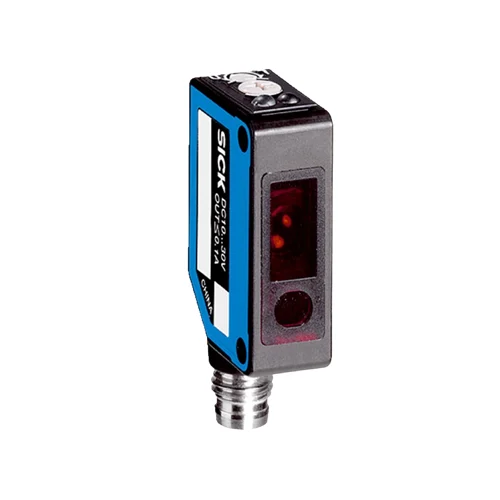
SICK 6033219 WTB8L-P2131 PNP Class 1 Laser BGS Sensor

USD 220.74

650 nm laser sensing with a 1.5 mm spot at 300 mm, four-turn range adjustment, selectable light/dark PNP switching and M8 three-pin connection.

SKU SICK-6033219 Category
SICK W8 Laser

SICK WTB8L-P2131 PNP Class 1 Laser BGS Sensor

BrandSICK
Model IdentifierWTB8L-P2131
Official Part Number6033219

Technical Overview

The SICK WTB8L-P2131 is a miniature photoelectric proximity sensor with background suppression and a visible 650 nm Class 1 laser. Its four-turn potentiometer adjusts the sensing condition within the specified 40–300 mm range on 90% remission reference white, while the maximum range is 30–300 mm. A 1.5 mm light spot at 300 mm supports localized target detection. One PNP output uses a separate light/dark rotary selector, with response no more than 0.25 ms at resistive load and 2,000 Hz switching at a 1:1 light/dark ratio. Orange output and green stability indicators assist setup. The IP67 ABS/PMMA unit connects through M8 three-pin wiring and includes a stainless steel BEF-W100-A mounting bracket.

Class 1 red-laser background-suppression sensor with 40–300 mm reference-white sensing, one PNP output and M8 three-pin connection.

Key Features

  • Background-suppressed photoelectric proximity sensing
  • 40–300 mm sensing; 30–300 mm maximum on 90% reference white
  • 650 nm visible red laser; Class 1
  • Ø1.5 mm light spot at 300 mm
  • Four-turn sensing-range potentiometer and separate light/dark selector
  • PNP switching output; maximum current ≤100 mA
  • ≤0.25 ms resistive-load response; 2,000 Hz at 1:1 light/dark ratio
  • M8 three-pin connector; 10–30 V DC; 30 mA without load
  • Orange output and green stability indicators; M3 mounting holes
  • ABS housing, PMMA optics, IP67 and supplied stainless steel BEF-W100-A bracket

Use a localized Class 1 laser spot and background suppression to detect small target features with a wired switching signal for external control.

Technical Specification Matrix

ParameterValue
Functional principlePhotoelectric proximity sensing with background suppression
Housing designRectangular
Sensing range40–300 mm on 90% remission reference white, DIN 5033
Maximum sensing range30–300 mm on 90% remission reference white, DIN 5033
Light source650 nm visible red laser
Laser classClass 1
Light spot sizeØ1.5 mm at 300 mm
Average laser service life100,000 h at ambient +25 °C
AdjustmentFour-turn sensing-range potentiometer
Switching outputPNP; one switching output
Switching modeLight/dark switching, selected by rotary switch
Signal voltage HIGH/LOWApproximately Vs−1.8 V / 0 V
Output current≤100 mA
Response time≤0.25 ms signal transit time with resistive load
Switching frequency2,000 Hz with 1:1 light/dark ratio
Power supply10–30 V DC; limit values in short-circuit-protected network, maximum 8 A
Ripple±10%; remain within supply-voltage tolerances
Current consumption30 mA without load
ConnectionM8 three-pin connector
Pin assignmentCD-045: 1 BN=L+; 3 BU=M; 4 BK=Q
Circuit protectionSupply and inputs/output reverse-polarity protection; outputs overcurrent and short-circuit protected
IndicatorsOrange: switching output active; green: stability indication
MountingM3 threaded mounting holes
Housing materialABS plastic
Optics materialPMMA plastic
IP ratingIP67
Items suppliedBEF-W100-A stainless steel mounting bracket, 1.4301 / 304
Operating temperature−10 to +50 °C
Storage temperature−40 to +70 °C
MTTFD453 years
DCavg0%
Physical Weight (kg)0.01

Industrial Applications

1. Checking a small insert in an assembly nest

An assembly nest can present a small insert ahead of a farther fixture surface and aim the laser spot at its expected location. The four-turn potentiometer establishes the background-suppressed sensing condition, and external inspection logic samples the PNP output after placement. Setup evaluates actual target remission, position tolerance and background separation within the specified sensing range.

Problem Solved

A localized target-present condition helps external assembly inspection identify an empty insert location, using the small laser spot and background suppression at the repeatable fixture presentation.

Insert presence Laser spot Background suppression

2. Counting separated tabs on a moving feed

A feed mechanism can move separated opaque tabs through the laser sensing point and route the PNP transitions to an external counter. The 2,000 Hz switching rating and ≤0.25 ms resistive-load response inform speed assessment alongside tab width, spacing and controller input timing. Commissioning checks target remission and the background-separation characteristic at the selected working distance.

Problem Solved

Repeated tab-passage transitions give external counting logic discrete movement events, helping track separated feed features through a localized laser sensing point.

Tab counting 2,000 Hz External counter

3. Detecting lateral edge displacement of a guided strip

A strip guide can place the laser sensing point near the expected lateral edge of a consistent opaque material. When the edge moves across that point, the PNP output supplies a discrete condition to external guidance logic. Setup uses representative surfaces, the documented sensing range and background separation, with the laser spot defining the local observation point rather than providing a continuous edge-position measurement.

Problem Solved

A discrete edge-crossing condition gives external guidance logic a reference for lateral material displacement, helping monitor whether the moving strip covers the installed laser sensing point.

Strip edge Discrete guidance Localized sensing

Select your currency