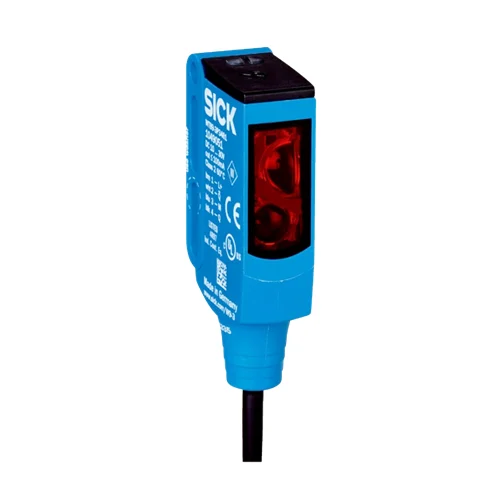
SICK 1050948 WTB9-3N1111S14 NPN Infrared BGS Sensor

USD 195.00

WTB9-3N1111S14 offers infrared background suppression, 20–400 mm black-target sensing, complementary NPN outputs, 200 Hz switching and a 2 m PVC cable.

SKU SICK-1050948 Category
SICK W9

SICK WTB9-3N1111S14 NPN Infrared BGS Sensor

BrandSICK
Model IdentifierWTB9-3N1111S14
Official Part Number1050948

Technical Overview

The SICK WTB9-3N1111S14 is a special-device photoelectric proximity sensor with background suppression and an 850 nm infrared LED. Its specified sensing range is 20–400 mm on a 6% remission black target, while the maximum range reaches 20–800 mm on 90% remission reference white. A five-turn potentiometer adjusts sensing distance, and complementary NPN outputs provide light and dark switching states. Response is below 2.5 ms with resistive load, with 200 Hz switching at a 1:1 light/dark ratio. The rectangular VISTAL housing has PMMA optics, M3 mounting holes and IP66/IP67/IP69K protection. A 2 m four-wire PVC cable connects the sensor; output current is limited to 50 mA at and above +50 °C.

Infrared background-suppression sensor with complementary NPN outputs, 20–400 mm black-target sensing, five-turn adjustment and a 2 m PVC cable.

Key Features

  • Background-suppression proximity sensing; manufacturer-designated special device
  • 20–400 mm sensing on a 6% remission black target
  • 20–800 mm maximum range on 90% remission reference white
  • 850 nm infrared LED; Ø40 mm light spot at 400 mm
  • Five-turn potentiometer for sensing-range adjustment
  • Complementary NPN outputs; Q provides light switching
  • <2.5 ms response with resistive load; 200 Hz at 1:1 light/dark ratio
  • 10–30 V DC; 30 mA without load; output ≤100 mA, or ≤50 mA at and above +50 °C
  • 2 m four-wire PVC cable; 0.14 mm² conductors; M3 mounting holes
  • VISTAL housing, PMMA optics and IP66/IP67/IP69K protection

Adjust an infrared background-suppression threshold and provide complementary NPN states for one-sided target detection against a more distant background.

Technical Specification Matrix

ParameterValue
Functional principlePhotoelectric proximity sensor with background suppression
Device designationSpecial device
Sensing range20–400 mm on 6% remission black, referenced to standard white DIN 5033
Maximum sensing range20–800 mm on 90% remission reference white, DIN 5033
Gray reference-target range20–600 mm on 18% remission gray, manufacturer range diagram
Light sourceInfrared LED; 850 nm
Average LED service life100,000 h at ambient +25 °C
Light spot sizeØ40 mm at 400 mm
AdjustmentSensing-range potentiometer, five turns
Switching outputComplementary NPN outputs Q and Q̅
Switching modeLight/dark switching; Q = light switching
Output current≤100 mA; at and above +50 °C maximum permitted load current is 50 mA
Response time<2.5 ms signal transit time with resistive load
Switching frequency200 Hz at 1:1 light/dark ratio
Power supply10–30 V DC; short-circuit-protected network, maximum 8 A
Ripple<5 Vpp; remain within supply-voltage tolerances
Current consumption30 mA without load
Connection2 m four-wire PVC cable; do not bend below 0 °C
Conductor cross-section0.14 mm²
Conductor functionsCD-094: BN=L+; WH=Q̅; BU=M; BK=Q
Circuit protectionSupply reverse-polarity protection; inputs and output reverse-polarity protection; interference suppression
Protection classIII
Housing designRectangular; M3 mounting holes, Ø3.1 mm
Housing materialVISTAL plastic
Optics materialPMMA plastic
IndicatorsYellow: received-light condition; green: power on
IP ratingIP66 / IP67 / IP69K
Operating temperature−40 to +60 °C; output-current derating applies at and above +50 °C
Storage temperature−40 to +75 °C
UL fileNRKH.E181493
Physical Weight (kg)0.08

Industrial Applications

1. Checking a dark insert in an assembly fixture

An assembly fixture can present a dark insert within the documented 20–400 mm black-target sensing range while placing more distant fixture surfaces behind it. Background suppression and five-turn distance adjustment establish the optical condition. External inspection logic samples the complementary NPN states after the insert settles, with setup checking actual remission, spot coverage and separation from the background.

Problem Solved

A defined short-range target condition helps external inspection logic identify a missing dark insert before the next operation, using reflected infrared light from one mounting side.

Dark insert Background suppression NPN states

2. Counting spaced opaque tabs on a feed track

A feed track can move separated opaque tabs through the infrared sensing field and route NPN transitions to an external counter. The 200 Hz switching rating and response below 2.5 ms define the timing basis. Commissioning checks actual tab remission, separation and coverage of the 40 mm spot at 400 mm so successive passages form distinct events.

Problem Solved

Individual reflected-light transitions give external counting logic tab-passage events, supporting feed tracking with the sender and receiver optics contained in a single sensor body.

Tab counting 200 Hz Infrared sensing

3. Detecting a load remaining at a transfer position

A transfer station can present an opaque load surface within the adjusted sensing zone and use the NPN state as its occupancy input. External control measures how long the target-present condition persists relative to the expected handoff sequence. The black, gray and white reference ranges provide separate distance bases for commissioning representative load surfaces at this fixed location.

Problem Solved

A persistent target-present signal gives external transfer logic a basis for recognizing an occupied handoff, helping coordinate upstream release when the monitored load has not cleared.

Transfer occupancy External dwell timing Complementary output

Select your currency