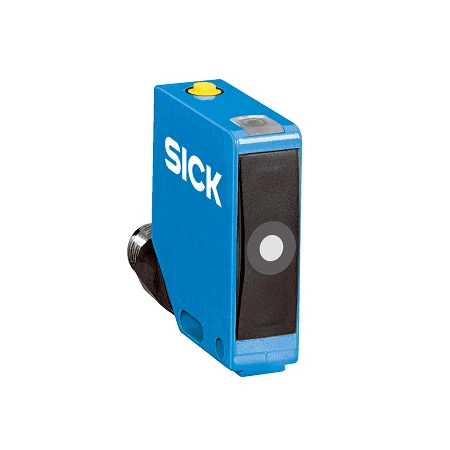
SICK 6029834 UC12-12235 Complementary NPN Ultrasonic Sensor

USD 415.74

UC12-12235 provides 55–250 mm ultrasonic operation, complementary NPN outputs, teachable switching modes, temperature compensation and IP65/IP67 protection.

SKU SICK-6029834 Category

Out of stock

Ultrasonic Distance Sensors - SICK UC12

SICK UC12-12235 Complementary NPN Ultrasonic Sensor

BrandSICK
Model IdentifierUC12-12235
Official Part Number6029834

Technical Overview

The SICK UC12-12235 detects natural objects using ultrasonic echoes within a 55–250 mm operating range. Its 350 mm limiting range is distinct from the operating range,and detection depends on target reflection,size and alignment. Two complementary NPN outputs provide opposite switching states for a taught distance condition. Distance-to-object,window and background modes adapt evaluation through a local teach button that can be deactivated. The sensor specifies30 ms response,25 Hz switching and8 ms output time. Internal temperature compensation reaches its optimum after30 minutes of operation. A rectangular zinc-diecast housing,green/orange status indication,M12 four-pin male connector and IP65/IP67 protection support installation on machinery.

55–250 mm ultrasonic sensor with complementary NPN outputs,local teach-in,temperature compensation and M12 four-pin connection.

Key Features

  • 55–250 mm operating range;350 mm limiting range
  • Two complementary NPN outputs(Q/invertedQ);maximum output current≤500 mA
  • Distance-to-object,window and background switching modes
  • Local teach-in button;button deactivation and factory reset
  • 30 ms response;25 Hz switching;8 ms output time
  • Typical500 kHz ultrasonic frequency;target-dependent detection area
  • Internal temperature compensation;optimum after30 minutes
  • 10–30 V DC;≤1.2 W without load;initialization<300 ms
  • M12 four-pin male connector;M4 mounting thread,4 mm deep
  • IP65/IP67 zinc-diecast housing;−25 to+70 °C operation

Teach a distance-based detection condition and provide complementary switching states to external machine control.

Technical Specification Matrix

ParameterValue
Functional principleUltrasonic object/distance detection
TargetNatural objects
Operating range55–250 mm
Limiting range350 mm;distinct from operating range
Detection areaDepends on reflection,size and alignment;reference diagrams use aligned10 ×10 mm plate andØ10 mm cylindrical bar
Resolution≥0.1 mm
Repeatability±0.15% of current measured value;minimum value≥resolution
Measurement accuracy±1% of current measured value
Temperature compensationInternal;optimum operating point after30 min for this non-E variant
Response time30 ms
Switching frequency25 Hz
Output time8 ms
Ultrasonic frequencyTypical500 kHz;acoustic frequency
Digital outputs2 ×NPN,complementary Q/invertedQ;maximum output current≤500 mA
Switching modesDistance to object(DtO),window(Wnd),object between sensor and background(ObSB)
Teach-inLocal teach button;can be deactivated;factory reset available
Hysteresis2 mm
Power supply10–30 V DC;limit values;reverse-polarity protected
Supply network requirementShort-circuit protected network,max8 A
Power consumption≤1.2 W without load
Initialization time<300 ms
Status indicationGreen:device ready;orange:digital output active
ConnectionM12 four-pin male connector
Pin assignment1BN=L+;3BU=M/0 V;4BK=Q/invertedQ;2WH=invertedQ/Q;complementary pair
MountingM4 threaded hole,4 mm deep;Ø4.2 mm fixing hole
Sending axisStraight
Housing materialZinc diecast
Transducer materialsPolyurethane foam and glass epoxy resin
IP ratingIP65/IP67
Protection classIII
Operating temperature−25 to+70 °C
Storage temperature−40 to+85 °C
MTTFD101 years
DCavg0%
Physical Weight (kg)0.075

Industrial Applications

1. Checking a fixture surface at a taught distance

A fixture can present a sufficiently reflecting part surface within the 55–250 mm operating range and teach the selected switching point with the local button. The complementary NPN signals supply opposite states to external inspection control for that condition. Actual part size and alignment are checked,and the30 ms response and temperature-compensation settling are considered before setting the process tolerance.

Problem Solved

A taught surface-distance condition lets external inspection control distinguish the expected part position from a displaced surface,adding a repeatable positional check to the fixture sequence.

Fixture reference Teach button Complementary states

2. Accepting a load within a distance window

A handling station can teach a window around an expected load-face position within 55–250 mm. External sequence control evaluates the configured output state to determine whether the target satisfies that window condition. Target reflection,size and angle are validated against the detection characteristics,and the local teach button can be deactivated after setup to retain the selected configuration.

Problem Solved

A taught distance window gives external control a defined acceptance region for the load face,helping identify a load positioned too near or too far before a handling action.

Load window Configuration retention Ultrasonic sensing

3. Detecting material in front of a taught background

A small material-handling station can teach a stable reflecting background and present the actual material between it and the sensor. Background mode evaluates the configured echo condition,and the complementary outputs report opposite states to external control. Background distance,target geometry and the selected operating range are checked on the actual material before the machine uses the result.

Problem Solved

A background-based condition helps external sequence control distinguish material occupying the taught space from the background alone,providing a useful process check where simple optical intensity contrast is limited.

Background reference Material presence Complementary outputs

Select your currency