Technical Overview
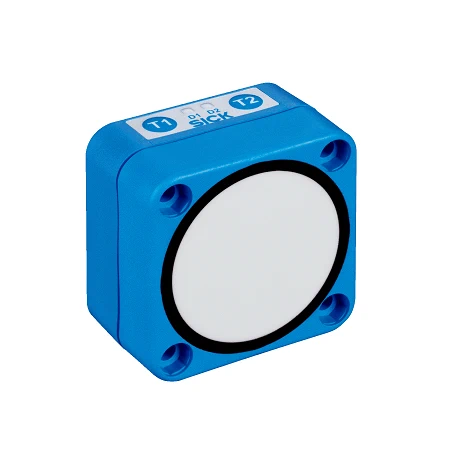
The SICK UC30-215162 is an ultrasonic distance sensor with a 600–6,000 mm operating range and two PNP switching outputs. Its 8,000 mm limiting range is distinct from the operating range, and detection depends on target reflection, size and alignment. Teachable switching-point, switching-window and background modes adapt the output condition to the installation. Temperature compensation, adjustable measurement filters and sensitivity support setup, while synchronization or multiplexing coordinates up to 50 sensors. The sensor specifies 240 ms response, 3 Hz switching and 60 ms output time. A rectangular PBT/PET housing, straight sending axis, M12 five-pin male connector and IP65/IP67 protection support installation on machinery.
600–6,000 mm ultrasonic distance sensor with two PNP outputs, teachable switching modes, temperature compensation, synchronization and M12 5-pin connection.
Key Features
- 600–6,000 mm operating range;8,000 mm limiting range
- Two PNP digital outputs;maximum output current≤200 mA
- Switching-point,window and background modes with teach-in
- 240 ms response;3 Hz switching;60 ms output time
- Temperature compensation;±1% accuracy relative to current measurement
- Adjustable measurement filters,sensitivity and sound beam
- Synchronization or multiplexing for up to50 sensors
- 9–30 V DC;≤1.2 W without load;initialization<450 ms
- M12 five-pin male connector;two LED indicators
- IP65/IP67 PBT/PET housing;−25 to+70 °C operation
Set distance-based switching conditions for external control using ultrasonic echoes, with target-dependent detection and coordinated operation for multiple sensors.
Technical Specification Matrix
| Parameter | Value |
|---|
| Functional principle | Ultrasonic distance sensing |
| Operating range | 600–6,000 mm |
| Limiting range | 8,000 mm;distinct from operating range |
| Detection area | Target dependent;affected by reflection properties,size and alignment;manufacturer diagrams use aligned500 ×500 mm plate andØ27 mm pipe |
| Resolution | ≥0.18 mm |
| Repeatability | ±0.15% of current measured value;minimum value≥resolution |
| Measurement accuracy | ±1% of current measured value |
| Temperature compensation | Available;can be switched off;without compensation0.17%/K |
| Response time | 240 ms |
| Switching frequency | 3 Hz |
| Output time | 60 ms |
| Ultrasonic frequency | Typical80 kHz;acoustic frequency |
| Switching modes | Switching point(DtO),switching window,background(ObSB) |
| Adjustment functions | Teach digital output,set output levels,invert output,set ON-delay,reset to factory defaults |
| Measurement filters | Adjustable measured-value filter/filter strength,foreground suppression,detection area,sensitivity and sound beam |
| Synchronization | Up to50 sensors |
| Multiplexing | Up to50 sensors for operation without cross talk in multiplex mode |
| Digital outputs | 2 ×PNP;maximum output current≤200 mA |
| Multifunctional input | 1 ×MF |
| Hysteresis | 100 mm |
| Power supply | 9–30 V DC;limit values;reverse-polarity protected |
| Supply network requirement | Short-circuit protected network,max8 A,Class2 |
| Power consumption | ≤1.2 W without load |
| Initialization time | <450 ms |
| Indicators | 2 ×LED |
| IP rating | IP65/IP67 |
| Protection class | III |
| Connection | M12 five-pin male connector |
| Pin assignment | 1BN=L+;3BU=M;2WH=Q1/invertedQ1;4BK=Q2/invertedQ2;5GY=synchronization/multiplex and Connect+ communication |
| Sending axis | Straight |
| Housing material | PBT/PET plastic |
| Transducer materials | Polyurethane foam and glass epoxy resin |
| Operating temperature | −25 to+70 °C |
| Storage temperature | −40 to+85 °C |
| MTTFD | 101 years |
| DCavg | 0% |
| Physical Weight (kg) | 0.24 |
Industrial Applications
1. Setting a container fill-level threshold
A level station can mount the sensor above a container and teach switching conditions for a sufficiently reflecting material surface within600–6,000 mm. The controller receives the selected digital output when the taught distance condition changes. Actual surface alignment and echo behavior are checked, and the240 ms response is considered when matching the installation to the filling process.
Problem Solved
Distance-based level switching gives external control a repeatable process condition for filling or replenishment, reducing reliance on a fixed visual estimate of the material surface position.
Level threshold
Teach-in
Ultrasonic echo
2. Checking whether a load is in a distance window
A handling station can define a switching window for an adequately reflecting load face positioned inside the operating range. The sensor is aligned to obtain a reliable echo, and external control interprets its selected output as the configured window condition. Target size and angle are verified against the detection characteristics before using that signal in the machine sequence.
Problem Solved
A taught distance window distinguishes a load in the expected position from one outside the allowed zone, providing more positional information than a simple far-range presence threshold.
Load position
Switching window
Target alignment
3. Coordinating nearby ultrasonic inspection points
A machine can use several compatible ultrasonic sensors at neighboring inspection positions and configure synchronization or multiplexing according to the required echo separation. This model supports groups of up to50 sensors, with the multifunction connection providing the coordinated mode. Each target is validated within its operating range, and external control uses the individual switching results for the machine sequence.
Problem Solved
Coordinating acoustic measurements addresses interference between nearby inspection points, helping external control interpret each station result without treating echoes from another sensor as the intended target return.
Synchronization
Multiplexing
Multiple stations