1. Registering the label feed before dispensing
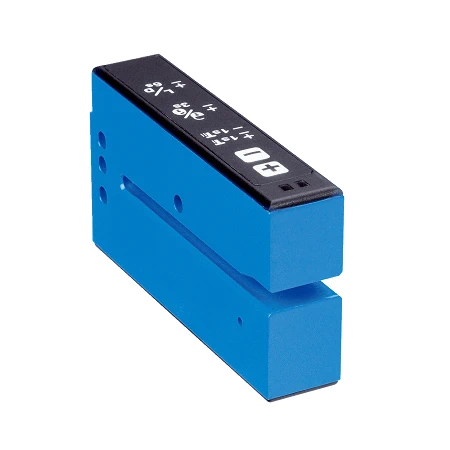
A label applicator can pass its carrier web through the fork and use the label-to-gap transition as a feed reference before the peel point. Teaching learns the carrier and label condition for that stock. The 3 mm opening, 69 mm fork depth and material-dependent 2 mm minimum label/gap specification define the mechanical and target limits.
Problem Solved
A detected label edge gives the feed controller a reference for stopping and advancing the web, helping align each dispensing cycle with the next label on its carrier.
Label-feed registration
3 mm opening
PNP
2. Counting labels during a roll transfer
A roll-transfer machine can use one qualified PNP transition per label as an input to its external counter while the web passes through the fork. Teaching distinguishes the label from the exposed carrier. The typical 1.5 kHz switching frequency depends on material and speed, and the controller evaluates the actual label pitch before selecting its operating speed.
Problem Solved
Counting qualified label transitions gives the roll-transfer controller a quantity reference for batch completion and inventory reconciliation, avoiding manual counting of labels already wound onto the destination roll.
Roll quantity
Typical 1.5 kHz
PNP counter input
3. Detecting tear-off perforations in garbage-bag production
SICK documents this exact model detecting tear-off perforations in black, yellow and blue garbage bags. The tested setup guided the film and aligned the sensor at the perforated line, with particular attention to the drawstring region on folded bags. Teaching established the material distinction; fine sensitivity adjustment was available for the tested films.
Problem Solved
Detecting the tested perforated section gives the converting machine a tear-off reference despite different bag colors and drawstring features, provided the material is guided and positioned as in the documented setup.
Ultrasonic sensing
Perforation reference
Plus/minus adjustment