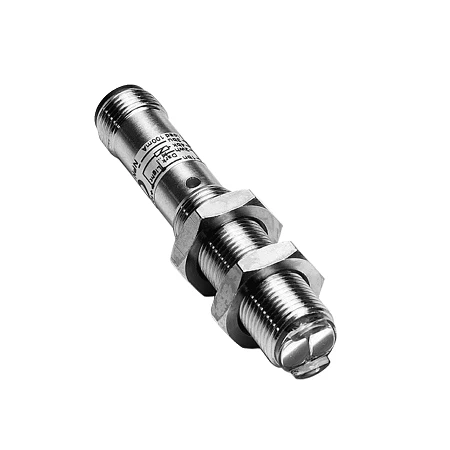
SICK 6026220 PNP Retro-reflective Photoelectric Sensor

USD 108.42

VL12-2P430 offers 0.03–2.3 m PL80A sensing, polarized 660 nm LED optics, selectable PNP light/dark switching and M12 connection in an IP67 housing.

SKU SICK-6026220 Category
SICK V12-2

SICK VL12-2P430 Retro-reflective Photoelectric Sensor

BrandSICK
Model IdentifierVL12-2P430
Official Part Number6026220

Technical Overview

The SICK VL12-2P430 is a cylindrical photoelectric retro-reflective sensor with a polarization filter and 660 nm visible red LED illumination. It detects interruptions of the reflected-light path across 0.03–2.3 m with a PL80A reflector, with 0.03–2.8 m maximum range. The light spot is 80 mm at 2 m. A PNP output uses the L/D control connection for light/dark selection, while no sensitivity adjustment is provided. Response is up to 1.25 ms under resistive load, with 400 Hz operation at a 1:1 light/dark ratio. Its M12 × 1 threaded nickel-plated brass/PA housing, PMMA optics, M12 four-pin connector and IP67 protection support mounting in machine assemblies.

Polarized retro-reflective sensor with 0.03–2.3 m PL80A sensing, selectable PNP light/dark switching and M12 four-pin connection.

Key Features

  • Polarized retro-reflective sensing with PL80A reflector
  • 0.03–2.3 m sensing; 0.03–2.8 m maximum range with PL80A
  • 660 nm visible red LED; Ø80 mm spot at 2 m
  • PNP output; light/dark selection through L/D connection
  • No sensitivity adjustment; maximum output current ≤100 mA
  • ≤1.25 ms response; 400 Hz switching under stated load and light/dark conditions
  • 10–30 V DC; 20 mA consumption without load
  • M12 four-pin male connector
  • M12 × 1 threaded nickel-plated brass/PA housing; PMMA optics
  • IP67 protection; −25 to +70 °C operation

Use polarized reflected-light detection and selectable PNP switching to monitor an opaque target across a PL80A reflector path.

Technical Specification Matrix

ParameterValue
Functional principlePhotoelectric retro-reflective sensor
Sensing range0.03–2.3 m with PL80A reflector
Maximum sensing range0.03–2.8 m with PL80A reflector
Light sourceVisible red LED
Wavelength660 nm
Light spot sizeØ80 mm at 2 m
Angle of dispersionApprox. 2.3°
LED service lifeAverage 100,000 h at +25 °C
AdjustmentNone
Digital outputPNP switching output; maximum current ≤100 mA
Switching modeLight/dark switching, selectable via L/D control connection
Response time≤1.25 ms signal transit time with resistive load
Switching frequency400 Hz at 1:1 light/dark ratio
Power supply10–30 V DC, limit values
Residual ripple±10%; remain within supply tolerances
Current consumption20 mA without load
Protection classIII
Circuit protectionA: supply reverse-polarity protection; B: inputs and output reverse-polarity protection; C: interference suppression; D: outputs overcurrent and short-circuit protection
Housing designCylindrical, M12 × 1 threaded housing
Housing materialNickel-plated brass / PA
Optics materialPMMA plastic
ConnectionMale M12 four-pin connector
Pin assignment1 BN=L+; 2 WH=L/D; 3 BU=M; 4 BK=Q (CD-087)
IP ratingIP67
Operating temperature−25 to +70 °C
Storage temperature−25 to +70 °C
Polarization filterYes
MTTFD1,139 years
DCavg0%
Physical Weight (kg)0.018
Yellow LED indicatorContinuous: reception signal above reserve factor 2; blinking: below reserve factor 2 but above switching threshold 1

Industrial Applications

1. Counting separated opaque packages on a conveyor

A conveyor can place the sensor and a PL80A reflector across the package path within the 0.03–2.3 m sensing range. Each separated opaque package interrupts the reflected-light path. External counting logic evaluates the PNP output using the selected light/dark configuration, with package spacing and transit speed checked against the response and switching-frequency limits.

Problem Solved

A package-passage reference helps external counting logic register separated opaque packages from a sensor mounted on one side of the conveyor, with a reflector opposite the detection point.

Opaque packages PL80A reflector External counting

2. Confirming a carrier at a transfer stop

A transfer stop can align the sensor and PL80A reflector across an opaque carrier feature at its seated position. The polarized retro-reflective path supplies a discrete occupied or clear condition, with light/dark mode selected through the L/D connection. External transfer control samples that state after actual carrier geometry and seated tolerance have been verified during setup.

Problem Solved

A carrier-arrival reference helps external transfer control coordinate a staged handoff by recognizing when the carrier interrupts a defined reflected-light path at the stop.

Carrier arrival Transfer stop Selectable switching

3. Monitoring an opaque strip edge at a guide

A strip guide can position the sensor and PL80A reflector across a defined lateral edge location. An opaque strip normally blocks the reflected-light path, and movement that uncovers it changes the PNP output. External process control uses the state as a discrete edge-presence reference, with the actual strip opacity, flutter and optical alignment checked during installation.

Problem Solved

A discrete strip-edge reference helps external process control recognize an uncovered guide location using reflected-light interruption, without relying on light returned from the moving strip surface.

Opaque strip Edge presence Reflected-light path

Select your currency