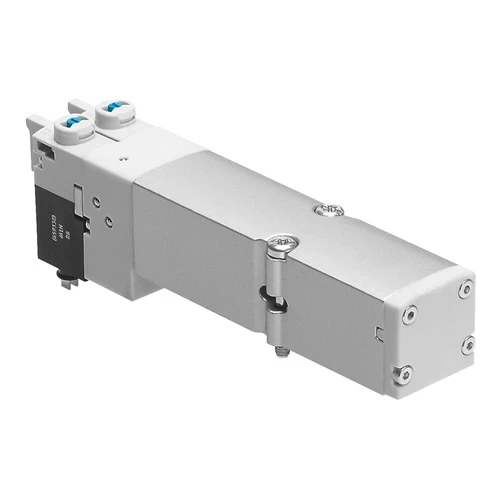
1. Fixture Clamp and Ejector Sequencing
An assembly fixture uses separate single-acting clamp and ejector circuits at different points in its cycle. The dual normally closed 3/2-way functions provide two pneumatic switching paths in one 20 mm body, with mechanical spring reset. Festo lists 500 l/min for MPA-S/QS-8 and 480 l/min for MPA-L/QS-10 arrangements, distinguishing the selected station configuration.
Problem Solved
Two monostable switching functions consolidate the clamp and ejector air commands in one valve, supporting separate fixture steps while retaining arrangement-specific flow data for the pneumatic station.
2 × 3/2 normally closed
Mechanical spring reset
20 mm valve
2. Vacuum-Circuit Path Switching
A handling circuit needs a directional valve whose working paths can operate below atmospheric pressure. This model is explicitly suitable for vacuum and permits working pressure down to −0.9 bar with reversible flow. A separate 3–8 bar pilot requirement supplies the actuation condition while the working circuit follows the selected vacuum and venting connections.
Problem Solved
Documented vacuum suitability permits switching of sub-atmospheric working paths, while the separate pilot-pressure range defines the positive-pressure actuation needed for that vacuum circuit arrangement.
Vacuum suitability
−0.9 bar
3–8 bar pilot
3. Valve-Station Commissioning
During assembly of a pneumatic valve station, technicians need to exercise routing states and correlate electrical commands with the installed valve. The detenting and non-detenting manual override provides local actuation, while signal indication makes the commanded condition visible. The 20 mm valve uses through-hole mounting with a specified 0.65 Nm maximum valve-mounting torque for installation.
Problem Solved
Manual actuation and visible signal indication support local routing checks during commissioning, helping technicians relate the electrical command to the selected pneumatic path at the valve station.
Manual override
Signal indication
20 mm