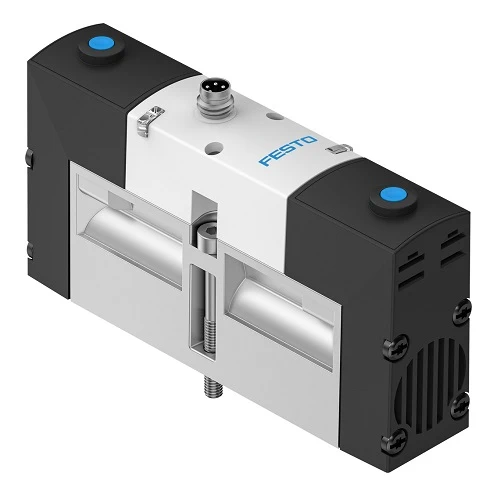
1. Transfer Cylinder with a Vented Neutral Circuit State
A machine moves a suitable double-acting cylinder in two directions and requires a valve neutral state that connects the working circuit to exhaust. The 5/3 exhausted-centre function supplies those three routing states, with mechanical spring reset to centre. Its ISO 15407-1 sub-base interface and 1000 l/min interlinked nominal flow characterize the valve within the documented 26 mm station arrangement.
Problem Solved
The exhausted centre supplies a distinct vented routing state between directional commands, supporting a cylinder circuit that requires working-line exhaust rather than closed valve paths in neutral.
5/3 exhausted centre
ISO 15407-1
1000 l/min
2. Gripper Circuit with a Vented Neutral State
A handling machine needs open, close and vented neutral valve commands for a suitable double-acting pneumatic gripper circuit. The exhausted-centre function provides the third routing state, while internal piloting operates within the 3–8 bar working range. A four-pin M8 central plug supplies electrical commands, and holding-current reduction characterizes the coil drive when a working command remains applied.
Problem Solved
Three directional routing states support the gripper sequence, while the central electrical connection and holding-current reduction define the valve interface for maintaining a commanded working state.
Vented neutral
Internal pilot
Holding-current reduction
3. Reversible Pneumatic Motor Routing
A machine uses a suitable reversible pneumatic motor and needs forward, reverse and vented neutral routing commands. This valve supplies those states through its ISO 15407-1 interface, with a four-pin M8 central electrical plug. Specified 20 ms on and 52 ms off times characterize the valve component, while motor run-down and stopping behavior remain properties of the complete drive and load.
Problem Solved
One electrically commanded valve provides forward, reverse and vented neutral air routing, with documented component switching times for evaluating its place in the pneumatic motor command sequence.
Forward/reverse/vented neutral
20 ms on
52 ms off