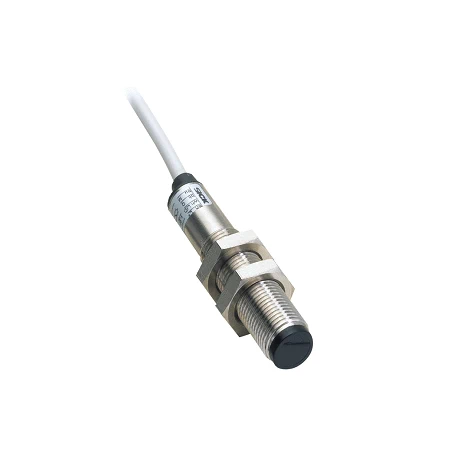
1. Counting separated tabs at a component guide
A component guide can present separated tabs within the 2–300 mm white-target sensing range. Energetic optics evaluate light reflected from each tab, while local or electronic teaching establishes the working sensitivity. External counting logic evaluates the PNP output using the selected light/dark mode. Setup checks actual tab reflectance, spacing and transit speed against the optical response and switching limits.
Problem Solved
A tab-passage reference helps external counting logic register separated features from one mounting side, with teaching available to establish detection for the presented target condition.
Tab counting
Sensitivity teaching
Reflected-light sensing
2. Checking an insert in an assembly nest
An assembly nest can present a small insert at a repeatable distance facing the sensor. Button or electronic teaching establishes a reflected-light condition using representative assemblies. External inspection logic samples the switching output when the assembly is stationary. Actual insert material, background and placement tolerance are checked because energetic detection depends on the returned light level.
Problem Solved
An insert-present reference helps external inspection logic identify an empty assembly location before the next operation, using a taught reflected-light condition at a repeatable nest position.
Insert presence
Assembly nest
Electronic teaching
3. Confirming a carrier against a transfer stop
A transfer stop can bring a defined carrier surface into the sensor’s working distance. Energetic sensing and the taught sensitivity provide a discrete arrival condition, while control input C selects the required light/dark output behavior. External transfer logic samples the state after setup verifies actual carrier reflectance and seated gap, using the shorter gray-target ranges where relevant.
Problem Solved
A seated-carrier reference helps external transfer logic coordinate release at a compact stop, using light returned from a nearby surface and keeping the optical components on one mounting side.
Carrier arrival
Transfer stop
Selectable switching