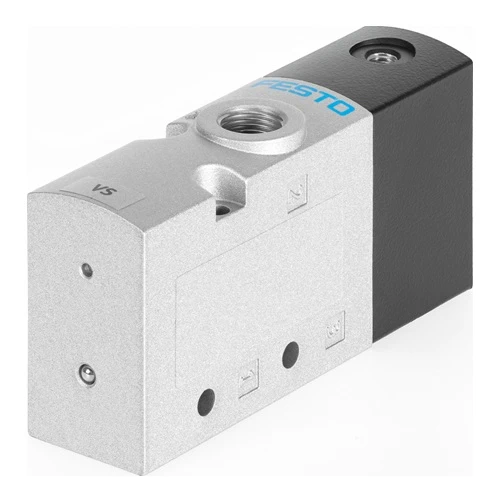
1. Air-Signal Operation of a Single-Acting Fixture
An assembly fixture uses an air signal to operate a single-acting clamp cylinder. The normally closed 3/2-way valve switches the working connection between supply and exhaust, while mechanical spring return provides the monostable valve state. G1/4 ports and the 1000 l/min nominal flow characterize the working circuit, and M5 pilot port 12 receives the pneumatic command.
Problem Solved
Pneumatic actuation converts an air command into supply-and-exhaust switching for the fixture, while mechanical spring return restores the valve’s monostable state when the command is removed.
Pneumatic command
3/2-way NC
Mechanical spring return
2. Pneumatically Triggered Air Blast
A packaging machine needs an air blast triggered by an existing pneumatic sequence signal. This valve’s normally closed 3/2-way function commands the air branch through G1/4 ports, with no electrical coil required at the switching point. Published 10 ms switch-on and 43 ms switch-off times provide component timing information alongside the response of the connected tubing and nozzle.
Problem Solved
The pneumatic command directly controls the blast-air branch, and the normally closed monostable function supplies a repeatable switching arrangement for the machine’s air-signal sequence.
1000 l/min nominal
10 ms on
43 ms off
3. Pneumatic Command Distribution in a Manifold
A machine uses an air-signal control circuit to command a downstream pneumatic function. The valve converts the signal at M5 pilot port 12 into a G1/4 working-air connection state. Manifold-rail mounting groups the valve with other pneumatic controls, while its mechanical spring return and reversible flow define the individual switching function within the assembled circuit.
Problem Solved
A pneumatically actuated valve links the command circuit to a working-air branch in the manifold, consolidating signal-to-flow switching without adding an electrical interface at that valve.
M5 pilot port
Manifold-rail mounting
G1/4 working ports