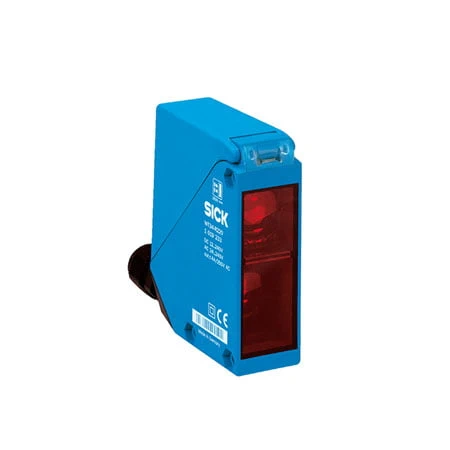
SICK 1019240 WT34-R250 Relay Background-Suppression Sensor

USD 282.62

WT34-R250 offers visible red background suppression, an isolated change-over relay, adjustable on/off delay, 10 Hz switching and an IP67 housing.

SKU SICK-1019240 Category
SICK W34

SICK WT34-R250 Relay Background-Suppression Sensor

BrandSICK
Model IdentifierWT34-R250
Official Part Number1019240

Technical Overview

The SICK WT34-R250 is a photoelectric proximity sensor with background suppression and an electrically isolated change-over relay. It evaluates visible red light reflected from a target while limiting responses from more distant backgrounds. The specified sensing range is 100–1,200 mm, with the maximum range referenced to a white target having 90% remission. The LED forms a 40 mm at 1,200 mm spot, and a potentiometer adjusts detection. Adjustable on-delay and off-delay functions provide 0.5–10 s timing. A light/dark selector, response of no more than 10 ms, 10 Hz switching, M16-gland terminal connection and IP67 ABS housing support machine integration.

Relay background-suppression sensor with 100–1,200 mm sensing, visible red LED, light/dark selector, adjustable 0.5–10 s delay and IP67 housing.

Key Features

  • Photoelectric proximity sensing with background suppression
  • 100–1,200 mm sensing; maximum on 90% remission white reference
  • Visible red LED; Ø 40 mm at 1,200 mm
  • Sensitivity potentiometer
  • Electrically isolated change-over relay
  • Light/dark switching selected via selector
  • Response ≤10 ms; 10 Hz switching
  • Adjustable on-delay/off-delay functions, 0.5–10 s
  • Terminal connection with M16 gland
  • IP67 ABS housing; −40 to +60 °C operation

Combine background-suppressed object detection with an isolated change-over relay and adjustable on/off delay to shape the machine signal.

Technical Specification Matrix

ParameterValue
Functional principlePhotoelectric proximity sensor with background suppression
Sensing range100–1,200 mm
Maximum sensing range100–1,200 mm on 90% remission white target (DIN 5033)
Light sourceLED, visible red light
Light spot sizeØ 40 mm at 1,200 mm
AdjustmentPotentiometer
Power supply20–250 V AC/DC
Power consumption<2 VA
Switching outputElectrically isolated relay, change-over contacts
Switching modeLight switching or dark switching; selectable via light/dark selector
Relay switching ratings4 A at 250 V AC; 4 A at 24 V DC; 0.125 A at 250 V DC
UL relay ratings250 V AC: 4 A general use, 4 A resistive NO, 3 A resistive NC; 24 V DC: 4 A NO general use, 3 A NC general use; R300/B300 for NO contacts only
Load suppressionSuitable spark suppression required for inductive or capacitive loads
Response time≤10 ms
Switching frequency10 Hz at light/dark ratio 1:1
ConnectionTerminal connection with M16 gland
Circuit protectionSupply reverse-polarity protection and interference suppression
Protection classII; rated voltage 250 V AC/DC
Housing formRectangular
Housing materialABS plastic
IP ratingIP67
Usage categoryAC-15, DC-13 according to EN 60947-1
Operating temperature−40 to +60 °C
Storage temperature−40 to +75 °C
UL fileNRKH.E181493 and NRKH7.E181493
MTTFD487 years
Diagnostic coverage DCavg0%
Mission time20 years
Wavelength660 nm
Time functionsSwitch-on delay and off delay, adjustable
Delay time0.5–10 s, adjustable via time-delay selector
B10D59,123 switching cycles; total MTTFD calculation must include switching cycles and the stated MTTFD for electromechanical devices
Dimensions L x W x H (cm)7 x 2.7 x 9.2
Physical Weight (kg)0.14

Industrial Applications

1. Monitoring sustained load accumulation

A conveyor transfer can direct the sensor toward opaque loads waiting at a discharge point. Background suppression limits responses from more distant structures, while the adjustable on-delay distinguishes sustained occupancy from a brief passage. The isolated change-over relay provides the resulting signal to compatible machine controls, with light or dark switching selected locally.

Problem Solved

A timed occupancy signal helps the controller identify loads remaining at the transfer position, supporting upstream feed coordination when downstream handling pauses during normal production.

On delay 0.5–10 s Isolated relay

2. Counting separated loads on a conveyor

A conveyor can position the sensor so each separated opaque load passes nearer than the background belt or frame. The 40 mm at 1,200 mm light spot defines the monitored region, while background suppression helps distinguish the raised load from the farther surface. The 10 Hz switching frequency supports repeated transitions within the specified timing limits.

Problem Solved

Optical switching events identify separated load passages without contact, providing a count input while background rejection helps limit unwanted events from the surface behind the loads.

Background suppression 10 Hz Separated loads

3. Confirming a tray at a pickup point

A handling station can direct the sensor toward the expected edge of a seated opaque tray. Background suppression limits responses from farther surfaces when the tray is absent, and the adjustable sensing condition establishes the local monitoring point. A response of no more than 10 ms and the switching output supply the controller with the occupancy transition.

Problem Solved

A local tray-position signal helps the controller coordinate the handling sequence and distinguish an occupied pickup location from an empty station without a contact switch at the moving edge.

Background suppression Tray position Contactless sensing

Select your currency