1. Counting small opaque components
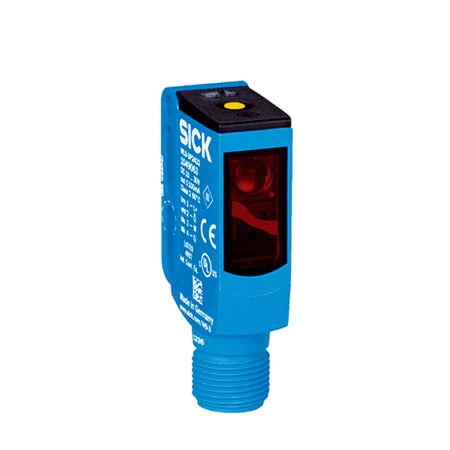
A feeder can position a sensor and reflector across a short transfer path so each separated opaque component crosses the focused optical spot. The 2 mm spot at 35 mm defines a local detection point, and the single teach-in button sets the sensing condition. Complementary PNP outputs report the light and dark states to the machine counter.
Problem Solved
A small optical spot helps isolate individual component passages, providing discrete count events without mechanically touching the parts moving through the monitored position.
Focused optics
Ø 2 mm at 35 mm
PNP
2. Monitoring accumulation at a transfer point
At a conveyor transfer, a load that remains between the sensor and reflector holds the received-light signal in the blocked state. The machine controller can use this duration to identify sustained occupancy and regulate upstream release. Complementary PNP outputs provide light and dark switching signals, while the M12 4-pin connector connects the sensor to local machine wiring.
Problem Solved
A sustained beam blockage identifies a transfer position that remains occupied, helping the controller coordinate upstream feeding before additional loads enter the same constrained space.
Complementary PNP
M12 4-pin connector
Beam interruption
3. Checking opaque sheet continuity
An opaque sheet feeder can direct the returned beam through the expected material path. The sensor detects whether the material continues to block that path, and an opening caused by runout or a break changes its switching state. IP67 protection suits exposed machine mounting, while the visible red beam assists positioning during initial setup.
Problem Solved
A change in the received-light state gives the controller an electrical indication of missing material at the monitoring position, supporting an orderly response to interrupted feed.
IP67
Visible red light
Material continuity