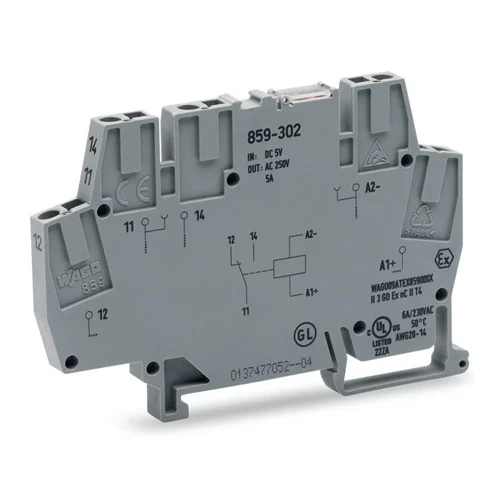
1. Industrial Automation Control Panel Signal Isolation
The WAGO 859-304 relay module is ideal for isolating control signals from sensitive electronics in industrial automation control panels. Its 24 VDC nominal input voltage reliably interfaces with PLCs, while the SPDT contact switches up to 250 VAC at 5 A, providing effective signal isolation and power amplification for different voltage levels. Its compact 6mm width optimizes space in crowded cabinets.
Problem SolvedProtects sensitive PLC outputs from inductive loads or higher voltages in industrial settings, allowing low-power control signals to switch higher-power loads while saving critical space in control cabinets.
Signal IsolationPLC InterfaceLoad SwitchingVoltage ConversionDIN Rail MountingCompact Design
2. Motor Starter Circuit Interface
This relay module serves as a reliable interface between low-voltage control circuits (e.g., 24 VDC from emergency stop buttons or control switches) and the coils of larger motor starters or contactors. The 5A contact rating is sufficient for energizing most standard contactor coils, ensuring dependable operation in motor control centers.
Problem SolvedEnables safe and dependable control of motor starters from low-voltage safety or control circuits, providing essential electrical separation and facilitating localized control without the need for long runs of high-current wiring.
Motor ControlContactor CoilLow-Voltage ControlPower InterfaceSafety CircuitElectrical Separation
3. Building Automation HVAC System Control
In building automation systems, particularly for HVAC control, the 859-304 effectively switches auxiliary loads such as small fans, damper actuators, or indicator lights. Its 24 VDC coil is compatible with standard building control voltages, and the 5A/250VAC contact is well-suited for various loads within air handling units or zone control panels. The broad operating temperature range of -40 to +50 °C ensures robust performance across diverse environmental conditions.
Problem SolvedProvides reliable switching for auxiliary HVAC components, allowing seamless integration with central building management systems while ensuring robust operation in varying environmental conditions, all within a space-efficient form factor.
HVAC ControlBuilding AutomationAuxiliary Load SwitchingEnvironmental ResilienceSpace SavingZone Control