Technical Overview
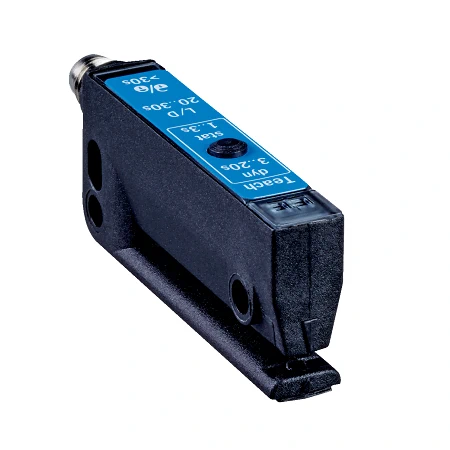
The SICK WFS3-40B41CA70 is an infrared optical fork sensor for label and carrier-gap detection with a push-pull PNP/NPN switching output and IO-Link V1.1. Its 3 mm fork opening and 42 mm fork depth support installation around a guided label web. The minimum label size and gap are 2 mm, depending on label thickness. One-point, two-point or dynamic teaching adapts the threshold, while IO-Link provides two switching signals, measurement and teaching feedback. This version includes time measurement + debouncing. The sensor combines 15 kHz switching, response no greater than 46 µs, an M8 four-pin male connector and an IP65 glass-fiber-reinforced PA housing for machine integration.
Infrared label fork sensor with 3 mm opening, 42 mm depth, IO-Link and time measurement + debouncing, 15 kHz switching and M8 four-pin male connector.
Key Features
- Infrared LED optical label and carrier-gap detection
- 3 mm fork opening and 42 mm fork depth
- Minimum label size/gap 2 mm, depending on label thickness
- One-point, two-point and dynamic teach-in
- IO-Link V1.1; 2.3 ms cycle time
- Smart Task: Time measurement + debouncing
- 15 kHz switching; response ≤46 µs and ±20 µs response-time stability
- M8 four-pin male connector
- Selectable IO-Link off-delay settings from 0 to 520 ms
- IP65 glass-fiber-reinforced PA housing; −20 to +60 °C operation
Teach separate label and web-presence thresholds, then use IO-Link switching and measurement data to combine feed detection with web-break monitoring.
Technical Specification Matrix
| Parameter | Value |
|---|
| Functional principle | Optical label and carrier-gap detection |
| Light source | LED, infrared light |
| Label detection | Yes |
| Fork opening | 3 mm |
| Fork depth | 42 mm |
| Minimum detectable object | Label gap / label size: 2 mm, depending on label thickness |
| Adjustment | Teach-in button and cable; teaching, sensitivity, light/dark switching and key lock |
| Teach-in mode | One-point, two-point and dynamic teach-in |
| Indicators | Yellow switching-output/function LED; green function LED |
| Power supply | 10–30 V DC |
| Residual ripple | <10% |
| Current consumption | 20 mA without load |
| Initialization time | 40 ms |
| Switching frequency | 15 kHz |
| Response time | ≤46 µs |
| Response-time stability | ±20 µs |
| Jitter | 17 µs |
| Switching output | Push-pull PNP/NPN |
| Switching mode | Light/dark switching |
| Output current | 100 mA maximum |
| Teach input | Teach: 5 V<U<supply voltage; run: U<4 V |
| Protection class | III |
| Circuit protection | Supply reverse-polarity protection, output Q short-circuit protection and interference-pulse suppression |
| Connection | M8 four-pin male connector |
| Pin assignment | 1/BN: L+; 4/BK: Q1/C; 2/WH: multifunction; 3/BU: M |
| Housing material | Glass-fiber-reinforced PA |
| IP rating | IP65 |
| Operating temperature | −20 to +60 °C |
| Storage temperature | −30 to +80 °C |
| Ambient light immunity | ≤10,000 lx |
| Shock resistance | According to EN 60068-2-27 |
| MTTFD | 97 years |
| Diagnostic coverage DCavg | 0% |
| UL file | NRKH.E191603 |
| IO-Link | V1.1; cycle time 2.3 ms |
| Vendor ID | 26 |
| Device ID | HEX 8000AF; DEC 8388783 |
| Smart Task | Time measurement + debouncing |
| Output voltage | Push-pull HIGH: supply voltage minus a drop <2 V; LOW ≤2 V |
| Time delay | IO-Link adjustable switch-off delay: 0 / 8 / 16 / 32 / 65 / 130 / 260 / 520 ms; default 0 ms |
| Second threshold | Teach Q1 for label versus carrier and Q2 for carrier versus empty fork; read Q1/Q2 in IO-Link or configure pin 2 for Q2 |
| Process data layouts A/B | A: bits 0/1 QL1/QL2; B: bit 0 QL1, bit 1 Quality of Run Alarm; both bit 2 unused, bit 3 teach busy, bits 4–15 empty |
| Process data layouts C/D | C: bits 0/1 QL1/QL2; D: bit 0 QL1, bit 1 Quality of Run Alarm; both bit 2 unused, bit 3 teach busy, bits 4–5 empty, bits 6–15 measuring value |
| Process data layout E | Bits 0/1: AFC Q1/Q2 outputs; bits 2–15: time measurement value |
| Dynamic teach procedure | Hold teach button 3–20 s while moving at least three label/carrier repeats; yellow flashes at 3 Hz |
| Fine adjustment | Press/release button within 10 s after teaching to move threshold toward taught object |
| Key lock | Hold teach button >30 s to lock or unlock |
| Dimensions L x W x H (cm) | 6.43 x 1 x 2.5 |
Industrial Applications
1. Registering a label feed at the dispenser
A label applicator can guide its web through the 3 mm fork opening near the dispensing point and use each label-to-carrier transition as a feed reference. Teaching sets the optical threshold for the selected label stock. The 42 mm fork depth and thickness-dependent 2 mm minimum label/gap specification define the mechanical and material limits for this installation.
Problem Solved
A qualified label transition supplies a feed-position reference to the machine controller, helping align each dispensing cycle with the next label while the web remains mechanically guided.
Label registration
3 mm opening
15 kHz
2. Detecting a carrier-web break
A labeling machine can teach Q1 to distinguish label from carrier and Q2 to distinguish carrier material from an empty fork. SICK documents this two-threshold arrangement for IO-Link WFS sensors. The controller reads both signals in the process data, or configures pin 2 for Q2 while pin 4 reports Q1.
Problem Solved
The second threshold distinguishes missing carrier from a normal inter-label gap, giving the controller a separate web-break indication while label detection continues through the first threshold.
Two thresholds
Q1 / Q2
IO-Link
3. Monitoring a configured label-event duration
A converting machine can configure the sensor’s time-measurement Smart Task and read its time value through IO-Link process layout E. Label and carrier transitions provide the optical events for the configured measurement. The controller can compare the resulting value with its commissioned timing window while the debouncing function conditions the selected signal.
Problem Solved
A reported event-duration value gives the controller a timing reference for detecting changes in the commissioned label sequence, while configured debouncing helps suppress unwanted transitions in that signal.
Time measurement
Debouncing
Process layout E