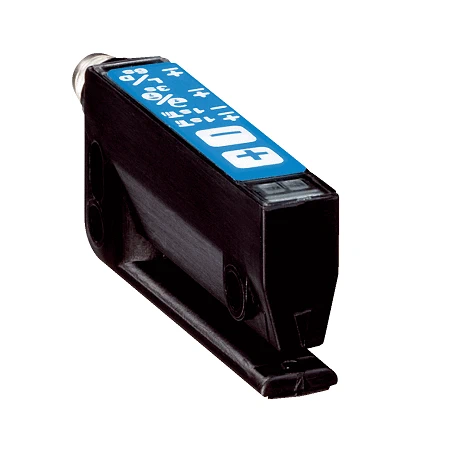
1. Registering a label feed at the dispenser
A label applicator can guide its web through the 3 mm fork opening near the dispensing point and use each label-to-carrier transition as a feed reference. Teaching sets the optical threshold for the selected label stock. The 42 mm fork depth and thickness-dependent 2 mm minimum label/gap specification define the mechanical and material limits for this installation.
Problem Solved
A qualified label transition supplies a feed-position reference to the machine controller, helping align each dispensing cycle with the next label while the web remains mechanically guided.
Label registration
3 mm opening
10 kHz
2. Counting labels during a roll transfer
A roll-transfer machine can route the web through the fork and count one qualified NPN transition per label with an external counter. Two-point or dynamic teaching sets detection for that label stock. The 10 kHz switching frequency, response no greater than 50 µs and minimum label/gap dimensions define the detection timing and target limits.
Problem Solved
Label-passage pulses give the external counter a quantity reference for batch completion and roll reconciliation, avoiding manual counting of labels already wound onto the destination roll.
External label count
NPN
10 kHz
3. Flagging an empty label position before application
An inspection station can compare NPN label events with expected pitch windows from the machine controller while the web passes through the optical fork. A missing taught label event in a scheduled window indicates an empty carrier position at that inspection point. Actual label thickness and optical contrast determine whether the stock meets the stated 2 mm label/gap limit.
Problem Solved
Comparing a scheduled label window with the detected event identifies a missing-label position before dispensing, allowing the external controller to mark or reject that cycle in the machine sequence.
Missing-label inspection
2-point / dynamic teach
≤50 µs