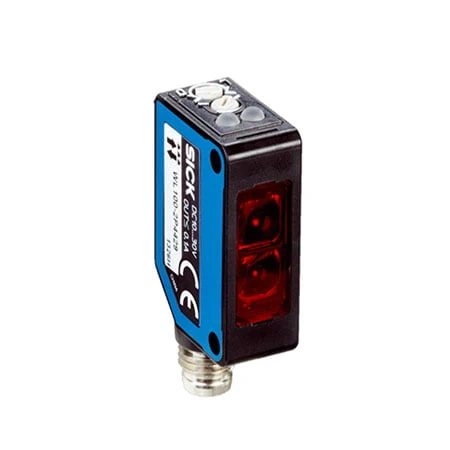
SICK 6052386 WL100-2P4429 PNP Transparent-Object Sensor

USD 111.02

WL100-2P4429 detects transparent targets with ≥20% beam attenuation, PNP output, 1,000 Hz switching, an M8 4-pin connector and supplied P250 reflector.

SKU SICK-6052386 Category
SICK W100-2

SICK WL100-2P4429 PNP Transparent-Object Sensor

BrandSICK
Model IdentifierWL100-2P4429
Official Part Number6052386

Technical Overview

The SICK WL100-2P4429 is a retro-reflective photoelectric sensor for transparent objects that attenuate the optical beam by at least 20%. A 632 nm visible red LED illuminates a reflector, and the receiver evaluates the returned light as the target enters the beam. A sensitivity potentiometer and selectable light/dark switching adapt the PNP signal to the machine. The specified 0.01–2.5 m sensing range and 3 m maximum range use a PL80A reflector; distance depends on reflector choice. A P250 reflector and BEF-W100-A bracket are supplied, alongside an M8 4-pin connector and IP67 housing for equipment integration.

PNP retro-reflective sensor for transparent targets with ≥20% beam attenuation, sensitivity adjustment, M8 4-pin connector and supplied reflector.

Key Features

  • Transparent-object detection with ≥20% beam attenuation
  • Dual-lens retro-reflective optical system
  • 0.01–2.5 m sensing range; 3 m maximum with PL80A reflector
  • 632 nm visible red LED; Ø 140 mm spot at 2 m
  • Sensitivity potentiometer
  • PNP output with selectable light/dark switching
  • Response ≤ 0.5 ms; 1,000 Hz switching frequency
  • 10–30 V DC supply and M8 4-pin connector
  • IP67 ABS/PC/POM housing
  • BEF-W100-A bracket and P250 reflector supplied

Detect qualifying transparent targets through reduced returned light, using adjustable sensitivity and an PNP output for the packaging controller.

Technical Specification Matrix

ParameterValue
Functional principlePhotoelectric retro-reflective sensor with minimum reflector distance, dual-lens system
Sensing range0.01–2.5 m with PL80A reflector
Maximum sensing range0.01–3 m with PL80A reflector
Light sourceLED, visible red light
Wavelength632 nm
Light spot sizeØ 140 mm at 2 m
AdjustmentSensitivity potentiometer
Special applicationDetecting transparent objects
Required beam attenuation≥ 20%
Current consumption30 mA without load
Power supply10–30 V DC
Residual ripple±10%; remain within supply-voltage limits
Switching outputPNP
Switching modeLight/dark switching; selectable via rotary switch
Output current≤ 100 mA
Response time≤ 0.5 ms with resistive load
Switching frequency1,000 Hz at light/dark ratio 1:1
ConnectionMale connector M8, 4-pin
Circuit protectionSupply/output reverse-polarity protection; output overcurrent and short-circuit protection
Protection classIII
Housing formRectangular
Housing materialABS/PC/POM plastic
Optics materialPMMA plastic
IP ratingIP67
Operating temperature−25 to +55 °C
Storage temperature−40 to +70 °C
Output signal voltageSupply voltage minus 1.8 V / approximately 0 V (HIGH/LOW)
Items suppliedBEF-W100-A mounting bracket and P250 reflector
MTTFD954 years
Diagnostic coverage DCavg0%
Dimensions L x W x H (cm)2 x 1.1 x 3.1

Industrial Applications

1. Counting clear containers on a packaging line

A packaging conveyor needs a switching event for each separated clear container even though the container transmits some light. The sensor evaluates attenuation in the beam returned by a reflector rather than requiring complete blockage. With containers producing at least 20% beam attenuation, the sensitivity potentiometer sets the detection threshold and the switching output supplies count events to the controller.

Problem Solved

The sensor converts a qualifying reduction in returned light into a discrete event, allowing the machine to count transparent containers that do not fully block an ordinary optical path.

Transparent-object detection ≥ 20% attenuation PNP

2. Monitoring transparent film continuity

A film feeder can monitor a fixed location where a transparent web crosses the beam between sensor and reflector. Film that reduces the returned beam by at least 20% creates a detectable state relative to the empty path. Sensitivity adjustment accommodates the installed optical path, and light/dark switching provides the chosen electrical logic for a web-present or web-missing signal.

Problem Solved

Loss of the qualifying film attenuation changes the switching state when the web runs out or breaks, giving the feeder controller an electrical indication of interrupted material supply.

Sensitivity adjustment Light/dark switching Film presence

3. Detecting accumulation of transparent trays

At a packaging transfer, a transparent tray remaining between sensor and reflector can indicate that the downstream position is occupied. The tray must attenuate the beam by at least 20% for this sensing mode. The machine controller evaluates how long the signal persists, while IP67 protection and an M8 4-pin connector support mounting beside the transfer mechanism.

Problem Solved

A sustained attenuation signal lets the controller identify a tray held at the transfer point, helping coordinate upstream release when transparent packaging remains in the monitored position.

IP67 M8 4-pin connector Occupancy duration

Select your currency