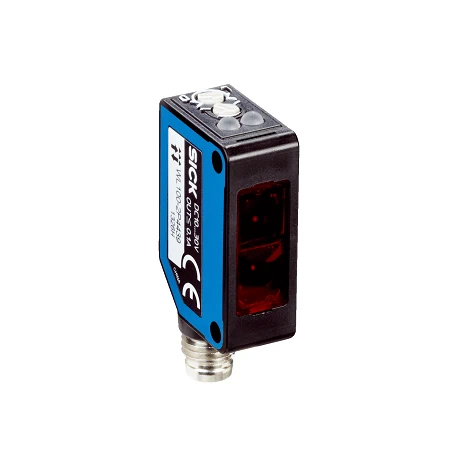
SICK 6052362 PNP Retro-reflective Photoelectric Sensor

USD 98.80

WL100-2P4439 offers 0.01–5.5 m sensing, 632 nm red LED light, adjustable sensitivity, selectable PNP switching and M8 four-pin connection.

SKU SICK-6052362 Category
SICK W100-2

SICK WL100-2P4439 Retro-reflective Photoelectric Sensor

BrandSICK
Model IdentifierWL100-2P4439
Official Part Number6052362

Technical Overview

The SICK WL100-2P4439 is a polarized retro-reflective photoelectric sensor with dual-lens optics and a minimum reflector distance. A PL80A reflector provides 0.01–5.5 m sensing and 0.01–7.2 m maximum range; the 632 nm red LED produces a 280 mm spot at 4 m. A potentiometer adjusts sensitivity, while a separate rotary switch selects light or dark operation for the PNP output. An M8 four-pin male connector provides the electrical connection. Response is no more than 0.5 ms with resistive load, with 1,000 Hz switching at a 1:1 light/dark ratio. The rectangular ABS/PC/POM housing has PMMA optics, M3 threaded mounting holes and IP67 protection.

Retro-reflective red LED sensor with 0.01–5.5 m PL80A sensing, PNP selectable light/dark switching and M8 four-pin male connector.

Key Features

  • Polarized dual-lens retro-reflective optics; minimum reflector distance
  • 0.01–5.5 m sensing and 0.01–7.2 m maximum range with PL80A reflector
  • 632 nm visible red LED; Ø280 mm spot at 4 m
  • Sensitivity potentiometer; separate light/dark rotary switch
  • PNP switching output; maximum current ≤100 mA
  • ≤0.5 ms response with resistive load; 1,000 Hz at 1:1 light/dark ratio
  • 10–30 V DC; 30 mA without load
  • M8 four-pin male connector
  • ABS/PC/POM housing; PMMA optics; M3 threaded mounting holes
  • IP67; −25 to +55 °C operation; −40 to +70 °C storage

Use polarized reflected-light detection and locally adjustable sensitivity with selectable PNP switching to support machine passage checks.

Technical Specification Matrix

ParameterValue
Functional principlePhotoelectric retro-reflective sensor; dual-lens system with minimum reflector distance
Housing designRectangular
Sensing range0.01–5.5 m with PL80A reflector
Maximum sensing range0.01–7.2 m with PL80A reflector
Light sourceVisible red LED
Wavelength632 nm
Light spot sizeØ280 mm at 4 m
LED service lifeAverage 100,000 h at ambient +25 °C
AdjustmentSensitivity potentiometer
Digital outputPNP switching output; maximum current ≤100 mA
Switching modeLight/dark switching, selectable via rotary switch (L=light; D=dark)
Signal voltage HIGH/LOWSupply voltage −1.8 V / approximately 0 V
Response time≤0.5 ms signal transit time with resistive load
Switching frequency1,000 Hz at 1:1 light/dark ratio
Power supply10–30 V DC, limit values
Residual ripple±10%; remain within supply tolerances
Protection classIII
Circuit protectionA: supply reverse-polarity protection; B: output reverse-polarity protection; D: outputs overcurrent and short-circuit protection
Housing materialABS/PC/POM plastic
Optics materialPMMA plastic
ConnectionM8 four-pin male connector
MountingM3 threaded mounting holes
IP ratingIP67
Operating temperature−25 to +55 °C
Storage temperature−40 to +70 °C
Orange LED indicatorSwitching output active
Green LED indicatorPower on
Polarization filterYes
Current consumption30 mA without load
MTTFD954 years
DCavg0%
Alternative reflector rangesP250: 0.01–4 m sensing / 0.01–5.7 m maximum; PL50A or PL40A: 0.01–4 m / 0.01–5.5 m; PL30A or PL31A: 0.01–3 m / 0.01–5.2 m; PL20A: 0.01–1.6 m / 0.01–2.2 m; Diamond Grade tape: 0.1–1.2 m / 0.1–1.7 m; P45: 0.01–1.2 m / 0.01–1.7 m. Close-up ranges apply at maximum sensitivity.
Pin assignment1 BN=L+; 2 WH=not connected; 3 BU=M; 4 BK=Q (CD-067)
Items suppliedOne BEF-W100-A mounting bracket and one P250 reflector

Industrial Applications

1. Counting opaque cartons using a reflector

A conveyor can place the sensor and a suitable reflector across the route of separated opaque cartons. Each carton interrupts the reflected red light. The sensitivity potentiometer and light/dark rotary switch establish the PNP switching condition. External counting logic evaluates the resulting state after setup checks carton gaps, actual blocking geometry and transit speed against the response and switching-frequency limits.

Problem Solved

A defined reflected-light path gives external counting logic a carton-passage reference, helping track separated loads while keeping electrical wiring on the sensor side of the conveyor.

Carton passage Polarized optics Reflected-light path

2. Confirming a carrier at a transfer stop

A transfer station can align the sensor and reflector through the space occupied by an opaque carrier feature when seated. The sensitivity potentiometer and light/dark rotary switch establish the PNP switching condition. The installation uses the range specified for its chosen reflector and maintains the required minimum distance. External transfer logic samples the state after the carrier reaches its mechanical stop.

Problem Solved

A carrier-arrival reference helps external transfer logic coordinate the next release from a defined stop, using the carrier feature to interrupt the returned optical path.

Carrier arrival Minimum reflector distance Selectable reflector

3. Checking an opaque tab on a presented assembly

An assembly fixture can present an expected opaque tab across the sensor’s reflected-light path, leaving the path clear when the tab is missing. The 632 nm LED provides visible alignment, and its specified spot size guides checks of the actual blocking geometry. External inspection logic samples the switching state at a repeatable presentation position after checking neighboring assembly features.

Problem Solved

A tab-present reference helps external inspection logic identify a missing blocking feature before the next operation, tying the returned-light state to a defined assembly location.

Assembly inspection Opaque tab Visible red LED

Select your currency