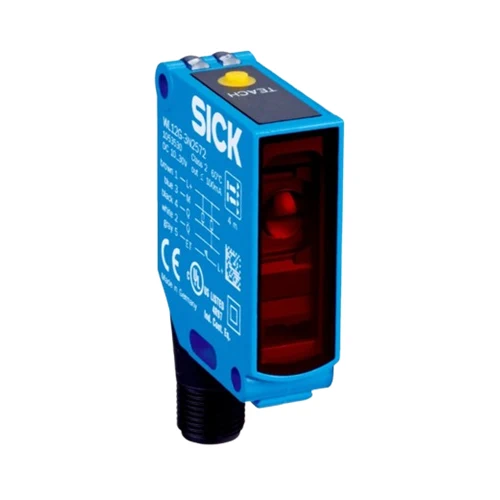
SICK 1044114 WL12G-3O2431S47 PNP Transparent-Object Sensor

USD 292.76

WL12G-3O2431S47 uses polarized coaxial retro-reflection for transparent objects, with 0–4 m maximum PL80A range, PNP dark switching and M12 connection.

SKU SICK-1044114 Category
SICK W12G

SICK WL12G-3O2431S47 PNP Transparent-Object Photoelectric Sensor

BrandSICK
Model IdentifierWL12G-3O2431S47
Official Part Number1044114

Technical Overview

The SICK WL12G-3O2431S47 is a polarized retro-reflective photoelectric sensor for detecting transparent objects. Coaxial autocollimation optics operate without a reflector minimum distance, with a 0–4 m maximum sensing range using a PL80A reflector. A five-turn potentiometer adjusts sensitivity, while the 640 nm visible red LED supports optical alignment. The fixed PNP dark-switching output provides response up to 330 µs under resistive load and 1,500 Hz switching at a 1:1 light/dark ratio. The 10–30 V DC sensor connects through a four-pin M12 male connector with pin 2 unassigned. A zinc die-cast housing and PMMA screen provide IP66/IP67/IP69K protection for operation from −40 to +60 °C.

Polarized coaxial retro-reflective sensor for transparent objects, with 0–4 m maximum PL80A range, PNP dark switching and a four-pin M12 connector.

Key Features

  • Transparent-object retro-reflective detection with polarization filter
  • Coaxial autocollimation optics; no reflector minimum distance
  • 0–4 m maximum sensing range with PL80A reflector
  • 640 nm visible red LED; average life 100,000 h at +25 °C
  • Five-turn sensitivity potentiometer; approximately 1.5° dispersion
  • Fixed PNP dark-switching output; ≤100 mA
  • Response ≤330 µs with resistive load; 1,500 Hz at 1:1 light/dark ratio
  • 10–30 V DC; M12 four-pin male connector; pin 2 unassigned
  • Zinc die-cast housing; PMMA front screen; IP66/IP67/IP69K
  • Operation −40 to +60 °C; yellow received-light and green power LEDs

Detect transparent targets with adjustable coaxial retro-reflection and no reflector minimum distance, using a fixed PNP dark-switching signal for external control.

Technical Specification Matrix

ParameterValue
Functional principlePolarized photoelectric retro-reflective sensor for transparent objects
Optical arrangementAutocollimation/coaxial optics; without reflector minimum distance
Maximum sensing range0–4 m with PL80A reflector
Reflector-dependent maximum rangesPL80A: 0–4 m; C110A: 0–4 m; P250F: 0–3 m; PL50A: 0–3.5 m; PL40A: 0–3.5 m; PL30A: 0–3 m; PL20A: 0–1.8 m; REF-IRF-56 tape: 0–0.6 m
Polarization filterYes
Light sourceVisible red LED; 640 nm
Average LED service life100,000 h at TU = +25 °C
AdjustmentSensitivity potentiometer, five turns
Angle of dispersionApproximately 1.5°
Digital outputPNP; maximum ≤100 mA
Switching modeDark switching
Response time≤330 µs signal transit time with resistive load
Switching frequency1,500 Hz at 1:1 light/dark ratio
Power supply10–30 V DC
Protection classIII
Circuit protectionA: supply reverse-polarity protection; C: interference suppression; D: output overcurrent and short-circuit protection
ConnectionM12 four-pin male connector
Pin assignmentCD-070: 1 BN=L+; 2 WH=not connected; 3 BU=M; 4 BK=dark-switching output Q̅
Housing designRectangular
Housing materialZinc die-cast metal
Front screen materialPMMA plastic
IP ratingIP66 / IP67 / IP69K
Operating temperature−40 to +60 °C
Storage temperature−40 to +75 °C
MountingM4 threaded mounting hole, 4 mm deep; Ø4.2 mm mounting hole
IndicationYellow LED: received-light status; green LED: power supply active
MTTFD823 years
DCavg0%
UL filesNRKH.E181493 and NRKH7.E181493
ECOLABManufacturer certificate listed
Physical Weight (kg)0.12

Industrial Applications

1. Counting separated transparent containers

A packaging conveyor can place the sensor and a suitable reflector across a clear-container path and adjust sensitivity for the actual container wall and return-light loss. Each separated container produces a dark-switching PNP event for external counting logic. Setup verifies optical alignment, target presentation and spacing against the 330 µs resistive-load response and 1,500 Hz switching rating.

Problem Solved

Transparent-container passages become switching events for an external counter, helping track separated loads through a fixed conveyor reference using an adjusted retro-reflective optical path.

Transparent containers External counting PNP dark switching

2. Monitoring a transparent-film buffer threshold

A transparent-film buffer can arrange the coaxial optical path across a chosen loop level so film entering that location changes the reflector return. External feed logic reads the fixed dark-switching PNP condition to coordinate material delivery. Commissioning establishes usable return-light contrast for the actual film and reflector, then checks loop flutter and the required threshold position.

Problem Solved

A discrete optical loop-level reference helps external feed control coordinate material delivery with buffer demand, using the configured change in return light at a selected threshold.

Film buffer Loop threshold Coaxial optics

3. Triggering an operation from a clear workpiece edge

A process station can position the sensor and reflector across a clear-workpiece route and use the leading-edge transition to trigger external timing logic. The five-turn potentiometer establishes detection for the actual workpiece and optical return. The controller accounts for travel and input delay, while commissioning verifies repeatable edge response at the installed speed and reflector-dependent range.

Problem Solved

A clear-workpiece edge supplies a repeatable process reference to external timing logic, helping coordinate a downstream operation with material movement through the installed optical path.

Leading-edge reference Process timing Transparent workpiece

Select your currency