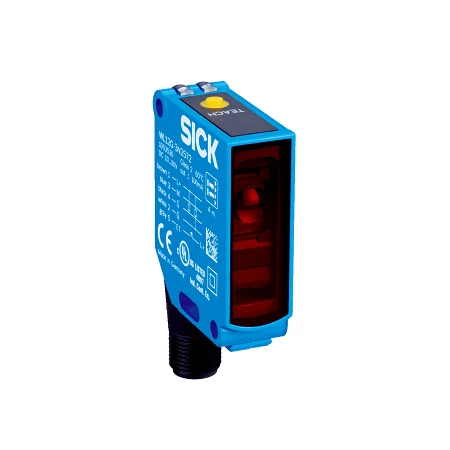
SICK 1053536 WL12G-3P2582 Transparent-object Sensor

USD 77.74

WL12G-3P2582 offers 0–4 m maximum PL80A range, 10%/18% teach-in modes, AutoAdapt, complementary PNP outputs and IP66/IP67.

SKU SICK-1053536 Category
SICK W12G

SICK WL12G-3P2582 Transparent-object Photoelectric Sensor

BrandSICK
Model IdentifierWL12G-3P2582
Official Part Number1053536

Technical Overview

The SICK WL12G-3P2582 is a infrared LED retro-reflective photoelectric sensor for transparent-object detection. Polarized coaxial optics operate without a reflector minimum distance, with a 0–4 m maximum range using PL80A. An 850 nm infrared LED produces a typical 100 mm spot at 3 m. Single-button teach-in selects sensitivity, with Mode I 10% and Mode II 18% attenuation settings and AutoAdapt. Complementary PNP outputs provide light/dark switching signals to external control. Response is ≤333 µs under resistive load, with 1,500 Hz operation at a 1:1 light/dark ratio. The zinc diecast housing has a PMMA front screen, IP66/IP67 protection and an M12 five-pin connector.

Transparent-object infrared LED sensor with 0–4 m maximum PL80A range, 10%/18% teach-in modes, AutoAdapt and complementary PNP outputs.

Key Features

  • Transparent-object retro-reflective sensing with polarized coaxial optics
  • 0–4 m maximum range using PL80A; no reflector minimum distance
  • 850 nm infrared infrared LED; typical Ø100 mm spot at 3 m
  • Single teach-in button; Mode I 10% and Mode II 18% attenuation
  • AutoAdapt; external teach connection on pin 5
  • Complementary PNP light/dark switching outputs, ≤100 mA
  • ≤333 µs response with resistive load; 1,500 Hz at 1:1 light/dark ratio
  • 10–30 V DC; 40 mA without load; M12 five-pin connector
  • Zinc diecast housing and PMMA screen; IP66/IP67
  • Two BEF-KH-W12 clamps with screws included

Teach the reflector-return threshold for transparent objects and use complementary PNP signals to support external counting, transfer and material-feed control.

Technical Specification Matrix

ParameterValue
Functional principlePhotoelectric retro-reflective sensing for transparent objects; polarized coaxial/autocollimation optics
Maximum sensing range0–4 m with PL80A reflector
Reflector minimum distanceNo minimum distance with coaxial optics
Polarization filterYes
Light sourceInfrared LED
Wavelength850 nm
Light spot sizeTypically Ø100 mm at 3 m
LED service lifeAverage 100,000 h at ambient +25 °C
AdjustmentSingle teach-in button; external teach input on pin 5
Digital outputComplementary PNP switching outputs, maximum output current ≤100 mA
Switching modeLight/dark switching
Response time≤333 µs with resistive load
Switching frequency1,500 Hz at 1:1 light/dark ratio
Power supply10–30 V DC; operate in short-circuit protected supply network, maximum 8 A
Current consumption40 mA without load
Residual ripple<5 Vpp; remain within supply limits
Protection classIII
Circuit protectionA: supply reverse-polarity protection; B: inputs and output reverse-polarity protection; C: interference suppression; D: outputs protected against overcurrent and short circuits
Housing designRectangular
Housing materialMetal, zinc diecast
Front screenPMMA plastic
ConnectionMale M12 five-pin connector
Mounting provisionsM4 threaded mounting hole, 4 mm depth; Ø4.2 mm mounting hole
IP ratingIP66/IP67
Operating temperature−40 to +60 °C
Storage temperature−40 to +75 °C
Physical Weight (kg)0.12
Pin assignment1 BN=L+; 3 BU=M; 4 BK=Q; 2 WH=/Q; 5 GY=Teach (CD-146)
Attenuation modesMode I 10% and Mode II 18%
AutoAdaptYes
Signal voltage PNP HIGH/LOWApproximately supply voltage −2.5 V / 0 V
Items suppliedTwo BEF-KH-W12 clamps, including screws
MTTFD1,099 years
DCavg0%

Industrial Applications

1. Counting separated transparent containers

A conveyor can align the sensor and a PL80A reflector across a path carrying separated transparent containers. Each container changes the returned light for external counting logic. Setup uses the 0–4 m maximum range with PL80A, adjusts the single-button teach-in and checks actual wall thickness, finish, alignment and clear gaps against representative production samples.

Problem Solved

A transparent-container passage reference gives external counting logic a way to track separated products whose clear walls may pass much of the light used by ordinary opaque-object detection arrangements.

Transparent containers Reflector return External counting

2. Confirming a clear tray at a transfer position

A transfer station can place a PL80A reflector opposite the sensor so a clear tray crosses the optical path at its expected seated position. The single-button teach-in establishes a usable return threshold with representative loaded and empty conditions. External machine logic evaluates the switching state alongside its own transfer sequence after commissioning checks tray ribs, seams and positioning variation.

Problem Solved

A clear-tray presence reference helps external transfer control recognize whether the expected carrier has arrived, supporting coordinated release of the next load when visual transparency complicates ordinary presence checks.

Clear tray Transfer presence Sensitivity setting

3. Monitoring continuity of a transparent film feed

A feeder can route transparent film between the sensor and a reflector so the normal web changes the reflected-light level. External feeder logic evaluates a transition toward the unobstructed return as a possible loss of material. Commissioning tests actual film grade, thickness, flutter, seams and reflector alignment while adjusting the single-button teach-in for the expected production conditions.

Problem Solved

A film-present versus clear-path reference helps external feeder control recognize possible material loss, reducing the chance that downstream processing continues without the expected transparent web.

Transparent film Material continuity External feeder control

Select your currency