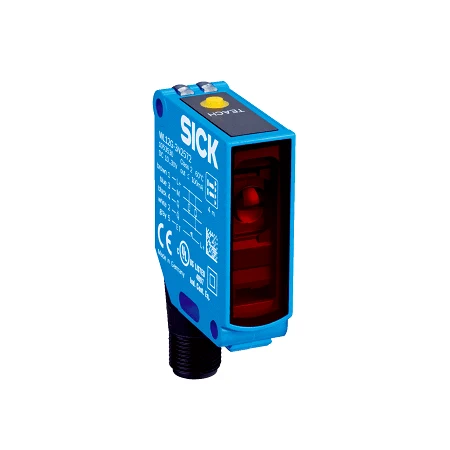
SICK 1067778 WL12GC-3P2472A70 IO-Link Transparent-object Sensor

USD 62.40

WL12GC-3P2472A70 offers 0–4 m PL80A sensing, IO-Link V1.1, time-measurement and debounce functions, configurable pin 2 and contamination diagnostics.

SKU SICK-1067778 Category
SICK W12G

SICK WL12GC-3P2472A70 IO-Link Transparent-object Sensor

BrandSICK
Model IdentifierWL12GC-3P2472A70
Official Part Number1067778

Technical Overview

The SICK WL12GC-3P2472A70 is an IO-Link retro-reflective photoelectric sensor for transparent objects. Polarized coaxial optics operate without a reflector minimum distance, with a 0–4 m sensing range using PL80A. A visible 660 nm PinPoint LED produces a typical 25 mm spot at 1.5 m. Single-button teach-in, IO-Link adjustment and AutoAdapt support setup. A PNP switching output connects to external control, while multifunction pin 2 supports configured input or output functions. The selected Smart Task combines time measurement with debouncing, and 16-bit IO-Link process data contains QL1, QL2 and a time measurement value. Device status, teach quality and run quality with contamination indication are available. The zinc diecast housing uses PMMA optics, IP66/IP67 protection and an M12 four-pin connector.

IO-Link transparent-object sensor with 0–4 m PL80A range, time measurement and debouncing, PNP output and configurable pin 2.

Key Features

  • Transparent-object sensing with polarized coaxial optics; no reflector minimum distance
  • 0–4 m sensing and maximum range using PL80A
  • 660 nm PinPoint LED; typical Ø25 mm spot at 1.5 m
  • Single-button teach-in, IO-Link adjustment and AutoAdapt
  • PNP output; configurable multifunction input/output on pin 2
  • IO-Link V1.1 COM2; 2.3 ms cycle; 16-bit process data with time measurement value
  • Time measurement and debouncing Smart Task; configurable logic and timing
  • Device status, teach quality and run quality with contamination indication
  • 10–30 V DC; 30 mA without load; M12 four-pin connector
  • Zinc diecast housing, PMMA screen and IP66/IP67 protection

Detect transparent products and provide a time measurement value with switching and contamination information to external control through IO-Link.

Technical Specification Matrix

ParameterValue
Functional principleTransparent-object photoelectric retro-reflective sensing; polarized coaxial/autocollimation optics
Sensing range0–4 m with PL80A reflector
Maximum sensing range0–4 m
Reflector minimum distanceNo minimum distance with coaxial optics
Polarization filterYes
Light sourceVisible red PinPoint LED
Wavelength660 nm
Light spot sizeTypically Ø25 mm at 1.5 m
LED service lifeAverage 100,000 h at ambient +25 °C
AdjustmentIO-Link and single teach-in button
AutoAdaptYes
Attenuation along light beam>8%
Digital outputPNP; maximum output current ≤100 mA
Switching modeLight/dark switching
Pin 2 configurationConfigurable external input, teach-in input, sender-off input, detection output, logic output or device contamination alarm output
Pin assignment1 BN=L+; 3 BU=M; 4 BK=QL1/C; 2 WH=MF (CD-367)
Pin 4 connection restrictionThis switching output must not be connected to another output
Signal voltage PNP HIGH/LOWApproximately supply voltage −2.5 V / 0 V
Switching frequency1,500 Hz at 1:1 light/dark ratio
Configured pin 2 response time200–300 µs with resistive load; valid for switching output on pin 2 if configured with software
Configured pin 2 repeatability100 µs; valid for switching output on pin 2 if configured with software
Configured pin 2 frequency≤1,500 Hz at 1:1 light/dark ratio; valid for switching output on pin 2 if configured with software
IO-LinkV1.1; COM2 at 38.4 kBaud; compatible master port type A; SIO supported
IO-Link cycle time2.3 ms
IO-Link process data16 bits: bit 0 QL1; bit 1 QL2; bits 2–15 measuring value (time measurement value)
IO-Link identifiersVendorID 26; DeviceID 0x8000F3 / 8388851
Smart TaskTime measurement + debouncing
Logic functionsDirect and WINDOW; inverter available
Timer functionsDeactivated, switch-on delay, off-delay, on-and-off delay or impulse (one-shot)
DiagnosticsDevice status; quality of teach; quality of run with contamination display
Power supply10–30 V DC; operate in short-circuit protected supply network, maximum 8 A
Current consumption30 mA without load
Residual ripple<5 Vpp; remain within supply limits
Protection classIII
Circuit protectionA: supply reverse-polarity protection; B: inputs and output reverse-polarity protection; C: interference suppression; D: outputs protected against overcurrent and short circuits
Housing designRectangular
Housing materialMetal, zinc diecast
Front screenPMMA plastic
ConnectionMale M12 four-pin connector
Mounting provisionsM4 threaded mounting hole, 4 mm depth; Ø4.2 mm mounting hole
IP ratingIP66/IP67
Operating temperature−40 to +60 °C
Storage temperature−40 to +75 °C
MTTFD891 years
DCavg0%
Mission time20 years
Physical Weight (kg)0.12
Time measurement resolution1 ms
Minimum event spacingSIO Logic: 300 µs; IO-Link: 500 µs

Industrial Applications

1. Measuring a transparent-container occupancy interval

A conveyor can align the sensor with a PL80A reflector so a transparent container changes the returned light while occupying the sensing position. Teach-in establishes detection with actual samples. The Time measurement Smart Task supplies a time measurement value through IO-Link, with 1 ms resolution; external line logic relates that measured interval to its own conveyor sequence and expected product spacing.

Problem Solved

An occupancy-time reference gives external line control additional information about how long a transparent container affects the sensing path, helping recognize unusual passage duration alongside the ordinary switching signal.

Transparent containers Time measurement 1 ms resolution

2. Debouncing clear-carrier presence at a transfer

A transfer station can position the sensor and reflector across a clear carrier location, then teach sensitivity with representative carriers. Configured debouncing and timing functions process the detection state before external transfer logic evaluates it. Installation checks real carrier movement, seams and short optical transitions, then selects the internal timing behavior appropriate to the machine sequence and operating mode.

Problem Solved

Configured state processing helps external transfer control distinguish a stable carrier condition from short optical transitions, supporting coordinated upstream release when moving seams or edges disturb the raw detection signal.

Clear carrier Debouncing Configured timing

3. Monitoring a transparent film feed with optical diagnostics

A feeder can route transparent film between the sensor and reflector so normal material changes the returned light. Teach-in establishes the operating threshold with actual film, and external feeder control evaluates a change toward the clear return as possible material loss. IO-Link run-quality information and contamination indication provide an additional optical-condition reference during the feed process.

Problem Solved

A film-continuity signal and optical-condition information help external feeder control recognize possible material loss while giving maintenance staff a separate indication that contamination may be affecting the detection arrangement.

Transparent film Run-quality diagnostics Material continuity
Select your currency