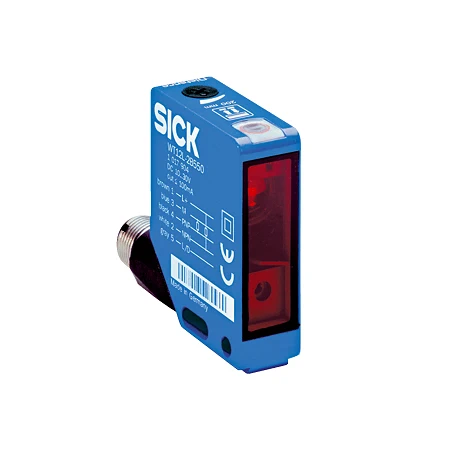
SICK 1048969 WL12L-2B530S04 Laser Retro-reflective Sensor

USD 105.30

WL12L-2B530S04 offers polarized coaxial laser sensing, 0–600 mm maximum range with PL80A, fixed focus and sensitivity, and separate PNP/NPN outputs.

SKU SICK-1048969 Category
SICK W12-2 Laser

SICK WL12L-2B530S04 Laser Retro-reflective Sensor

BrandSICK
Model IdentifierWL12L-2B530S04
Official Part Number1048969

Technical Overview

The SICK WL12L-2B530S04 is a laser retro-reflective photoelectric sensor that detects interruption of light returned from a reflector. Polarized coaxial optics operate without a reflector minimum distance, with a specified 0–600 mm maximum range using PL80A. The visible 650 nm class 2 laser produces a typical 0.8 mm spot at 300 mm; focus is fixed and sensitivity is fixed, with no adjustment provided. Separate PNP and NPN outputs connect to external control, while the L/D input selects light or dark switching. Response is ≤200 µs under resistive load, with 2,500 Hz operation at a 1:1 light/dark ratio. The metal housing has a PMMA screen, IP67/IP69K protection and a male M12 five-pin connector.

Polarized coaxial laser retro-reflective sensor with 0–600 mm maximum PL80A range, class 2 laser, Ø0.8 mm spot at 300 mm and PNP/NPN outputs.

Key Features

  • Polarized coaxial/autocollimation retro-reflective sensing
  • 0–600 mm maximum sensing range with PL80A reflector
  • No reflector minimum distance with coaxial optics
  • 650 nm visible red class 2 laser; typical Ø0.8 mm spot at 300 mm
  • No adjustment; fixed focus and fixed sensitivity
  • Separate PNP and NPN outputs; L/D input selects light or dark switching
  • ≤200 µs response with resistive load; 2,500 Hz at 1:1 light/dark ratio
  • Metal housing, PMMA screen and IP67/IP69K protection
  • 10–30 V DC, 55 mA without load; M12 five-pin connector

Align a focused laser return from a reflector to provide opaque-object interruption signals through separate PNP and NPN outputs.

Technical Specification Matrix

ParameterValue
Functional principlePhotoelectric retro-reflective sensing with polarized coaxial/autocollimation optics; reflector required
Maximum sensing range0–600 mm with PL80A reflector
Light sourceVisible red laser
Wavelength650 nm
Laser class2
Light spot sizeTypically Ø0.8 mm at 300 mm
Laser service lifeAverage 50,000 h at ambient +25 °C
Pulse duration4 µs
AdjustmentNone; fixed focus and fixed sensitivity
Digital outputSeparate PNP and NPN switching outputs; maximum current ≤100 mA
Switching modeLight or dark switching, selected through L/D control input
L/D control input0 V or not connected: light switching; supply voltage: dark switching
Pin assignment1 BN=L+; 3 BU=M; 4 BK=QPNP; 2 WH=QNPN; 5 GY=L/D (CD-145)
Response time≤200 µs with resistive load
Switching frequency2,500 Hz at 1:1 light/dark ratio
Signal voltage PNP/NPN HIGH/LOWDatasheet notation: Uv − <2.9 V, Uv / 0 V, ≤1.5 V
Power supply10–30 V DC; operate in short-circuit protected supply network, maximum 8 A
Current consumption55 mA without load
Residual ripple<5 Vpp; remain within supply limits
Protection classIII
Circuit protectionA: supply reverse-polarity protection; C: interference suppression; D: outputs protected against overcurrent and short circuits
Housing designRectangular
Housing materialMetal
Front screenPMMA plastic
ConnectionMale M12 five-pin connector
Mounting provisionsM4 threaded hole, 4 mm depth; Ø4.2 mm mounting hole
IP ratingIP67/IP69K
Operating temperature−10 to +50 °C
Storage temperature−25 to +75 °C
Physical Weight (kg)0.13
Polarization filterYes
Reflector minimum distanceNo minimum distance with coaxial optics
Maximum laser pulse power<5.0 mW
Laser reference standardsEN 60825-1:2014; IEC 60825-1:2007
Sensing range0–600 mm with PL80A reflector

Industrial Applications

1. Counting separated opaque products

A conveyor can align the sensor with a PL80A reflector across a path carrying separated opaque products. Each product interrupts the returned laser beam and changes the PNP and NPN signals for external counting logic. Setup checks beam coverage, product gaps and actual head-to-reflector spacing within the specified 0–600 mm maximum range, while the fixed focus and fixed sensitivity require checking the installed beam geometry.

Problem Solved

A blocked-versus-clear reflector return supplies external counting logic with a product-passage reference, helping track throughput without relying on light reflected by changing product surface finishes.

Opaque products Reflector return External counting

2. Monitoring an opaque web for a break

A material feeder can route an opaque web between the sensor and a reflector so the normal material blocks the returned laser beam. A break exposes the reflector and changes the output states for external feeder control. Installation establishes adequate material width, flutter tolerance and beam coverage; the typical 0.8 mm spot at 300 mm is checked at the actual operating distance.

Problem Solved

A blocked-to-clear return transition gives external feeder control a possible web-break reference, helping recognize missing material before downstream processing continues without its expected opaque feed.

Web continuity Laser return Opaque material

3. Recognizing a blocked conveyor transfer

A transfer station can place the sensor and reflector across an expected load location. A load remaining in the laser path maintains the interrupted-return condition, while external control evaluates its duration using a separate dwell timer. The machine controller uses the chosen PNP or NPN signal and light/dark selection to coordinate upstream release after the transfer position clears.

Problem Solved

Sustained interruption provides external transfer control with an occupancy indication, helping coordinate load release when a station remains blocked instead of assuming that every passing signal represents a cleared position.

Transfer occupancy External dwell timer PNP/NPN signals

Select your currency