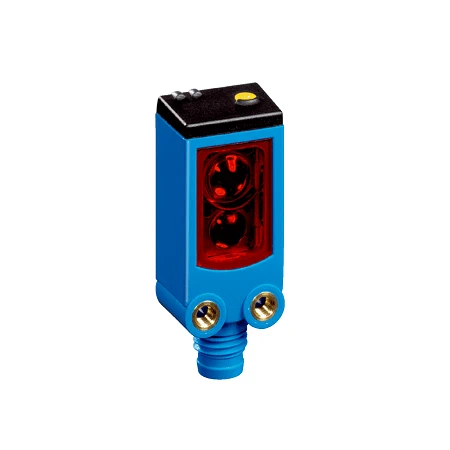
1. Counting separated clear containers
A packaging feeder can mount the sensor opposite a PL80A reflector so separated clear containers pass through the reflected-light path. Single-button teach-in establishes detection using actual container material, wall shape and contents. External counting logic evaluates the PNP dark-switching output, with spacing and sampling checked against the 1,000 Hz specification at a 1:1 light/dark ratio and the 0.02–0.9 m PL80A sensing range.
Problem Solved
A transparent-container passage reference helps external counting logic track clear products whose transmitted light makes ordinary opaque-object detection unsuitable, after actual container presentation and separation have been verified.
Clear containers
PNP dark switching
External counting
2. Confirming a clear carrier at a transfer stop
A compact transfer station can align the sensor and PL80A reflector across a defined wall of a clear carrier at its seated position. Optics without a polarization filter evaluate the reflector return, and the M8 three-pin connector supports local installation. Setup teaches using representative carriers and verifies that nearby machine features remain outside the intended optical path throughout carrier movement.
Problem Solved
A clear-carrier position reference helps external transfer control recognize arrival at the intended location, supporting coordinated upstream release after carrier wall geometry and the seated position have been checked.
Clear carrier
Unpolarized optics
Transfer position
3. Checking a transparent cover on a presented assembly
An assembly nest can present a transparent cover across the reflected-light path at a defined inspection point. Single-button teach-in establishes detection with representative covered and uncovered assemblies, while the transparent-object sensing function evaluates the cover condition. External inspection logic samples the switching output at the intended stage after verifying cover material, curvature, presentation tolerance and nearby background interference on the actual assembly.
Problem Solved
A cover-present reference helps external inspection logic identify an assembly missing its transparent cover, reducing the chance that a cover omission proceeds unnoticed to the following operation.
Transparent cover
Assembly inspection
Single-button teach-in