1. Counting separated cartons across a conveyor
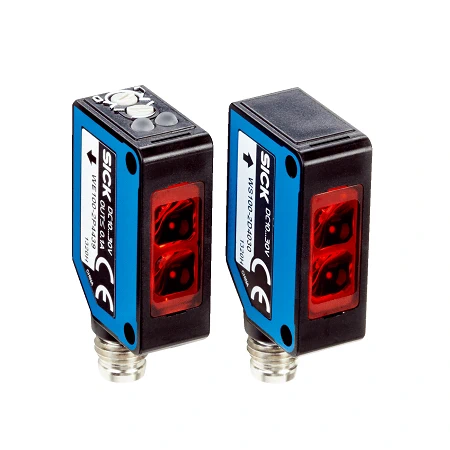
A conveyor can position the sender and receiver across the route of separated opaque cartons. Each carton interrupts the red beam, producing a PNP state for external counting logic. The 0–20 m sensing range supports the installed separation, and the sensitivity potentiometer establishes the received-light condition. Setup checks carton gaps and transit speed against the response and switching-frequency limits.
Problem Solved
Beam interruption supplies a distinct carton-passage event for external counting logic, helping the conveyor track separated loads without relying on light reflected from their printed surfaces.
Carton counting
Through-beam
Selectable switching
2. Monitoring an opaque strip for a break
A strip feeder can place the sender and receiver on opposite sides of an opaque material path. Loss of material exposes the receiver to the red beam, changing the switching state. The potentiometer sets sensitivity for the installed separation, while the light/dark rotary switch selects the required output behavior for the external feed controller.
Problem Solved
A material-continuity signal helps the feed controller recognize a break or exhausted strip and coordinate its response before another operation proceeds with an empty material path.
Strip continuity
Sensitivity adjustment
Light/dark selection
3. Managing accumulation at a conveyor transfer
At a conveyor transfer, an opaque load can block the path between the separate sender and receiver while the receiving location remains occupied. External control logic evaluates the duration of the switching state to distinguish passing loads from sustained blockage. IP67 housings and M3 threaded mounting holes support positioning the optical pair around the transfer area.
Problem Solved
A sustained-occupancy reference helps external transfer logic coordinate upstream release when the receiving position is blocked, using the duration of an interrupted optical path.
Transfer occupancy
IP67
M3 mounting