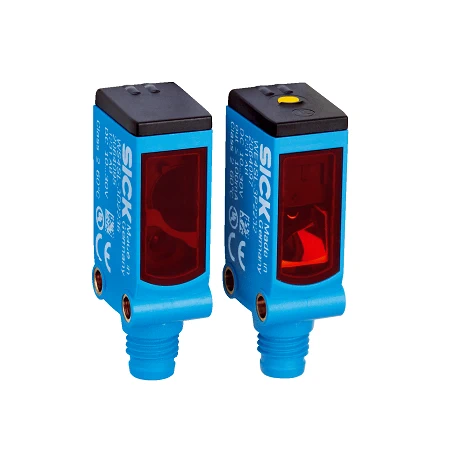
1. Counting separated small opaque components
A feeder can mount the sender and receiver on opposite sides of a path carrying separated opaque components. The typical 1 mm spot at 500 mm helps align the direct beam with the intended blocking feature, and teach-in establishes sensitivity with actual parts. External counting logic verifies orientation, clear gaps and controller sampling against the 1,000 Hz switching specification at a 1:1 light/dark ratio.
Problem Solved
A direct beam-interruption reference helps external counting logic track separated components, reducing dependence on component color or reflected intensity after the actual blocking feature and part spacing have been verified.
Small components
Direct laser beam
External counting
2. Confirming a narrow carrier feature at a transfer
A transfer station can align the sender and receiver across an opaque feature that defines a carrier seated at its expected position. Single-button teach-in establishes detection with representative carriers. External transfer logic evaluates the complementary receiver states after testing real carrier tolerances, feature position and alignment, with the direct optical path kept clear of other moving machine features throughout the transfer sequence.
Problem Solved
A local carrier-position reference helps external transfer control recognize arrival at the intended location, supporting coordinated upstream release when a narrow mechanical feature defines the required seated condition.
Carrier feature
Opposed sensing
Transfer position
3. Checking an opaque tab on a presented assembly
An assembly station can present a part so an expected opaque tab interrupts the direct laser beam while a surrounding opening leaves it clear. Setup aligns the sender and receiver at the chosen distance and teaches using representative complete and missing-tab samples. External inspection logic evaluates the receiver state at the intended point in the sequence after confirming that other assembly features cannot mask the tab condition.
Problem Solved
A tab-present reference helps external inspection logic flag an assembly with a missing blocking feature, reducing the chance that an expected component omission proceeds unnoticed to the next operation.
Opaque tab
Assembly check
Direct beam interruption