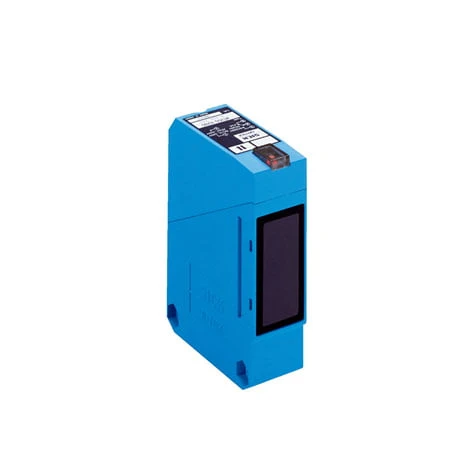
SICK 6020769 WT260-S270 Relay Diffuse Photoelectric Sensor

USD 185.12

WT260-S270 offers energetic diffuse sensing, an isolated change-over relay, 5–1,300 mm sensing, 25 Hz switching and a cable gland in an IP67 housing.

SKU SICK-6020769 Category
SICK W260

SICK WT260-S270 Relay Diffuse Photoelectric Sensor

BrandSICK
Model IdentifierWT260-S270
Official Part Number6020769

Technical Overview

The SICK WT260-S270 is an energetic photoelectric proximity sensor with an electrically isolated change-over relay output. It evaluates visible red light reflected by the target, providing detection from one mounting side without a separate receiver or reflector. The specified sensing range is 5–1,300 mm, with a maximum of 5–1,700 mm on a white reference target having 90% remission. A 270° potentiometer adjusts sensitivity, and the LED forms a 60 mm spot at 1,300 mm. Light switching, response of no more than 20 ms, 25 Hz switching, cable-gland connection and an IP67 ABS housing support machine integration.

Energetic diffuse sensor with isolated change-over relay, 5–1,300 mm sensing, 270° adjustment, cable gland and IP67 housing.

Key Features

  • Energetic diffuse photoelectric detection
  • 5–1,300 mm sensing; 5–1,700 mm maximum on 90% remission white
  • Visible red LED; Ø 60 mm spot at 1,300 mm
  • 270° sensitivity potentiometer
  • Electrically isolated change-over relay; light switching
  • Relay ratings: 3 A at 240 V AC or 3 A at 30 V DC
  • Response ≤20 ms; 25 Hz switching
  • 12–240 V DC or 24–240 V AC supply; ≤5 VA
  • Cable-gland connection; IP67 ABS housing with PC optics
  • BEF-W260 mounting bracket included

Detect targets from one mounting side and provide an electrically isolated change-over relay signal using adjustable reflected-light sensing.

Technical Specification Matrix

ParameterValue
Functional principleEnergetic photoelectric proximity sensor
Sensing range5–1,300 mm
Maximum sensing range5–1,700 mm on 90% remission white target (DIN 5033)
Light sourceLED, visible red light
Light spot sizeØ 60 mm at 1,300 mm
Angle of dispersionApproximately 1.8°
AdjustmentPotentiometer, 270°
Power supply12–240 V DC or 24–240 V AC; ±10%
Power consumption≤ 5 VA
Switching outputElectrically isolated relay, change-over contacts
Switching modeLight switching
Relay switching ratings3 A at 240 V AC; 3 A at 30 V DC
Load suppressionSuitable spark suppression required for inductive or capacitive loads
Response time≤ 20 ms
Switching frequency25 Hz at light/dark ratio 1:1
ConnectionCable gland
Circuit protectionSupply reverse-polarity protection and interference suppression
Protection classII; rated voltage 250 V AC/DC
Housing formRectangular
Housing materialABS plastic
Optics materialPC plastic
IP ratingIP67
Items suppliedBEF-W260 mounting bracket
Operating temperature−25 to +55 °C
Storage temperature−40 to +70 °C
MTTFD710 years
Diagnostic coverage DCavg0%
Dimensions L x W x H (cm)6.3 x 2.5 x 7.8
Physical Weight (kg)0.12

Industrial Applications

1. Confirming a tote in a loading bay

A loading fixture can aim the sensor toward the expected face of an opaque tote within the specified sensing range. The 270° potentiometer sets reception for that target, and the electrically isolated change-over relay reports detection. A visible red LED provides sensing light, while IP67 protection supports exposed machine mounting.

Problem Solved

A contactless tote-presence signal helps the sequence controller identify an occupied loading position before dispensing or handling proceeds, avoiding a mechanical feeler against the container wall.

5–1,300 mm 270° adjustment Isolated relay

2. Counting separated cartons at a transfer

A carton conveyor can aim the sensor toward a position crossed by separated opaque cartons. Energetic sensing evaluates light reflected from each carton face, and the isolated relay supplies a light-switching event to compatible control electronics. The 25 Hz switching frequency and response of no more than 20 ms define the available transition timing.

Problem Solved

A discrete optical event marks each separated carton passage, supplying a counting input without a contact arm while preserving electrical isolation through the relay interface.

Energetic sensing 25 Hz Relay

3. Checking opaque material continuity

A material feeder can direct the sensor at a sheet or strip so reflected light indicates material at the monitored position. A break or runout removes the target from that position and changes the light-switching relay state. The 270° sensitivity potentiometer adapts reception to the installed target and sensing distance.

Problem Solved

A change in local material presence provides an electrical indication of interrupted feed, supporting a coordinated machine response before additional product enters the affected process section.

Diffuse sensing Light switching Material continuity

Select your currency