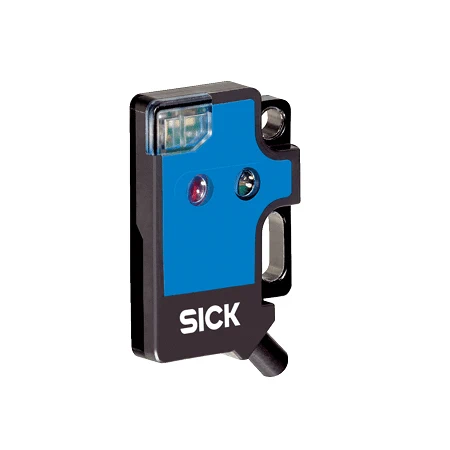
SICK 6030580 PNP Diffuse Photoelectric Sensor

USD 148.20

WT2F-P150 offers 2–34 mm sensing on reference white, fixed adjustment, PNP light switching and a 2 m PVC cable in an IP67 PC housing.

SKU SICK-6030580 Category
SICK W2 Flat

SICK WT2F-P150 Diffuse Photoelectric Sensor

BrandSICK
Model IdentifierWT2F-P150
Official Part Number6030580

Technical Overview

The SICK WT2F-P150 is a miniature energetic photoelectric proximity sensor for short-range detection using light reflected from the target. Its specified 2–34 mm sensing and maximum range apply to 90% remission reference white according to DIN 5033; target reflectance affects the usable distance. The 660 nm visible red LED operates without a sensitivity adjustment control. A PNP light-switching output connects to external control through a 2 m three-wire PVC cable. Response is no more than 0.5 ms with resistive load, with 1,000 Hz operation at a 1:1 light/dark ratio. The rectangular PC housing and PC optics provide IP67 protection and mounting holes for compact machine integration.

Energetic diffuse sensor with 2–34 mm reference-white range, PNP light switching, no sensitivity adjustment and 2 m three-wire PVC cable.

Key Features

  • Energetic reflected-light proximity sensing
  • 2–34 mm sensing and maximum range on 90% remission reference white
  • 660 nm visible red LED illumination
  • No sensitivity adjustment
  • PNP light-switching output; maximum current ≤50 mA
  • ≤0.5 ms response with resistive load; 1,000 Hz at 1:1 light/dark ratio
  • 12–24 V DC supply with ±10% tolerance
  • 2 m three-wire PVC cable; Ø2.4 mm cable
  • PC housing and PC optics; mounting holes Ø2.1 mm
  • IP67 protection; −20 to +55 °C operation

Detect nearby targets from one mounting side with fixed energetic sensing and a PNP switching signal for external control.

Technical Specification Matrix

ParameterValue
Functional principleEnergetic photoelectric proximity sensor
Sensing range2–34 mm on 90% remission reference white (DIN 5033)
Maximum sensing range2–34 mm on 90% remission reference white (DIN 5033)
Light sourceVisible red LED
Wavelength660 nm
LED service lifeAverage 100,000 h at +25 °C
AdjustmentNone
Digital outputPNP switching output; maximum output current ≤50 mA
Switching modeLight switching
Output signal levelsApprox. VS −1.8 V / 0 V for PNP HIGH/LOW
Response time≤0.5 ms signal transit time with resistive load
Switching frequency1,000 Hz at 1:1 light/dark ratio
Power supply12–24 V DC, ±10% tolerance
Residual ripple<5 Vpp; remain within supply tolerances
Connection2 m three-wire PVC cable; do not bend cable below 0 °C
Cable diameterØ2.4 mm
Pin assignmentBN=L+; BU=M; BK=Q (CD-043)
Circuit protectionA: supply connections reverse-polarity protected; C: interference suppression; D: outputs overcurrent and short-circuit protected
Housing materialPC plastic
Optics materialPC plastic
Mounting provisionsMounting holes Ø2.1 mm
IP ratingIP67
Operating temperature−20 to +55 °C
Storage temperature−40 to +75 °C
MTTFD1,526 years
DCavg0%
Reference-target rangesBlack 6%: 2–8 mm; gray 18%: 2–15 mm; white 90%: 2–34 mm
Physical Weight (kg)0.02

Industrial Applications

1. Counting separated light-colored tabs at a guide

A guide can present separated light-colored tabs close to the sensor so their surfaces return the emitted light. The 2–34 mm range applies to 90% remission reference white, with shorter distances shown for darker targets. External counting logic evaluates the PNP light-switching output after actual tab reflectance, spacing and motion have been checked against the fixed sensing response.

Problem Solved

A close-range tab-passage reference helps external counting logic register separated features where a receiver cannot be mounted across the path, using light reflected from the presented surface.

Tab counting Reflected-light sensing Short range

2. Checking a small insert at an assembly nest

An assembly nest can hold a small insert at a repeatable distance facing the sensor. Energetic sensing evaluates reflected light from the insert, with the documented reference-target ranges guiding setup. External inspection logic samples the PNP output while the assembly is stationary. The actual insert material, background and placement tolerance are checked because the sensor has no sensitivity adjustment.

Problem Solved

An insert-present reference helps external inspection logic identify an empty assembly location before the next operation, using a repeatable near-field reflected-light condition at the nest.

Insert presence Assembly nest Fixed adjustment

3. Confirming a carrier against a compact stop

A compact stop can present a defined carrier surface within the sensor’s short working distance. The fixed energetic response and PNP light-switching output provide a local arrival condition for external transfer logic. Setup verifies the actual carrier reflectance and seated gap, with darker surfaces evaluated against the shorter reference-target ranges rather than the white-target maximum.

Problem Solved

A seated-carrier reference helps external transfer logic coordinate release at a confined stop, using a nearby target surface and keeping both optical elements on one mounting side.

Carrier arrival Compact stop PNP switching

Select your currency