1. Counting separated small opaque components
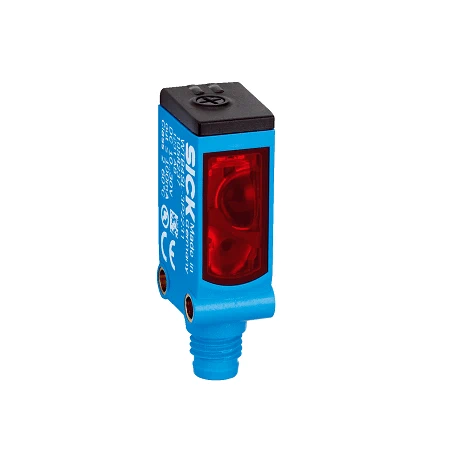
A feeder can mount the sensor beside an adjusted detection path of separated opaque components, using reflected laser light from one side. The typical 1 mm spot at 170 mm helps align detection with the intended feature. Setup verifies actual target finish, orientation and background spacing; the 25–300 mm range is specified for a 90% remission white reference target. External counting logic checks part gaps against the 1,000 Hz switching specification at a 1:1 light/dark ratio.
Problem Solved
A component-passage reference helps external counting logic track separated parts where one-sided mounting is practical, reducing dependence on a second device or reflector across the feeder after actual targets have been checked.
Small components
One-sided laser detection
External counting
2. Confirming a narrow carrier feature at a transfer
A transfer can mount the sensor beside an opaque carrier feature that defines the seated position. The five-turn potentiometer sets the sensing position using representative carriers and nearby background conditions. External transfer logic evaluates the complementary NPN states after testing actual feature finish, position tolerances and the separation between the carrier and background throughout the expected mechanical variation.
Problem Solved
A local carrier-position reference helps external transfer control recognize arrival at the intended location, supporting coordinated upstream release when a narrow mechanical feature defines the required seated condition.
Carrier feature
Background suppression
Transfer position
3. Checking an opaque component at an assembly nest
A machine can present an assembly so the expected opaque component occupies the adjusted laser detection position. Setup checks representative complete and missing-component samples, surface finish and surrounding background, then external inspection logic evaluates the switching state at the correct point in the machine sequence. The five-turn potentiometer provides local adjustment, and the complementary NPN states are verified against the expected presentation sequence.
Problem Solved
A component-present reference helps external inspection logic flag an assembly missing the expected part, reducing the chance that a component omission proceeds unnoticed to the next operation.
Assembly component
Nest presence
External inspection