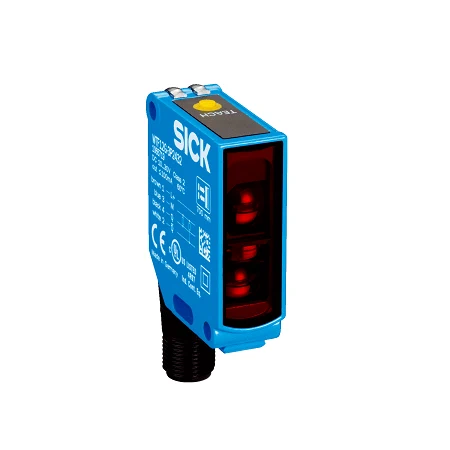
1. Counting separated transparent bottles
A packaging conveyor can present separated transparent bottles in front of a stable machine background. The single teach-in button establishes the installed background condition, while complementary NPN outputs provide passage events to external counting logic. The installer checks the leading bottle edge against the background-dependent sensing curve rather than applying the 400 mm maximum at every background position.
Problem Solved
A background-referenced bottle passage signal helps external counting logic track transparent containers while allowing the actual background distance and bottle presentation to determine the usable detection position.
Transparent bottles
Taught background
External counting
2. Confirming a transparent tray at a transfer stop
A transfer station can position the sensor above a stable background so a seated transparent tray changes the taught optical condition. With a 500 mm sensor-to-background distance, the datasheet example limits the transparent leading edge to 300 mm from the sensor. Setup verifies tray geometry and position before external transfer control uses the complementary outputs to coordinate the following movement.
Problem Solved
A transparent-tray arrival reference supports external transfer sequencing at a defined stop, helping identify whether the expected tray has reached its position before the next movement is requested.
Transparent tray
Transfer stop
Qualified geometry
3. Checking an uneven shiny component in an assembly nest
An assembly nest can present an uneven shiny component in front of a stable taught background and sample the output at a defined inspection stage. The foreground-suppression principle and listed shiny-object application support this arrangement. Installation verifies the actual component and background finish; a shiny background can require greater sensor clearance, including the stated 300 mm minimum for brushed and pickled stainless steel.
Problem Solved
A component-presence reference helps external assembly inspection recognize an empty nest when a shiny or uneven target makes a simple reflected-light level less dependable, after the actual surface arrangement has been checked.
Shiny component
Assembly presence
Foreground suppression