Sale!

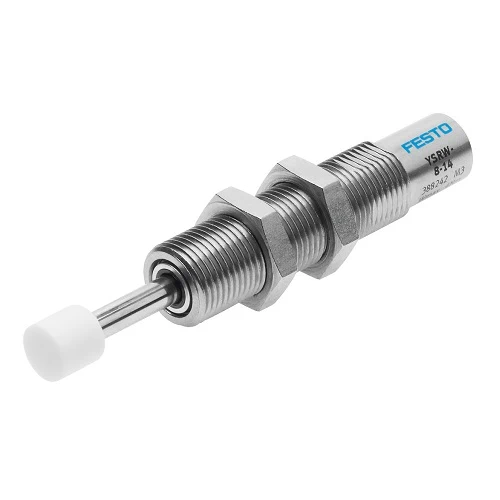
Festo 191192 Self-Adjusting Shock Absorber, 8 mm, 1.3 J per Stroke

Original price was: USD 96.20.Current price is: USD 83.20.

Single-acting pushing absorber with 2 m/s maximum impact speed, 200 N maximum stop force, 10,000 J/hour energy limit, lock-nut mounting and 8 g weight.

SKU Festo-191192 Category
Festo Industrial Shock Absorber

Festo YSRW-5-8 Self-Adjusting Shock Absorber

BrandFesto
Model IdentifierYSRW-5-8
Official Part Number191192

Technical Overview

The Festo YSRW-5-8 is a self-adjusting, single-acting shock absorber with a soft characteristic curve, operating in the pushing direction over an 8 mm stroke. It is rated for a maximum 1.3 J energy absorption per stroke and 10000 J per hour, with a 2 m/s maximum impact speed and 200 N maximum stop force. These are distinct limits rather than a combined unrestricted operating point. Reset time is 0.2 s at room temperature and 1 s at the minimum ambient temperature. The 8 g high-alloy-steel assembly mounts with lock nuts in any position, uses NBR seals and has a −10 to +80 °C ambient range.

Self-adjusting 8 mm single-acting shock absorber with 1.3 J per-stroke capacity, 10000 J/hour limit, 2 m/s maximum impact speed and 8 g product weight.

Key Features

  • Self-adjusting soft-characteristic cushioning with 8 mm stroke and cushioning length
  • Single-acting operation in the pushing direction
  • 1.3 J maximum energy absorption per stroke
  • 10000 J maximum energy absorption per hour
  • 2 m/s maximum impact speed
  • 200 N maximum stop force and 0.01 J maximum residual energy
  • 0.2 s reset at room temperature; 1 s at minimum ambient temperature
  • 0.9 N reset force and 7.5 N minimum insertion force
  • Lock-nut mounting in any position
  • 8 g product weight, high-alloy-steel body/rod and −10 to +80 °C ambient range

Cushion a pushing end-of-travel impact through a self-adjusting 8 mm stroke with a documented 1.3 J per-stroke energy limit.

Technical Specification Matrix

ParameterValue
Size5
Stroke8 mm
CushioningSelf-adjusting; Soft characteristic curve
Mounting positionAny
Position detectionNone
Max. impact speed2 m/s
Reset time at room temperature0.2 s
Reset time at min. ambient temperature1 s
Mode of operationPushing; Single-acting
Corrosion resistance class CRC2 - Moderate corrosion stress
LABS (PWIS) conformityVDMA24364-B2-L
Ambient temperature-10 °C...80 °C
Cushioning length8 mm
Max. stop force200 N
Max. energy consumption per stroke1.3 J
Max. energy consumption per hour10000 J
Max. residual energy0.01 J
Reset force0.9 N
Min. insertion force7.5 N
Physical Weight (kg)0.008
Load range2 kg
Type of mountingVia lock nut
Note on materialsRoHS compliant
Material sealsNBR
Material housingHigh-alloy steel
Material piston rodHigh-alloy steel

Industrial Applications

1. End-of-Travel Impact Cushioning on a Transfer Mechanism

A transfer mechanism brings a moving attachment against an end-of-travel cushioning element. The YSRW operates in the pushing direction with self-adjusting cushioning over 8 mm, a 1.3 J maximum per-stroke energy rating and a 2 m/s maximum impact speed. Those separate specifications characterize the selected shock absorber for evaluating the mechanism's actual moving energy and contact arrangement.

Problem Solved

The self-adjusting cushioning stroke provides a defined component for absorbing end-of-travel impact energy, with explicit stroke, energy and speed limits for the moving mechanism.

8 mm cushioning 1.3 J per stroke 2 m/s maximum

2. Repeated Indexing with an Hourly Energy Budget

A machine repeatedly indexes a mechanism into a cushioned endpoint and needs to evaluate accumulated impact energy as well as each individual hit. This model specifies 10000 J maximum energy per hour separately from the 1.3 J per-stroke maximum. Its 0.2 s room-temperature reset time adds a documented return characteristic, while actual cycle frequency must also respect the complete load and temperature conditions.

Problem Solved

Separate stroke and hourly energy ratings provide a basis for assessing repeated impacts, preventing a single-hit capacity from being treated as an unlimited repeated-cycle rating.

10000 J per hour 1.3 J per stroke 0.2 s room-temperature reset

3. Cold-Environment Stop Reset Planning

A pneumatic mechanism starts in a low-temperature machine area and needs the shock absorber to reset before the next pushing contact. The YSRW is specified down to −10 °C, but its reset time increases from 0.2 s at room temperature to 1 s at the minimum ambient temperature. Lock-nut mounting and any-position installation provide the documented mechanical arrangement for that cushioning point.

Problem Solved

The temperature-specific reset rating gives the machine sequence a defined cold-condition constraint, helping prevent the next impact from being commanded before the absorber has returned.

−10 °C minimum ambient 1 s cold reset Lock-nut mounting

Select your currency