
$ 1,112.74
Discover the IDS UE-39B4XLS-E event-based camera delivering microsecond motion detection, low data load, and high performance for robotics and advanced vision systems.
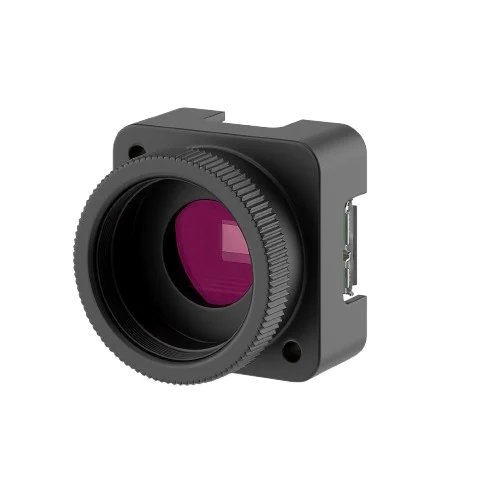
The IDS UE-39B4XLS-E event-based camera is designed for demanding motion analysis where conventional frame sensors struggle with blur or excess data. Using a Sony IMX636 sensor with a logarithmic response, the camera records only pixel-level changes, enabling extremely fast detection while keeping data volumes low. Its compact CS/C-mount form factor, low power draw, and stable operation across a wide temperature range make it suitable for embedded platforms, robotics, and scientific systems. With a 0.92 MP event sensor and a 1/2.5-inch optical format, the UE-39B4XLS-E provides responsive and efficient performance in environments where speed and precision are essential.
The IDS UE-39B4XLS-E shifts imaging from frame-based capture to continuous, event-triggered updates, giving users real-time visibility into motion, vibration, and rapid scene changes. This approach avoids motion smear and minimizes processing requirements, making it beneficial for applications that rely on immediate feedback or operate under tight computing constraints. The camera’s sensitive 4.86 µm pixel size and event-driven behavior allow it to perform effectively under varied lighting conditions. Its lightweight design and wide operating temperature capability support integration into drones, autonomous equipment, laboratory experiments, and compact industrial systems, delivering faster analysis and more actionable results than traditional cameras.
Why UE-39B4XLS-E?
The UE-39B4XLS-E excels in environments where ordinary cameras cannot keep up with rapid motion or produce too much redundant data. Its event-based architecture captures only meaningful pixel changes at microsecond speed, giving engineers a tool that is faster, lighter, and more insightful than conventional frame sensors. It delivers precision and responsiveness ideal for next-generation automation, robotics, and research.
What problem does it solve?
The UE-39B4XLS-E eliminates the limitations of frame-based imaging by removing motion blur, reducing data load, and enabling real-time analysis of fast, unpredictable events. It solves the challenge of monitoring high-speed processes without overwhelming storage or processing resources. This makes it a powerful solution for detecting subtle movements, tracking dynamic patterns, and improving overall system efficiency in demanding technical environments.
| Feature | Details | Benefit |
|---|---|---|
| Sensor Brand & Model | Sony IMX636, CMOS, event-based, logarithmic response | Captures only meaningful scene changes for ultra-fast motion analysis |
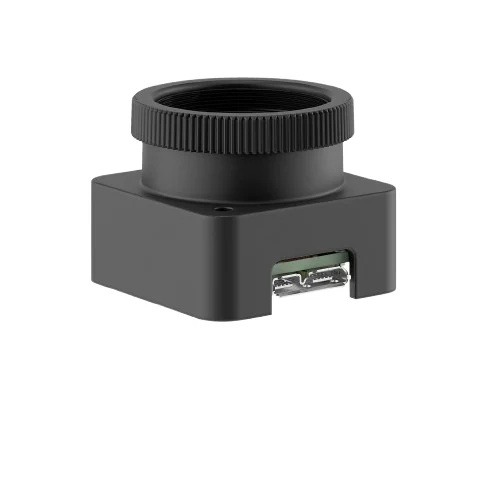
| Interface | USB 3.0 Micro-B | Simple integration with embedded and industrial platforms |
| Interface Speed | USB 3.0 high-bandwidth data transfer | Reliable, low-latency event streaming |
| Resolution (H × V) | 1280 × 720 pixels (0.92 MP) | Balanced resolution for high-speed event capture |
| Optical Area (H × V) | 6.221 mm × 3.499 mm | Optimized for compact optical designs |
| Optical Format | 1/2.5 inch (Diagonal 7.14 mm) | Broad lens compatibility while maintaining small form factor |
| Lens Mount | C-Mount / CS-Mount | Flexible lens selection for different FOV and system layouts |
| Pixel Size | 4.86 µm | High sensitivity and strong performance in varied lighting |
| Image Memory | Event-driven, no traditional frame buffer | Reduces data load and improves processing efficiency |
| Frame Rate @ Max Resolution | Event-based (asynchronous pixel output) | Eliminates frame limitations for true microsecond responsiveness |
| Shutter | Event-based shutter | Removes motion blur entirely |
| Exposure Time | Not frame-based; responds to per-pixel brightness change | Ideal for fast, dynamic processes |
| Trigger & Flash I/O | 1.8 V trigger input, SYNC signal, TDRSTN; 8-pin I/O connector | Enables synchronization with sensors, strobes, and automation systems |
| Power Supply | 5 V via USB (max 400 mA), 0.6–3.4 W consumption | Energy-efficient and easy to power on embedded devices |
| Software Tools | Compatible with IDS peak SDK and event-based processing tools | Fast system integration with advanced event-stream analytics |
| Environmental Tolerance | Operating: device 0°–70°C; ambient 0°–35°C; storage −20°–80°C; humidity 20–80% non-condensing | Suitable for compact enclosures and demanding embedded environments |
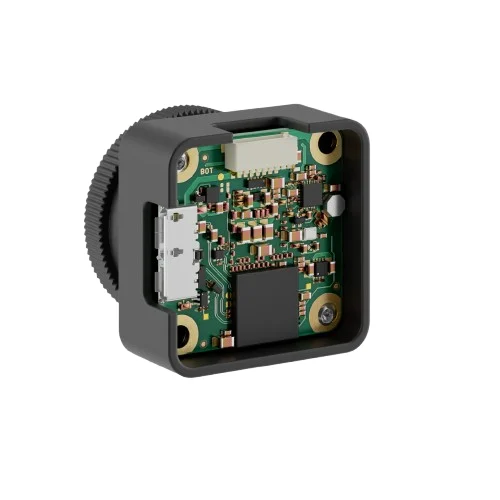
| Housing Protection | Compact camera board housing | Ideal for tightly constrained system designs |
| Size & Weight | 32.5 × 32.5 × 14 mm; 17 g | Extremely lightweight for drones, robots, and embedded systems |
Download UE-39B4XLS-E Datasheet
Download UE-39B4XLS-E Technical Drawing
1. High-Speed Industrial Sorting and Quality Verification
Production environments with rapid conveyor movement often face limitations when using frame-based cameras, as blur and excessive data make fine defect detection difficult. The UE-39B4XLS-E overcomes this by streaming only the brightness changes that truly matter, enabling microsecond-level capture of product movement. Even small anomalies such as dents, missing features, or distortions become visible in real time. With far less data to process, inspection systems can react faster and maintain higher throughput. This makes the camera highly effective for packaging lines, component grading, and continuous quality monitoring where responsiveness and accuracy directly influence yield.
2. Autonomous Drone Navigation in Dynamic Environments
Drones navigating confined industrial spaces or irregular outdoor landscapes require immediate visual feedback to avoid collisions and maintain stability. The UE-39B4XLS-E provides continuous event data that reacts to motion instantly, allowing drones to perceive obstacles or sudden environmental changes before typical frame cameras can refresh. Its lightweight build reduces strain on airborne systems, supporting longer flight times and better balance. This enables more reliable navigation for warehouse scanning, infrastructure inspection, and environmental surveys. With microsecond-level responsiveness, drones gain smoother maneuvering and improved safety even when lighting shifts or wind turbulence challenges traditional visual sensors.
3. Robotic Arm Feedback for Microsecond-Level Motion Control
Robots performing precision placement or ultra-fast movement often rely on vision systems that cannot keep up with sudden changes in object position. The UE-39B4XLS-E solves this by reporting scene changes immediately, offering robotic controllers a constant stream of actionable input. This real-time awareness improves alignment, reduces mis-placement errors, and stabilizes motion during repetitive cycles. Subtle vibrations or tool shifts that normally go unnoticed become detectable, allowing predictive adjustments to avoid collisions or part damage. The result is enhanced productivity in electronics assembly, micro-component handling, and laboratory automation requiring exact positional accuracy.
4. Research on Fluid Dynamics and High-Speed Particle Tracking
Scientific studies often involve fast-moving droplets, particles in turbulent flow, or rapid transitions that outpace standard imaging methods. The UE-39B4XLS-E’s event-driven architecture allows researchers to isolate movement without storing unnecessary background frames, giving a clear view of motion paths with exceptional temporal precision. It supports detailed study of phenomena such as micro-splashes, turbulence development, and particle collisions. Since the data stream contains only motion-relevant information, processing becomes faster and more efficient, enabling large experiments without burdensome storage demands. This makes it a powerful tool for fluid research, aerosol studies, academic labs, and aerodynamic investigations.
5. Vibration Monitoring and Structural Health Diagnostics
Mechanical systems often show early signs of wear through tiny vibrations that conventional cameras fail to capture clearly. The UE-39B4XLS-E detects these minute oscillations by monitoring only pixel changes, allowing engineers to visualize frequency patterns and instability with remarkable detail. This facilitates early detection of imbalance, component fatigue, or resonance issues before they escalate into failures. Because the camera produces minimal data, real-time analysis can run on compact processors, supporting portable diagnostic tools or embedded maintenance modules. It’s valuable for monitoring motors, rotating assemblies, precision tools, and structural components across industrial and research environments.
IDS Accessories (Recommended)
IDS Imaging Cameras
As an authorized distributor of IDS Imaging products, we offer certified expertise and technical support to ensure you get the most out of your IDS Imaging UE-39B4XLS-E – 0.92 MP camera. We stand by the quality of our products and provide comprehensive warranty services. Our team can also assist with special services like custom integration and creating pre-configured kits tailored to your specific needs.
We also offer:
Custom integration services for embedded systems
Pre-configured vision kits tailored to your project requirements