Description
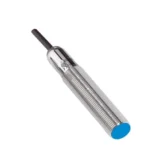
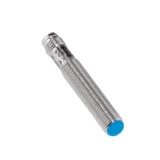
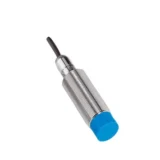
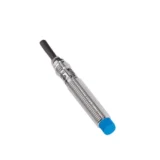
SICK IME08-04NNSZW2K NPN Inductive Proximity Sensor
Technical Overview
The SICK IME08-04NNSZW2K is an M8 inductive proximity sensor with an NPN normally open output and DC three-wire wiring. It detects metal targets without an optical path, with a nominal sensing range of 4 mm and an assured range of 3.24 mm. Target material must be considered using the documented reduction factors. The non-flush installation arrangement and M8 × 1 threaded nickel-plated brass housing support machine integration. The sensor provides 4,000 Hz switching and operates from 10–30 V DC, with a 2 m three-wire PVC cable, a PA66 sensing face and IP67 protection.
Non-flush M8 inductive sensor with 4 mm nominal range, NPN normally open output, 4,000 Hz switching and 2 m three-wire PVC cable.
Key Features
- Inductive proximity sensing of metal targets
- 4 mm nominal range; 3.24 mm assured range
- Non-flush installation; short M8 × 1 threaded housing
- NPN normally open output; DC three-wire wiring
- 4,000 Hz switching frequency
- 10–30 V DC operation; ≤10 mA no-load current
- Continuous output current ≤200 mA
- Nickel-plated brass housing; PA66 sensing face
- IP67; −25 to +75 °C operating range
- 2 m three-wire PVC cable; two mounting nuts supplied
Technical Specification Matrix
| Parameter | Value |
|---|---|
| Functional principle | Inductive proximity sensing of metal targets |
| Housing form | Metric cylindrical, short-body |
| Thread size | M8 × 1 |
| Housing diameter | 8 mm |
| Nominal sensing range Sn | 4 mm |
| Assured sensing range Sa | 3.24 mm |
| Installation type | Non-flush |
| Switching frequency | 4,000 Hz |
| Switching output | NPN |
| Output function | Normally open (NO) |
| Electrical wiring | DC 3-wire |
| Connection | Cable, 3-wire, 2 m |
| Power supply | 10–30 V DC |
| Residual ripple | ≤10% |
| Voltage drop | ≤2 V at maximum output current |
| Time delay before availability | ≤100 ms |
| Hysteresis | 5–15% |
| Reproducibility | ≤2% of Sr at constant supply and ambient temperature |
| Temperature drift | ±10% of Sr |
| Continuous output current | ≤200 mA |
| No-load current | ≤10 mA |
| Housing material | Brass, nickel-plated |
| Sensing face material | PA66 plastic |
| Housing length | 43 mm |
| Thread length | 21 mm |
| Maximum tightening torque | ≤5 Nm |
| Items supplied | 2 nickel-plated steel mounting nuts |
| IP rating | IP67 according to EN 60529 |
| Operating temperature | −25 to +75 °C |
| EMC | EN 60947-5-2 |
| Shock and vibration resistance | 30 g, 11 ms / 10–55 Hz, 1 mm |
| Reference material reduction factors | St37 steel: 1; stainless steel V2A/304: approximately 0.8; aluminum: approximately 0.45; copper/brass: approximately 0.4; reference values may vary |
| MTTFD | 1,735 years |
| Diagnostic coverage DCavg | 0% |
| UL file | NRKH.E181493 |
| Cable jacket material | PVC |
| Conductor cross-section | 0.25 mm² |
| Cable diameter | Ø3.9 mm |
Industrial Applications
1. Confirming a metal part in a fixture
A machining fixture can place the sensor beside the expected location of a metal part so the target enters its assured sensing zone when seated. Non-flush installation requires the sensing end to project beyond the surrounding mounting surface, and the NPN normally open output provides the presence signal. Target material must be considered using the documented reduction factors.
A contactless metal-presence signal helps the sequence controller identify an occupied fixture position before the next operation, avoiding a mechanical feeler pressing against the seated part.
2. Counting metal tabs on a rotating mechanism
A rotating mechanism can present separated metal tabs to the M8 sensing face and count each normally open output transition. The 4,000 Hz switching frequency supports repeated passages within the documented limits. Tab geometry, spacing, operating gap and material reduction factors must be qualified so consecutive targets produce distinct switching events.
Discrete tab passages provide the controller with a pulse count related to mechanism rotation, supporting cycle counting without an optical beam or contacting follower on the moving tabs.
3. Confirming a shuttle at a transfer position
A shuttle can carry a metal flag that enters the sensor’s local detection zone at a transfer position. The M8 thread and two supplied mounting nuts support fixed installation, while the normally open NPN signal reports the flag state. IP67 protection and the nickel-plated brass body support exposed machine placement.
A local position-confirmation signal helps the controller coordinate transfer sequencing when the metal flag reaches the monitored point, without a mechanical switch actuator following each shuttle movement.