Description
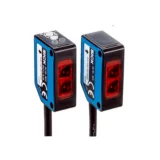
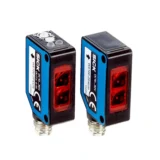
SICK WS/WE100-2N3439 Through-beam Photoelectric Sensor Pair
Technical Overview
The SICK WS/WE100-2N3439 is a through-beam photoelectric sensor pair with separate sender and receiver units. Its 632 nm red LED provides 0–20 m sensing and 0–33 m maximum range, with an 850 mm light spot at 12 m. A 270° sensitivity potentiometer adjusts the receiver condition, and a rotary switch selects light or dark operation for the NPN output. Response is no more than 0.5 ms with resistive load, with 1,000 Hz switching at a 1:1 light/dark ratio. Each rectangular unit uses an ABS/PC/POM housing, PMMA optics, M3 threaded mounting holes and an M8 three-pin male connector. IP67 protection and −25 to +55 °C operation support machine integration.
Through-beam red LED sensor pair with 0–20 m sensing, NPN selectable light/dark switching and M8 three-pin male connector.
Key Features
- Separate through-beam sender and receiver units
- 0–20 m sensing and 0–33 m maximum range
- 632 nm visible red LED; Ø850 mm spot at 12 m
- 270° sensitivity potentiometer; separate light/dark rotary switch
- NPN switching output; maximum current ≤100 mA
- ≤0.5 ms response with resistive load; 1,000 Hz at 1:1 light/dark ratio
- 10–30 V DC; sender ≤15 mA / receiver ≤20 mA without load
- M8 three-pin male connector on each unit
- ABS/PC/POM housing; PMMA optics; M3 threaded mounting holes
- IP67; −25 to +55 °C operation; −40 to +70 °C storage
Technical Specification Matrix
| Parameter | Value |
|---|---|
| Functional principle | Through-beam photoelectric sensor; separate sender and receiver |
| Housing design | Rectangular |
| Sensing range | 0–20 m |
| Maximum sensing range | 0–33 m |
| Light source | Visible red LED |
| Wavelength | 632 nm |
| Light spot size | Ø850 mm at 12 m |
| LED service life | Average 100,000 h at ambient +25 °C |
| Adjustment | 270° sensitivity potentiometer |
| Digital output | NPN switching output; maximum current ≤100 mA |
| Switching mode | Light/dark switching, selectable via rotary switch (L=light; D=dark) |
| Signal voltage HIGH/LOW | Approximately supply voltage / <1.8 V |
| Response time | ≤0.5 ms signal transit time with resistive load |
| Switching frequency | 1,000 Hz at 1:1 light/dark ratio |
| Power supply | 10–30 V DC, limit values |
| Residual ripple | ±10%; remain within supply tolerances |
| Protection class | III |
| Circuit protection | A: supply reverse-polarity protection; B: output reverse-polarity protection; D: outputs overcurrent and short-circuit protection |
| Housing material | ABS/PC/POM plastic |
| Optics material | PMMA plastic |
| Connection | M8 three-pin male connector on each unit |
| Mounting | M3 threaded mounting holes |
| IP rating | IP67 |
| Operating temperature | −25 to +55 °C |
| Storage temperature | −40 to +70 °C |
| Orange LED indicator | Switching output active |
| Green LED indicator | Power on |
| Sender current consumption | ≤15 mA without load |
| Receiver current consumption | ≤20 mA without load |
| Pin assignment | Sender: 1 BN=L+, 3 BU=M, 4 BK=not connected; receiver: 1 BN=L+, 3 BU=M, 4 BK=Q (CD-051) |
| Items supplied | Two stainless steel 1.4301/304 BEF-W100-A mounting brackets |
Industrial Applications
1. Counting separated cartons across a conveyor
A conveyor can position the sender and receiver across the route of separated opaque cartons. Each carton interrupts the red beam, producing an NPN state for external counting logic. The 0–20 m sensing range supports the installed separation, and the sensitivity potentiometer establishes the received-light condition. Setup checks carton gaps and transit speed against the response and switching-frequency limits.
Beam interruption supplies a distinct carton-passage event for external counting logic, helping the conveyor track separated loads without relying on light reflected from their printed surfaces.
2. Monitoring an opaque strip for a break
A strip feeder can place the sender and receiver on opposite sides of an opaque material path. Loss of material exposes the receiver to the red beam, changing the switching state. The potentiometer sets sensitivity for the installed separation, while the light/dark rotary switch selects the required output behavior for the external feed controller.
A material-continuity signal helps the feed controller recognize a break or exhausted strip and coordinate its response before another operation proceeds with an empty material path.
3. Managing accumulation at a conveyor transfer
At a conveyor transfer, an opaque load can block the path between the separate sender and receiver while the receiving location remains occupied. External control logic evaluates the duration of the switching state to distinguish passing loads from sustained blockage. IP67 housings and M3 threaded mounting holes support positioning the optical pair around the transfer area.
A sustained-occupancy reference helps external transfer logic coordinate upstream release when the receiving position is blocked, using the duration of an interrupted optical path.