Description
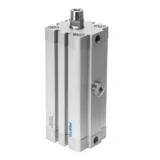
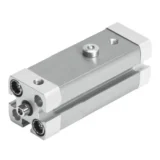
Festo CLR-63-50-L-P-A Linear/Swivel Clamp
Technical Overview
The Festo CLR-63-50-L-P-A combines a left-hand swivel movement with a linear clamping stroke for pneumatic fixtures. This double-acting 63 mm piston variant has 73 mm total stroke, including a 50 mm clamping stroke, and a swivel angle of 90° ±2°. Its effective clamping force is 1386 N at 6 bar, distinct from the 1682 N theoretical value. G1/8 ports connect the pneumatic supply, while an M10 piston-rod thread provides the attachment interface. Elastic cushioning acts at both ends and proximity switches support position detection. The 2635 g assembly operates from 2 to 10 bar and −10 to +80 °C in any mounting position.
Left-hand 90° linear/swivel clamp with 50 mm clamping stroke, 73 mm total stroke and 1386 N effective clamping force at 6 bar.
Key Features
- Left-hand swivel direction with 90° ±2° rotation
- 50 mm clamping stroke within 73 mm total stroke
- 63 mm piston diameter and double-acting operation
- 1386 N effective clamping force at 6 bar
- 823 N effective force at 4 bar and 441 N at 2 bar
- M10 piston-rod thread and G1/8 pneumatic ports
- Elastic cushioning rings or plates at both ends
- Position detection via proximity switch
- 2635 g product weight with smooth-anodised aluminium housing
- 2–10 bar operating pressure and −10 to +80 °C ambient range
Technical Specification Matrix
| Parameter | Value |
|---|---|
| Total stroke | 73 mm |
| Piston diameter | 63 mm |
| Piston rod thread | M10 |
| Swivel angle | 90 deg +/-2 deg |
| Clamping stroke | 50 mm |
| Cushioning | Elastic cushioning rings/plates at both ends |
| Mounting position | Any |
| Design | Piston; Piston rod; Cylinder barrel |
| Position detection | Via proximity switch |
| Swivel direction | left |
| Operating pressure | 2 bar...10 bar |
| Mode of operation | Double-acting |
| Operating medium | Compressed air to ISO 8573-1:2010 [7:4:4] |
| Note on operating and pilot medium | Lubricated operation possible (in which case lubricated operation will; always be required) |
| Corrosion resistance class CRC | 2 - Moderate corrosion stress |
| LABS (PWIS) conformity | VDMA24364-B2-L |
| Ambient temperature | -10 °C...80 °C |
| Effective clamping force at 0.2 MPa (2 bar, 29 psi) | 441 N |
| Effective clamping force at 0.4 MPa (4 bar, 58 psi) | 823 N |
| Effective clamping force at 0.6 MPa (6 bar, 87 psi) | 1386 N |
| Max. tightening torque Clamping finger screw | 47 Nm |
| Theoretical clamping force at 0.6 MPa (6 bar, 87 psi) | 1682 N |
| Physical Weight (kg) | 2.635 |
| Type of mounting | Either:; With through-hole; With female thread; With accessories |
| Pneumatic connection | G1/8 |
| Material collar screws | Steel; Galvanised |
| Material cover | Wrought aluminium alloy; coated |
| Material seals | NBR; TPE-U(PU) |
| Material housing | Wrought aluminium alloy; Smooth-anodised |
| Material piston rod | High-alloy stainless steel |
| Material cylinder barrel | Wrought aluminium alloy; Smooth-anodised |
Industrial Applications
1. Fixtures Requiring Clear Loading Access
A fixture needs its clamping attachment to move away from the workpiece loading area before applying downward clamping travel. The CLR combines a 90° left-hand swivel with a 50 mm clamping stroke, rather than providing linear motion alone. Its M10 piston-rod thread gives the attachment interface, while the 73 mm total stroke describes the complete actuator movement of this exact version.
Combined swivel and linear motion lets a suitable fixture attachment move between an access position and a clamping position using one pneumatic actuator with documented movement geometry.
2. Pressure-Defined Workpiece Clamping
An assembly fixture must apply a clamping action whose force can be evaluated at the available pneumatic pressure. Festo specifies effective forces of 441 N at 2 bar, 823 N at 4 bar and 1386 N at 6 bar for this clamp. These effective values characterize the clamping action directly, rather than requiring the fixture designer to treat the separately listed theoretical force as delivered force.
Published effective clamping forces at three pressures provide concrete force data for the fixture task, supporting a pressure-based assessment of the selected pneumatic clamping mechanism.
3. Position-Confirmed Automated Clamping Sequence
An automated station needs to observe clamp position before advancing the surrounding assembly sequence. This variant supports detection through proximity switches and uses double-acting pneumatic motion for movement in both directions. Elastic cushioning rings or plates act at the stroke ends, and through-hole, female-thread or accessory mounting options support integration into the fixture structure without changing the documented sensing method.
Proximity-switch compatibility supplies a means of monitoring actuator position in the sequence, while double-acting operation moves the clamp through its working and return movements.